
As global leaders gather in Baku, Azerbaijan to discuss finance at the 29th climate conference, the most vulnerable countries like Bangladesh are demanding new and additional climate finance that does not exacerbate climate debt.
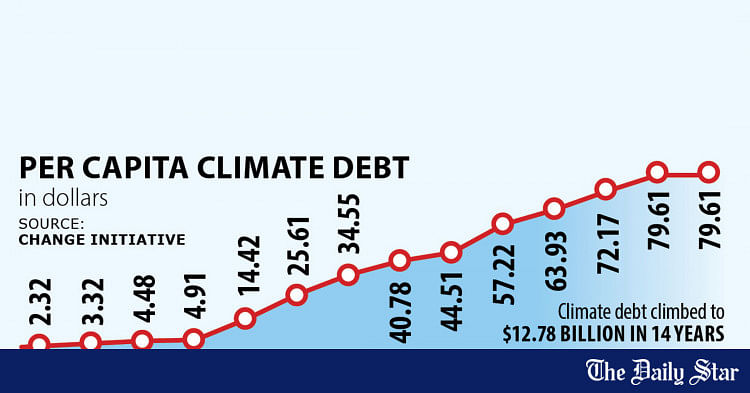
The per capita climate debt for every Bangladeshi citizen has reached $80, which is about Tk 9,500.
 For all latest news, follow The Daily Star’s Google News channel.
 And this debt was generated within just 14 years from 2009 to 2022 when Bangladesh started taking climate-related projects. During the period, Bangladesh has taken $12.78 billion in climate debt against multiple climate projects, according to Change Initiative.
During the period, Bangladesh has received grants worth only $268 million from the Green Climate Fund, Adaptation Fund and the LDC Fund.
Bangladesh’s significantly higher per capita climate debt burden leaves the country at high risk of falling into a debt burden, according to the report titled ‘Climate Debt Trap Risks for Bangladesh and Other LDC’ states’.
At COP29, the least-developed countries must prioritise securing 100 percent grant-based adaptation finance by 2025 and operationalising debt relief mechanisms, the report said.
As wealthy nations that polluted the most and caused global warming did not keep their promises and disbursed grants, not just Bangladesh but all LDCs have fallen into a debt trap.
In 2009, Bangladesh formed the Bangladesh Climate Change Trust Fund (BCCTF), a pioneering initiative by the government to address climate change adaptation and mitigation without relying solely on international aid.
With an initial allocation of an annual Tk 700 core from the national budget, BCCTF supported over 700 projects, spanning from constructing climate-resilient homes to developing early warning systems, with a focus on empowering local communities to adapt effectively.
However, despite the proactive measures, Bangladesh faces the “climate debt trap” as wealthier nations fail to fulfil their financial commitments under international climate agreements.
Though Bangladesh has contributed only 0.56 percent of global greenhouse gas emissions, Bangladesh ranked seventh in the long-term climate risk index.
Bangladesh, as one of the most climate-vulnerable countries globally, faces climate impacts such as floods, cyclones, sea-level rise and salinity intrusion that frequently affect its agriculture, water resources and coastal areas.
In 2022, Bangladesh finalised the National Action Plan (NAP) on climate change (2023-2050) to reverse the effects of climate change.
The NAP identified 113 major interventions in 11 climate-stressed regions across the country, for which $230 billion would be needed.
Currently, the government of Bangladesh spends approximately 6–7 percent of its annual budget on climate adaptation, about 75 percent of which comes from domestic sources.
However, scaling up adaptation measures as outlined in the NAP will require seven times the current spending, according to experts.
During the COP (conference of parties) 15 held in Copenhagen, wealthy nations committed to mobilise $100 billion a year by 2020.
The promise remains unfulfilled putting LDCs like Bangladesh at risk of falling further into debt to fund necessary climate resilience efforts.
Additionally, the pledges are not clear on how the money will be distributed, raising fears among LDCs that money will not reach the countries that need it most.
Along with other LDCs Bangladesh will push for new and additional climate finance available that does not exacerbate climate debt, Syeda Rizwana Hasan, adviser to the ministry of environment, forest and climate change, told The Daily Star.
“Bangladesh advocates for public funds from developed countries as the primary source of the financing,” she said, adding that the country will urge swift implementation of the 2019 commitment to double adaptation funding by 2025.
Bangladesh will also demand the wealthy nations to fulfil their funding commitments to developing countries, she said.
The country will be vocal in making the loss and damage fund operational with simplified access and regular replenishment cycles.
Although a decision was reached at COP-28 in Dubai to operationalise the fund with an initial pledge of $792 million, the fund is yet to become fully functional.
Apart from this, Bangladesh will emphasise the urgent need for all countries to uphold the commitment to limit global temperature rise to 1.5 degrees Celsius above pre-industrial levels by 2100.
This target is crucial to minimising severe climate impacts and is a priority Bangladesh intends to advocate at COP-29, Rizwana added.
Rizwana will reach Baku on November 17.
This year’s COP has been labelled as a “Finance COP”.
The global climate conference starts today, with world leaders convening at Baku on November 12 and 13. Chief Adviser Muhammad Yunus will lead the Bangladesh delegation to COP and he is scheduled to deliver his speech on November 13.
The world leaders are expected to establish a new financial goal post-2025, building on the $100 billion pledge by developed nations.
According to the UNFCCC, developing countries will require $5.8 to $5.9 trillion for mitigation by 2030, and between $215 to $387 billion for adaptation.
Bangladesh will push for the fund’s immediate activation at COP-29 to facilitate project funding and enable prompt implementation of adaptation and resilience-building initiatives.
The ministry of environment, forest and climate change will send a 28-member delegation comprising ministry officials, departmental representatives and climate experts.
In addition to negotiation efforts, Bangladesh has planned a 100-square-metre pavilion at COP-29. This space will host 13 side events and serve as a venue for bilateral discussions.
The pavilion is expected to function as a knowledge-sharing platform for both domestic and international stakeholders — including government officials, non-governmental organisations and youth groups — to foster engagement and dialogue on climate issues.