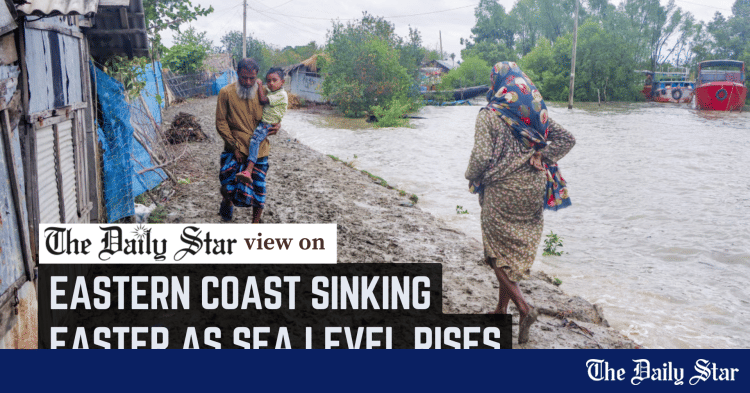
Without proper steps, farmland, infrastructure, and livelihoods will be at grave risk

VISUAL: STAR
“>
VISUAL: STAR
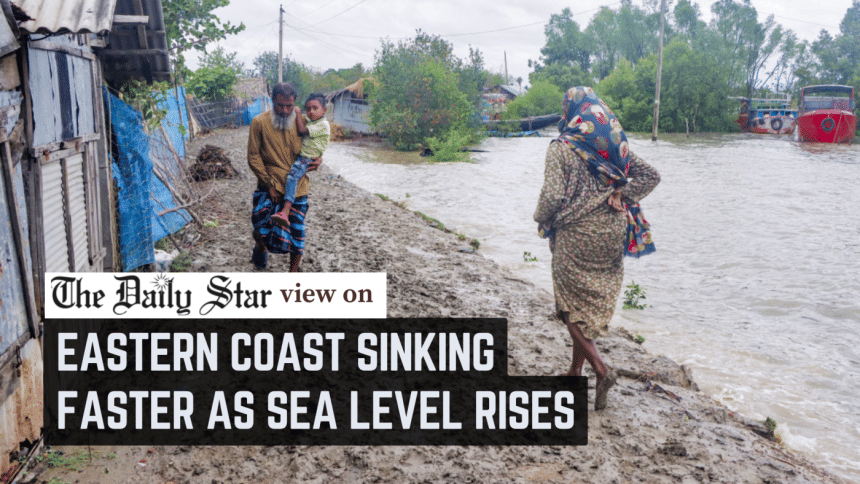
A recent scientific study has brought to light a worrying reality for Bangladesh’s eastern coast, revealing that it is sinking faster than the central and western coasts amid rising sea levels, posing serious threats to vast swathes of farmland, the livelihoods of millions, and critical infrastructure. According to the report, the sea level on the eastern Chattogram coastal plain is increasing at a rate of 4.73 millimetres per year, the fastest in the country. In contrast, the sea level on the western Sundarbans tidal plain is rising by 3.66 millimetres annually, while the Meghna estuarine floodplain in the central region is experiencing a rise of 2.4 millimetres per year. Reportedly, more than 43 million people live in the country’s coastal areas, which lie only about 1 to 1.5 metres above the sea level; so even a small increase in sea level could pose serious risks to the region. Given this reality, the reported increase along the eastern coast justifiably raises concern.
The study—published in the scientific journal Geomatics, Natural Hazards and Risk—also reveals how the combined effect of rising seas and land subsidence has accelerated the sinking of the eastern coastline. The eastern plains of Chattogram and Cox’s Bazar are witnessing rapid urbanisation and large-scale infrastructural projects, such as the Matarbari Power Plant. Construction and deep piling for these projects are contributing to subsidence in the region. In contrast, the western coast, protected by the Sundarbans’ natural mangrove buffer and subject to less urban development, faces a comparatively slower rate of sea level rise. This difference highlights how poorly planned human activities are intensifying risks along the eastern coast. Moreover, increasing tidal ranges are raising the risks of flooding and erosion in the area.
 For all latest news, follow The Daily Star’s Google News channel.
 Another government study recently found that Bangladesh is experiencing a faster rate of sea-level rise than the global average, which will have a greater impact on food production and livelihoods than previously anticipated. As a country already struggling to support and rehabilitate displaced climate refugees, the threat of further loss of livelihoods calls for stronger climate adaptation and resilience measures.
Experts warn that blanket climate policies will fail to address the nuanced challenges that vary between coastal regions. They suggest that disaster preparedness and adaptation strategies should be tailored to each coastal zone’s unique environment. Moreover, infrastructure projects need to incorporate climate data from the planning stages to ensure long-term resilience. Additionally, continuous satellite and ground-based monitoring is essential to provide real-time insights for informed decision-making and adaptive management. Equally importantly, harmful human activities that accelerate land subsidence must be prevented to stop further damage to the eastern coast.