
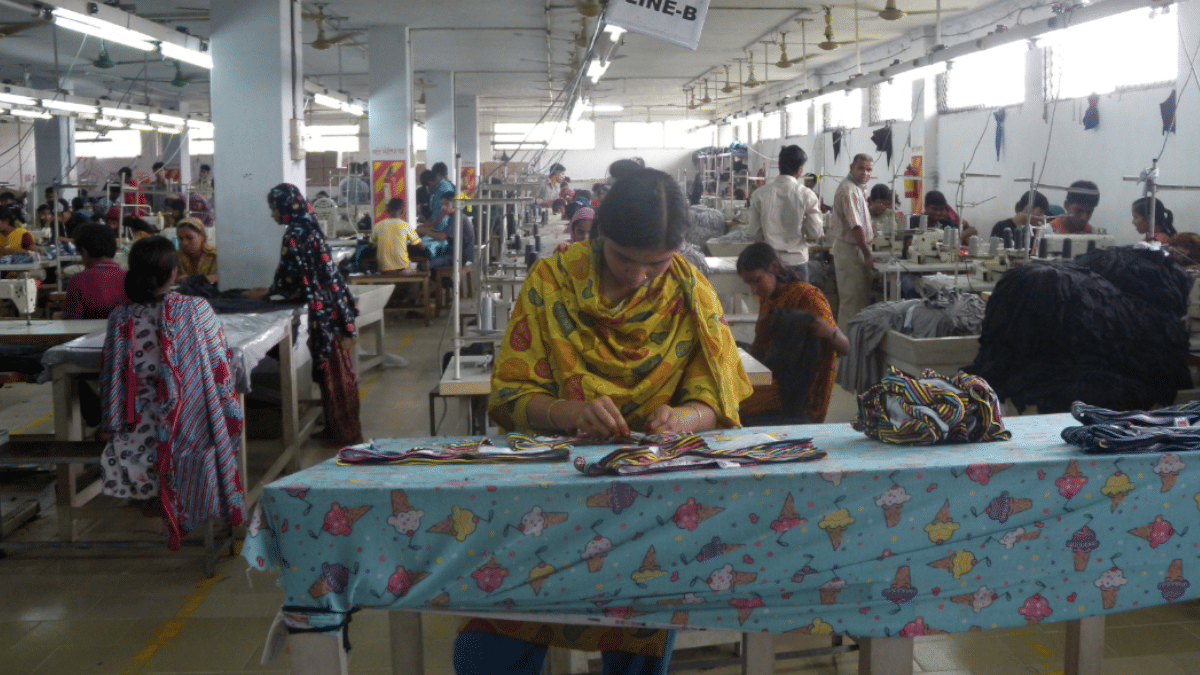
In times of regional economic instability, wise nations pay attention to the challenges faced by their neighbours. Bangladesh, once heralded as a quiet success story of South Asia, now confronts its most precarious economic situation in decades.
The nation that once turned its garments into gold and microfinance into a global model is currently facing a financial crisis. Non-performing loans have escalated to nearly Tk 4.2 lakh crore, about 36 per cent of sector credit, as of early 2025. Non-bank financial institutions (NBFIs) are under acute stress, with defaulted loans now accounting for roughly one-third of total lending. What was once a story of export-driven confidence has now turned into one of credit-deprived factories and fading trust.
In June 2025, the International Monetary Fund (IMF) approved approximately $ 1.3 billion in additional assistance for Bangladesh under its Extended Credit Facility, Extended Fund Facility, and Resilience and Sustainability programmes. The decision followed months of external financial strain, during which foreign-exchange reserves, having fallen below $ 20 billion in 2023, had only recently recovered to approximately $ 27 billion by mid-2024.
The IMF’s support has afforded Dhaka temporary relief: the taka has stabilised, and exports have shown a modest recovery. However, the deeper crisis persists. While IMF funds can stabilise balance sheets, they cannot restore credibility. When financial management becomes a political instrument and regulatory frameworks are compromised for convenience, liquidity serves merely as a temporary sedative.
For India, this is not an opportunity for schadenfreude but rather a reflection of shared responsibility. Bangladesh’s economic distress serves as a warning of the consequences that ensue when the governance framework underpinning economic growth is weakened.
A crisis that was foretold
Bangladesh’s current situation is characterised by a gradual deterioration. The restructuring of defaulted loans, rather than their recovery, the proposal to eliminate the term “wilful defaulter” from banking legislation, and the endurance of politically connected borrowers over their regulators have collectively transformed moral hazard into a component of monetary policy. This issue is not confined to domestic boundaries. Bangladesh’s export sectors, comprising garments, leather, and jewellery, are now more constrained by a lack of trust than by demand. When banks lose their credibility, exporters are deprived of credit, resulting in trade becoming a casualty.
For India, the lesson is clear and cautionary: the health of finance determines the horizon of growth. An economy experiencing rapid growth without disciplined financial management is just like a speeding car with worn-out brakes, impressive until it encounters a curve.
India’s progress and its precarious edge
India’s financial system has already encountered a significant challenge in the past. The twin balance-sheet crisis of the 2010s compelled the nation to address its financial excesses. The implementation of the Insolvency and Bankruptcy Code reinstated accountability; provisioning norms were strengthened; and public-sector banks were recapitalised and restructured. Those were challenging yet necessary reforms that ultimately paid off.
However, success must not lead to complacency. As India’s ambitions grow through initiatives such as Make in India, the Production-Linked Incentive (PLI) schemes, and increased infrastructure investment, regulatory oversight must not be relaxed.
The experience of Bangladesh serves as a reminder that complacency, rather than competition, poses a significant risk. Future reforms must be proactive rather than reactive. Financial systems must adapt to the increasing complexity of the economies they support. India’s current challenge is not merely to avoid crisis but to institutionalise resilience.
Institutions as strategic capital
At its core, the crisis in Bangladesh represents a narrative of institutional fatigue, characterised by overwhelmed regulators, diluted oversight, and evaded accountability. The conditions set forth by the IMF for support are indicative: greater exchange-rate flexibility, improved tax transparency, and strengthened financial-sector governance. These are not merely monetary adjustments; they are ethical imperatives.
India must absorb this lesson profoundly. The Reserve Bank of India, the Securities and Exchange Board of India (SEBI), and the Insolvency and Bankruptcy Board are not merely regulatory bodies; they are strategic institutions. Their autonomy is not a bureaucratic luxury but a national asset—an intangible capital that sustains investor confidence.
The same level of vigilance must be applied to India’s shadow-banking sector. Non-banking financial institutions are crucial for small and medium-sized enterprise (SME) credit and rural liquidity. In Bangladesh, such institutions became channels for crony credit. India must integrate transparency, stress testing, and climate-linked risk analysis into the operational framework of all lenders to ensure that financial leverage grows under proper oversight.
Regional leadership
A crisis next door undermines not only a currency but also the credibility of the entire region. In South Asia, financial instability is not restricted by national borders; it travels through trade routes and remittance channels. Consequently, India’s responsibility extends beyond its own economic interests. New Delhi should lead discussions on regional financial stability by offering technical cooperation in areas such as banking regulation, fintech interoperability, and export-credit insurance across the Bay of Bengal.
The establishment of a “South Asia Stability Forum” anchored by India and supported by the World Bank and the IMF could formalise this forum. Effective leadership is characterised not by rhetoric but by the establishment of robust architecture.
Also read: Nepal’s unrest is a wake-up call for India’s trade
From stability to strategic agility
While the reforms in Bangladesh supported by the IMF may temporarily stabilise the situation, their ultimate challenge lies in rebuilding institutions faster than liabilities accumulate. For India, resilience must be anticipatory, not reactive. By 2030, the goal should go beyond a $5-trillion economy to creating a digitally integrated, climate-aligned, and crisis-resilient financial ecosystem.
In this system, credit would circulate with the same efficiency as data, regulators would employ AI-driven stress analytics, and the digital rupee would operate seamlessly across Asian markets. Imagine an India where bank solvency is an academic discussion, exporters secure capital quickly after due diligence, and financial policy is evaluated based on prudence. This future will not be secured by luck or liquidity, but by leadership that transforms institutional integrity into institutional intelligence—detecting fragility early and responding with quiet precision.
Bangladesh’s current crisis serves as a cautionary tale; India’s opportunity lies in transforming it into a strategic advantage for the future. Our destiny will be determined not by crises, but by the preparedness and confidence with which our institutions confront them.
Bidisha Bhattacharya is an Associate Fellow, Chintan Research Foundation. She tweets @Bidishabh. Views are personal.
(Edited by Ratan Priya)