
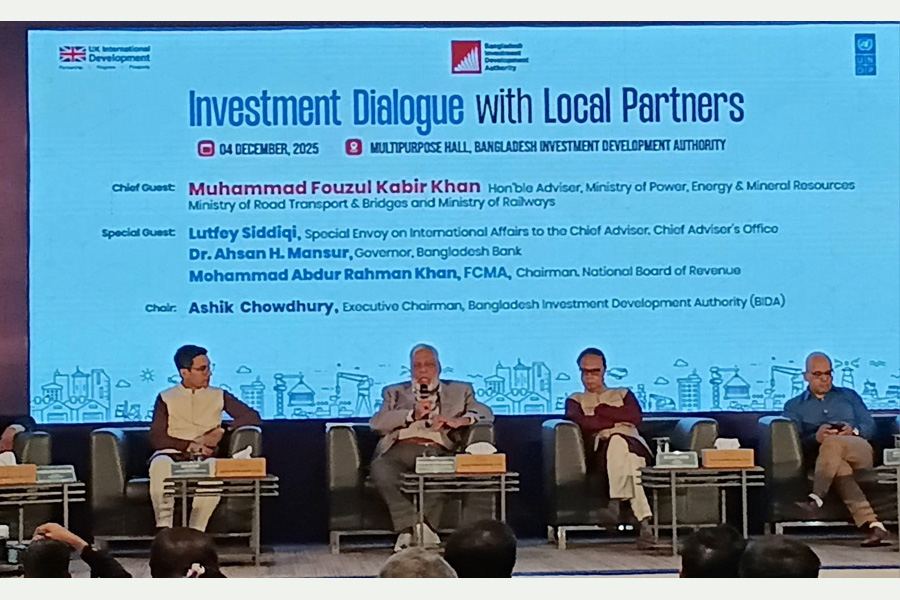
Bangladesh Bank Governor Dr Ahsan H Mansur on Thursday said the country’s economic policy is independently formulated and not dictated by the International Monetary Fund (IMF) or the World Bank.
“If we follow their prescriptions blindly, the exchange rate could surge to around Tk 170-180 per US dollar, as has happened in Pakistan and Sri Lanka,” he said.
The governor made the remarks while speaking as the special guest at the ‘Investment Dialogue with Local Partners’ held at the multipurpose hall of the Bangladesh Investment Development Authority (BIDA) on Thursday.
Energy Adviser Muhammad Fouzul Kabir Khan was also present at the programme.
Dr Mansur said inflation is expected to fall to 5 per cent by the end of the current fiscal year, FY2025-26. Consequently, the policy rate would likely be reduced to 8-9 per cent, with lending rates settling between 10 and 11 per cent.
He cautioned that reducing interest rates without controlling inflation could destabilise the exchange rate and the money market, responding to businesses’ demands for lower lending rates.
Citing examples from India and China, the governor noted that their low interest rates-3 per cent and zero per cent, respectively-reflect their economic conditions, which differ from Bangladesh’s.
“We are not currently taking IMF loan instalments because some conditions cannot be fulfilled at this time for the sake of our economy. When needed, we will take IMF loans after fully meeting the global lender’s conditions,” he added.
About the financial sector, Dr. Mansur said it has now emerged from previous data manipulations that had posed serious risks to the country.
For instance, while official figures under the previous regime showed single-digit inflation, actual inflation was around 12-13 per cent, with lending rates in single digits, leaving depositors with negative returns. Similarly, defaulted loans were underreported, shown below double digits, though they stood at around 35 per cent in September 2025. Current accounts have now been corrected.
On the question of recovering defaulted loans through the sale of industry assets, the governor clarified that industries should not be penalised for individual mismanagement.
He cited the example of the SS power plant of S. Alam Group, which continues to operate with support from Bangladesh Bank for LC openings.
The project involves about US $2.5 billion in investment, 80 per cent of which is foreign-owned. Although the plant is running, S. Alam will not retain any profit, as all funds will be used to repay liabilities, he added.
Dr Mansur pointed out that the Bangladesh Bank has received 1,300 applications for loan restructuring, approving 250 of them. The remaining applications have been forwarded to respective banks for customer- and client-based restructuring.
He projected that defaulted loans will decrease by 5 per cent by March FY2025-26, but bringing overall non-performing loans to a reasonable level may take 8-10 years.
Lutfey Siddiqi, Special Envoy of the Chief Adviser on International Affairs, and Mohammad Abdur Rahman Khan, FCNA, Chairman of NBR, participated in the dialogue, held by Chowdhury Ashik Mahmud Bin Harun, Executive Chairman of BEZA and BIDA, in the chair.