
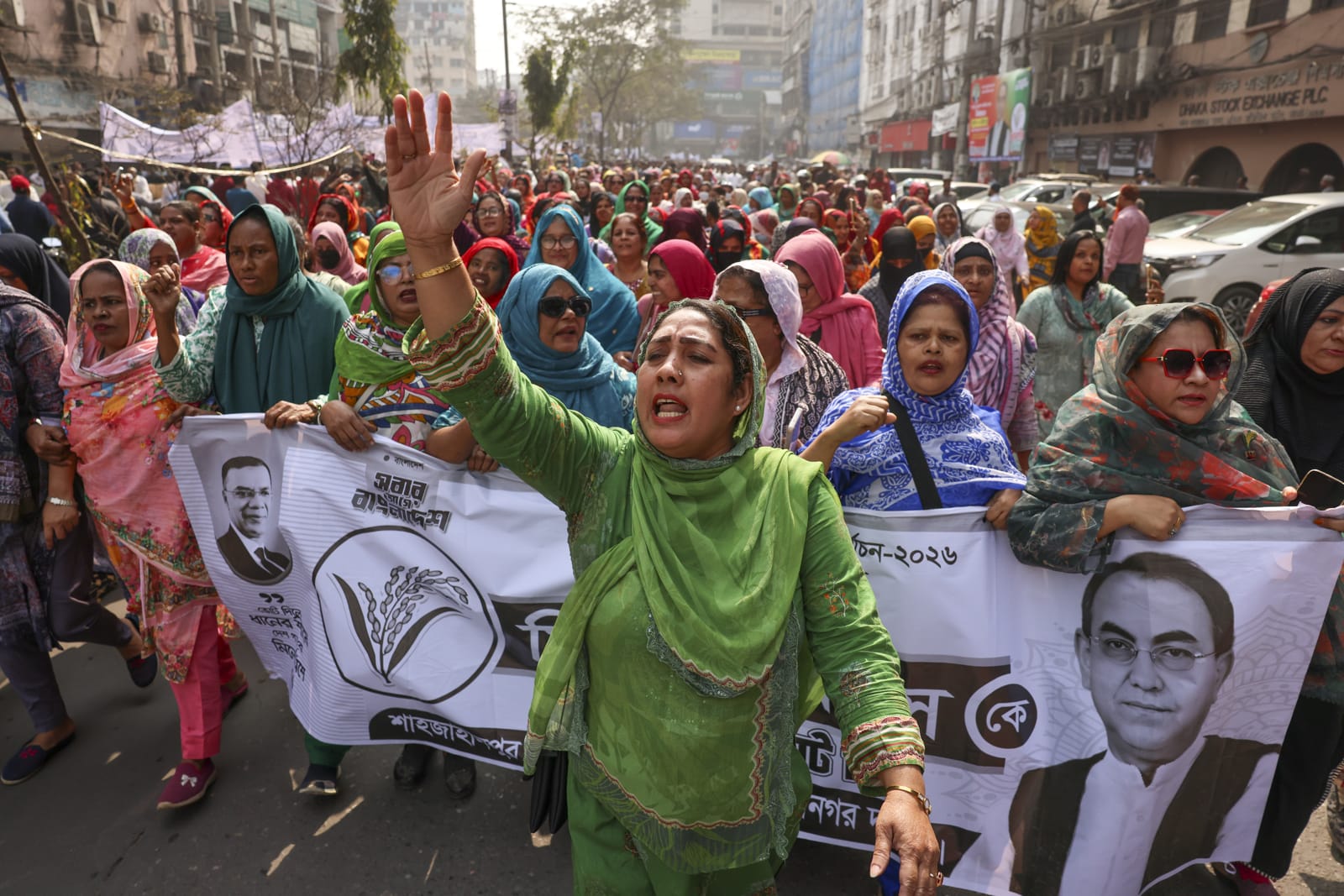
For more than half a century, Bangladesh’s politics has been shaped by Bengali cultural nationalism and Islamism alike. The clash between the two has led to sporadic violent attacks on liberal voices, religious and sexual minorities in the past. However, since the collapse of Prime Minister Sheikh Hasina’s government in August 2024, it has become especially pronounced. Irrespective of the outcome of elections later this month, Islamists are likely to continue their political and social push, potentially imperilling the hard-won rights of many.
But Bangladesh’s intelligentsia can serve as a bulwark. By virtue of history and influence, the country’s writers, artists, and film-makers are uniquely positioned to rebalance religious majoritarianism and plural humanism.
Bangladesh’s independence from Pakistan in 1971 marked the triumph of language over religion. A country of Bengali speakers who were predominantly – but not exclusively – Muslim, an independent Bangladesh also committed itself to pluralism, almost as a corollary of having privileged Bengali over Islam as a founding principle.
Nothing demonstrated this as decisively as the choice of a song by the Kolkata-born polymath Rabindranath Tagore as Bangladesh’s national anthem, despite early popular reservations among poor Muslims about his Hindu, landowning, background. Dhaka’s Chhayanaut, centred around Tagore’s work, remains one of Bangladesh’s most celebrated cultural institutions.
But Islam – as practised in the Indian subcontinent, with a syncretic accent – would also play an important role in Bangladesh’s creative sphere. The work of the late film-maker Tareque Masud attest to it. Funded in part by a grant from France, his 2002 masterpiece The Clay Bird is an exploration of freedom and the meaning of religion in a changing world, a visual tribute to Sufi traditions.
Even as indigenous Islamic practices enriched Bangladesh’s culture, episodic clamour for a greater role of religion in the country’s politics – influenced by Islamist movements in the Middle East and North Africa – has stood in the way of its full-throated expression. So has accommodation of extremists by mainstream political parties.

The author Taslima Nasreen would be forced to flee the country in face of death threats in 1994, during Prime Minister Khaleda Zia’s first term in office. That period also saw the nucleation of several violent Islamist groups in Bangladesh, leading some to accuse her of placating religious hardliners. Masud’s 2002 film would be banned by Zia in her second.
While Zia died in December last year, her Bangladesh Nationalist Party (BNP) remains a frontrunner in the upcoming elections. For Bangladeshi voters, it’s either them or a coalition around Jamaat-e-Islami (JeI), an outfit with ideological affinity to Egypt’s Muslim Brotherhood.
That said, many Bangladeshi intellectuals were not fans of Hasina. After all, she had curbed free speech online and jailed independent-minded bloggers. Some, including self-identified atheists, were also violently targeted by Islamists on her watch.
While cultivating new interlocutors, foreign diplomats in Dhaka must reach out to credible, independent voices – even those not given to singing their hosts’ paeans.
Nevertheless, Hasina remained committed to Bangladesh’s plural culture, conferring the country’s highest state award to a Hindu-born leftist poet in 2016. During her long tenure in office, Bangladeshi artists and intellectuals also chalked up accolades abroad. That, in turn, translated to cachet back home.
For example, a Bangladeshi film was screened as part of the official selection at the Cannes Film Festival for the first time, in 2021. Three years later, its lead actor, Azmeri Haque, became the first woman in her country’s history to be granted sole custody of her child. Both milestones helped her emerge as a leading rights voice.
The worry is that neither the BNP nor the JeI (even after its recent rebranding) is particularly interested in preserving the cultural space many Bangladeshis have carved out for themselves. And with that space diminishing, Bangladesh would be forced to fundamentally renegotiate its identity.
After all, as the BNP and JeI – alongside new unorganised actors – reasserted themselves in the country’s political scene following Hasina’s fall, attacks on traditional cultural icons and institutions have become frequent. The Chhayanaut office in Dhaka, along with those of prominent newspapers, was torched last December. Months before, Tagore’s ancestral home in Bangladesh was vandalised. The list goes on.
There is much that outsiders can do to stem the tide, beginning with supporting the artistic aspirations of Bangladeshi creatives. They must however recognise the importance of preserving diverse voices. As an example, despite both being feminist icons, the author Nasreen is vocally anti-religion; the actor Haque not. Support for Bangladesh’s intelligentsia must not turn into a counterproductive crusade.
Second, filmmakers would benefit from many more co-production arrangements. As European commercial support for Iranian cinema shows, this yields rich artistic and political dividends. Similarly, some European countries – including Norway – have supported Bangladeshi-led literary outlets through state grants. Earmarked funding for foreign short-term residencies will go a long way.
Third, when it comes to Bangladeshi intellectuals, governments must be less stingy with visas and reimagine their cost-benefit calculations. And while cultivating new interlocutors, foreign diplomats in Dhaka must reach out to credible, independent voices – even those not given to singing their hosts’ paeans.
When asked whether she had faced problems for playing a lesbian Indian intelligence asset in a 2023 Netflix movie, Haque had replied in the negative.
“Bangladesh hasn’t become such a state and I hope, and we need to ensure that, it never does,” she said.