
Bangladesh’s food production faces a significant threat, and food security is increasingly at risk as agricultural land has been eroded by 3.75 percent over the past eight years, driven by rapid urbanisation across the country.
This alarming finding was revealed in a comprehensive survey report by the Bangladesh Bureau of Statistics (BBS), conducted under its ‘Strengthening Environment, Climate Change and Disaster Statistics (ECDS)’ project. The survey, covering the period from 2015 to 2023, shed light on critical environmental and climate issues for the first time in such detail in Bangladesh.
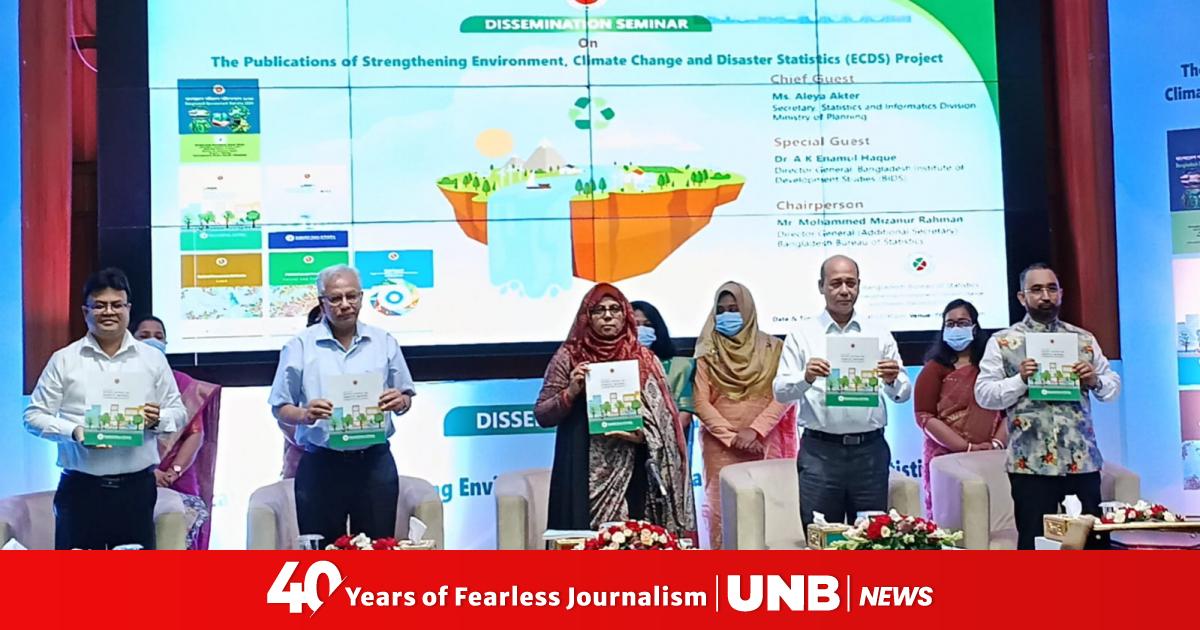
The report was officially unveiled on Sunday, at a dissemination seminar held at the BBS Auditorium, marking a significant step in the country’s commitment to environmental statistics.
Beyond the decline in agricultural land, the survey presented a range of crucial climate-related data. It found that natural forest cover decreased by 5.41 percent during the same eight-year period, although this was partially offset by a substantial 27.36 percent increase in planted forests (social plantations).
The extensive survey encompassed various critical areas, including a household-based environmental survey for 2024, water use information, materials consumed in households, land accounts, forest and ecosystem accounts, and detailed analyses of land cover and land use status. It also provided insights into waste management practices in both urban and rural areas, e-waste, solid waste management, and the alarming status of polluting water bodies.
Speaking at the seminar and report publication ceremony, Aleya Akter, secretary of the Statistics and Information Division, Ministry of Planning, graced the event as the chief guest. AK Enamul Haque, director general of the Bangladesh Institute of Development Studies (BIDS), was present as a special guest, while Muhammed Mizanur Rahman, Director General of BBS, presided over the event.
PKSF unveils five-year plan for inclusive growth
Mohammad Saddam Hossain Khan, project director of the ECDS project, presented the key findings of the survey during the seminar. He highlighted that the primary objective of the ECDS project is to establish a systematic framework for environmental statistics within Bangladesh by producing comprehensive data related to the environment, natural resources, biodiversity, climate change, and disaster risk.
Khan further emphasised that a major aim of the project is to conduct climate change and natural disaster-related surveys to monitor the impacts of these events. Another core objective, he added, is to develop physical flow natural resource accounts, including forest, land, and ecosystem accounts, as well as water accounts, aligned with the UN System of Environmental-Economic Accounting (SEEA).
The seminar saw the unveiling of seven detailed survey reports under the ECDS project. These include: the Household Based Environmental Survey (HBES) 2024; Material Footprint (MF) and Domestic Material Consumption (DMC); Physical Flow Water Accounts for Bangladesh; Development of Time Series Environmental Spreadsheets for International Reporting following the Global Environmental Template developed by the United Nations Statistics Division (UNSD); Compilation of the Bangladesh Environmental Statistics 2024; Natural Resource Accounts (Land); and Natural Resource Account (Forest and Ecosystem).
The findings underscore an urgent need for strategic planning to mitigate the impact of land erosion and rapid urbanization on Bangladesh’s vital agricultural sector and overall environmental health.