
September 16, 2025
DHAKA – When dusk falls over the countryside, a hush settles on the trees. Once, that silence would be broken by the soft “whoo-whoo” of a spotted owlet or the eerie call of a barn owl gliding above rice paddies. Now, the night feels strangely silent.
Owls—those mysterious, misunderstood raptors—are vanishing from Bangladesh’s landscapes. Their disappearance is not only a cultural loss; it is a warning. The fading of these night hunters signals ecological imbalance and a deepening silence in nature’s nocturnal orchestra.
Forests falling, owls fading
Bangladesh hosts more than 20 species of owls, including the barn owl (Tyto alba), brown fish owl (Ketupa zeylonensis), spotted owlet (Athene brama), and the elusive collared scops owl (Otus lettia).
Each species relies on tree cavities, dense forests, bamboo groves, and quiet farmlands to nest and hunt. But rapid deforestation, unplanned urbanisation, and infrastructure expansion are devouring their habitats.
Dr Rafiq Azam, a forest ecologist, notes: “Where trees once stood tall and silent, concrete now echoes. Owls are losing not just their homes, but their very ability to survive in nature.”
The Food and Agriculture Organization (FAO) estimates that Bangladesh loses nearly 2,000 hectares of forest annually, and this erosion of green cover is directly tied to shrinking owl populations.
Human fear, folklore, and harm
Superstition compounds the problem. In rural folklore, owls are often seen as omens of death or bad luck. Such beliefs fuel needless killings, especially of barn owls, whose pale face and haunting calls make them targets.
Some species are trapped for the illegal wildlife trade or used in traditional medicine. Others die from electrocution on power lines, collisions with vehicles, or entanglement in barbed wire as they are forced into human-dominated landscapes.
“We have turned cultural myths into excuses for cruelty. Every owl killed by superstition takes away a guardian of our fields,” laments wildlife activist Sharmin Jahan
Pesticides poison the night
Owls are natural pest controllers, but pesticides have turned their strength into vulnerability. When rats or insects consume poisoned food, owls that prey on them ingest toxins second-hand.
Modern rodenticides—often anticoagulants—cause internal bleeding. A single poisoned rat can kill an adult owl. Nestlings fed contaminated prey rarely survive.
A recent study in India found rodenticide residues in 60% of barn owl pellets examined—a worrying indicator for neighbouring Bangladesh.

A barn owl, now a rare sight in Bangladesh. PHOTO PROVIDED BY THE DAILY STAR
Why owls matter
Natural pest controllers
One barn owl family can consume over 3,000 rodents in a breeding season, protecting rice, vegetable, and grain crops. By reducing pest pressure, owls save farmers money and reduce dependence on toxic chemicals.
Ecosystem balancers
As apex nocturnal predators, owls regulate prey populations. Without them, rodent numbers can explode, leading to crop damage, disease outbreaks, and cascading ecological imbalance.
Bioindicators of ecosystem health
Because owls are highly sensitive to environmental changes, their presence—or absence—reflects the health of ecosystems. A decline in owls is an early warning of habitat collapse and biodiversity loss.
Cultural and educational value
Despite superstition, owls also appear in Bangladeshi folklore and proverbs, often symbolising wisdom and mystery. Today, they serve as “gateway species” for environmental education—capturing children’s imagination and linking conservation with cultural heritage.
As Dr Mohammad Ali Reza Khan, veteran Bangladeshi ornithologist, observes: “Owls are misunderstood protectors. If Bangladesh loses them, it loses an ally in farming, in culture, and in biodiversity itself.”
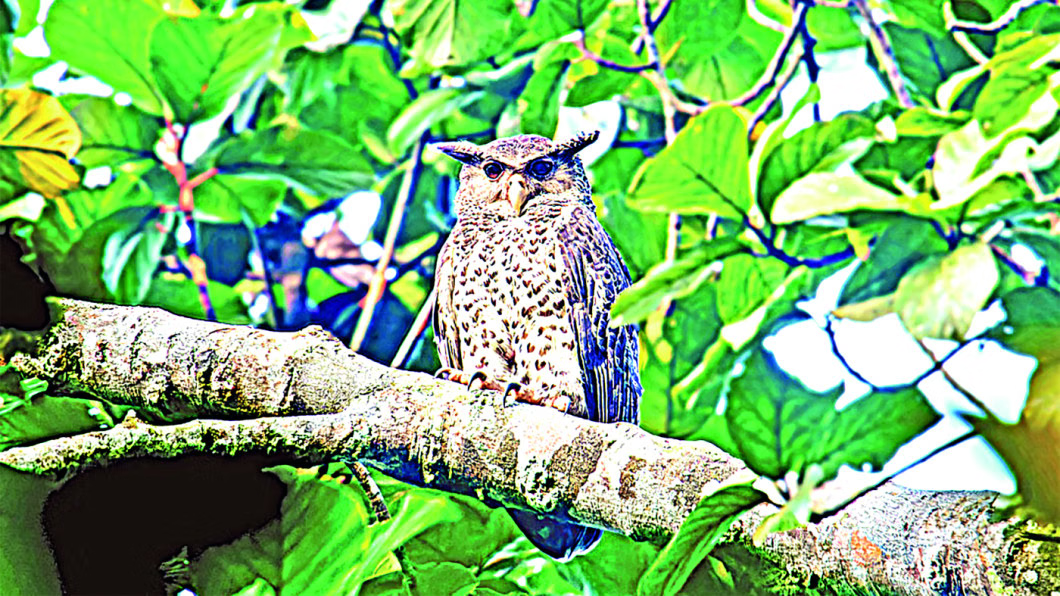
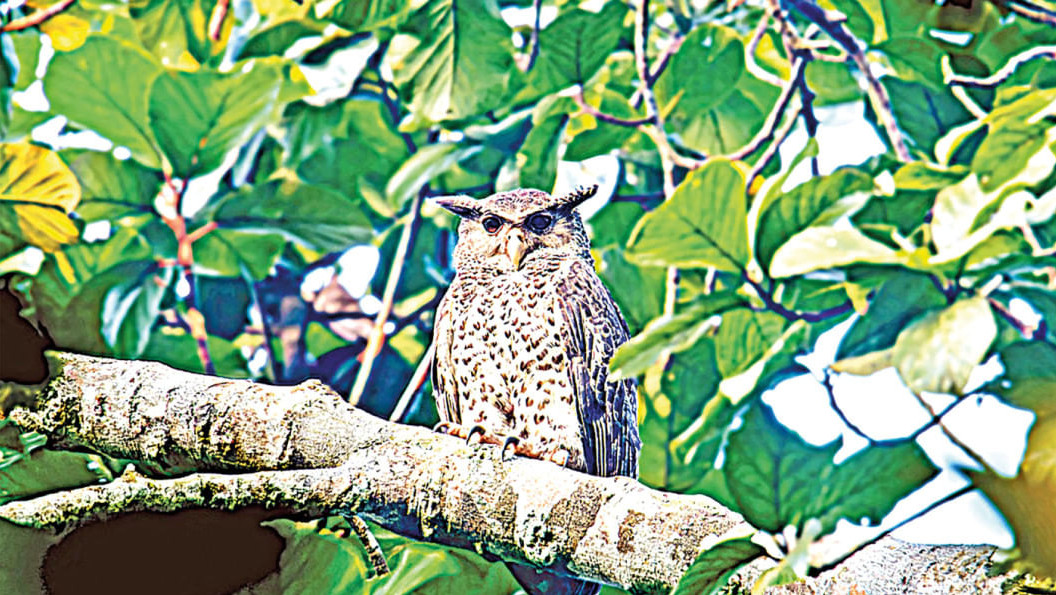
Majestic Spot-bellied Eagle-Owl spotted in Hazarikhil, Chattogram. PHOTO PROVIDED BY THE DAILY STAR
What can be done
In villages and towns
Install owl nest boxes in schools, farms, and homesteads.
Launch awareness programmes to challenge superstition and highlight their role in farming.
Avoid nighttime use of rodenticides, especially during breeding seasons.
In forest and farmland
Conserve large trees and allow deadwood to remain as nesting sites.
Promote owl-friendly farming by encouraging organic pest control.
Train farmers to recognise and protect owl species.
Policy and protection
Enforce wildlife laws to curb hunting and trade of owls.
Integrate owls into Bangladesh’s National Biodiversity Strategy and Action Plan (NBSAP).
Support research and citizen science to monitor owl populations and trends.
A final glimpse
Their eyes shine like moons in the dark. Their wings slice silently through the night. For centuries, owls have watched over our fields and forests—unseen guardians of balance. But now, they are watching us with dwindling numbers, slipping into silence.
If we lose them, we lose not just a species, but an entire night chorus—a silence heavy with meaning. The forests grow darker. The nights grow quieter.
Before the silence deepens beyond recovery, let us protect the owls: wise, mysterious, and vital. For in saving them, we save the night itself.
Afrina Momotaj is a Climate-Smart Agriculturist and Animal Rescuer. She can be contacted at momotajafrina@gmail.com