
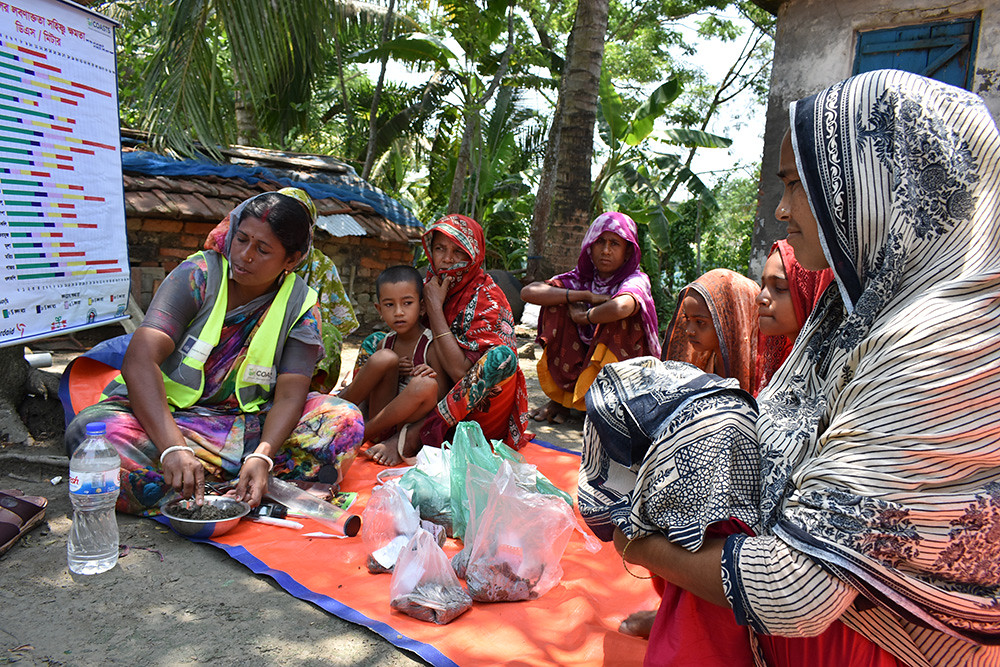
“In the saline area from January to April-May, the river water salinity is very high,” says Priya Lal Chandra Paul, an engineer with the Department of Irrigation and Water Management at Bangladesh Rice Research Institute (BRRI). “Farmers can’t use this water.”
The result is that by the end of the dry season, the water can be even saltier than seawater. The critical problem is that these rivers are connected to irrigation canals that lace southwestern Bangladesh, delivering saline water directly to smallholders’ land. So, Paul explains, the institute is teaching locals who control the sluice gates of these canals another simple shift: Open and close the gates a little earlier in the rainy season to store more freshwater.
I spoke with 16 farmers in this region, and all had the same complaint.
“Water is the number one issue that needs to be solved,” says Mukta Gazi, a 25-year-old farmer who’s been working the land all her life. “So re-excavating this river and canal and storing some freshwater during the rainy season will solve many problems of this area.”
Still, Gazi, who received training in saline agriculture through BRRI and the Bangladesh Agriculture Research Institute (BARI), says, in general, things have improved here.
“In the past, there was only rice. Only transplanted Aman rice [a wet-season rice variety that accounts for 40 percent of Bangladesh’s rice production]. And when I got introduced with BARI and BRRI and got some training and information from them, I used [it] to grow zero-tillage potato, zero-tillage garlic, sunflower, and salt-tolerant rice varieties as well.”
And all of this crop diversification is leading to crop intensification. Citing land use and land cover imaging analysis, Paul says that since 2016, when the first efforts began, cropping intensity increased by 270 percent in southwestern Bangladesh. “So day by day, because we have the technology, we have the salt-tolerant varieties, farmers can grow lots of crops, even they have salinity problem, climate problem, water problem, but still the crop cultivation is increasing,” he says. This, he adds, is good for food security.
The relative success of the project offers lessons and insights for other regions around the world that are facing similar problems. Soil salinization is devastating vast stretches of farmland from the United States to Uzbekistan to nations across Africa.
According to the UN Food and Agriculture Organization, salt-affected soils remove up to 1.5 million hectares of farmland a year from production and “decreases the production potential” of 46 million more hectares annually. Experts estimate a range of the annual cost of this loss from tens of millions to tens of billions of dollars. Implementing similar projects could help improve the economy and food security in these regions as well.
For Begum and her group of lead farmers, the measure of the project’s success is different, but equally important. They have been able to form collectives to sell their high-value crops as one unit at markets and to wholesalers and leverage their value, eliminating undercutting by middlemen. Some women have used their increased earnings to buy more cows and reinvest in their land, others to bring their husbands home from day-laboring in the cities because they can farm year round now. And it is enabling many, such as Gazi, to invest in the future.
“[With the project’s support,] I have been able to improve my family’s status. I can educate my child. I can spend money for better living,” she says. “This I want.”