
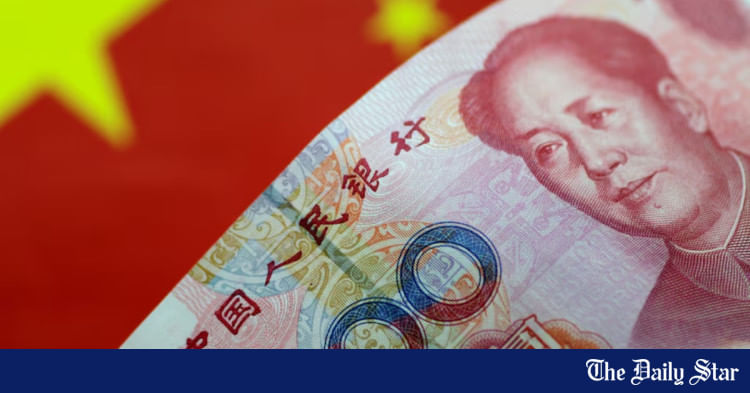

The world is moving towards a multi-polar currency system, and China is leading that charge. FILE ILLUSTRATION: REUTERS
“>

The world is moving towards a multi-polar currency system, and China is leading that charge. FILE ILLUSTRATION: REUTERS
Imagine a world where the US dollar is no longer the undisputed king of global trade—a world where transactions between nations, whether for oil, technology, or infrastructure, are settled not in greenbacks but in currencies that bypass American financial systems. This is not a distant fantasy; it is a reality being built today, largely by China. According to The Economist, China is “ditching the dollar, fast,” with over 30 percent of its trade in goods and services now conducted in its own currency, the renminbi (RMB), up from less than 1 percent in 2010. Therefore, it has become imperative for countries like Bangladesh that are seeking economic resilience to understand China’s construction of a dollar-alternative system, and form their plans accordingly.
China’s strategy is not born of mere economic convenience but of a calculated response to geopolitical risks. The increasing weaponisation of the dollar—through sanctions and tariffs—has exposed the vulnerabilities of relying on a currency controlled by a single nation. As People’s Bank of China Governor Pan Gongsheng recently argued, this reliance allows financial risks from one country to “overflow to the world,” potentially triggering international crises. China’s answer is a multi-pronged campaign to create an alternative financial ecosystem that reduces its exposure to dollar-dominated systems while offering other nations a hedge against American unilateralism. This could represent both an opportunity and a call to action.
 For all latest news, follow The Daily Star’s Google News channel.
 At the heart of China’s strategy is the Cross-Border Interbank Payment System (CIPS), a growing network designed to facilitate RMB-denominated transactions without relying on the dollar-centric SWIFT system. Recently, six foreign banks, including Standard Bank and First Abu Dhabi Bank, agreed to integrate with the CIPS, expanding its reach into Africa and the Middle East. This system, coupled with bilateral currency swap agreements with over 32 countries, provides the plumbing for a new financial architecture. For a trading nation like Bangladesh, which relies heavily on cross-border transactions, the rise of CIPS could eventually offer cheaper and more efficient alternatives to dollar-based settlements, particularly in dealings with China and other Asian economies.
China’s ambitions extend beyond traditional banking systems. The digital yuan (e-CNY) is poised to revolutionise cross-border payments. With an international operations centre recently established in Shanghai, China aims to use its central bank digital currency to enable direct, real-time settlements bypassing Western financial intermediaries. This push is not just about efficiency; it is about sovereignty. As Pan Gongsheng noted, traditional payment systems are “vulnerable to geopolitical risks” and can be “weaponised” for unilateral sanctions. For Bangladesh, which is steadily embracing digital finance, the e-CNY could become a tool for reducing transaction costs and minimising exposure to dollar-driven financial volatility.
Trade is another critical battleground. China is aggressively pushing for RMB-denominated contracts, especially in commodities. From oil deals with Saudi Arabia to mineral agreements with Brazil, Beijing is persuading its partners to settle transactions in yuan. This shift is particularly evident within the BRICS bloc, where the RMB now facilitates 50 percent of intra-group trade, a stark increase from just 2 percent of global payments. For Bangladesh, which imports billions worth of energy, raw materials, and machinery from China, denominating even a fraction of these transactions in RMB could reduce exchange rate risks and dependency on dollar reserves.
The most compelling aspect of China’s strategy is its pragmatic incrementalism. Unlike previous attempts to challenge dollar hegemony, China is not trying to replace the dollar outright. Instead, it is building a parallel system that operates alongside it, focusing on regional dominance rather than global supremacy. This approach acknowledges the dollar’s entrenched role—it still accounts for 88 percent of global foreign exchange transactions—while creating alternatives for those seeking to avoid its reach. For Bangladesh, this means that the RMB is not an all-or-nothing choice but an additional tool in its monetary toolkit, one that could be deployed selectively to enhance economic resilience.
However, China’s system is not without challenges. The RMB remains constrained by capital controls and a lack of full convertibility, issues Beijing seems unwilling to address in the near term. Moreover, the dollar’s deep and liquid markets, backed by the rule of law and institutional stability, make it a trusted store of value, something that the RMB cannot yet match. Therefore, any shift towards RMB-based transactions must be cautious and calibrated, ensuring that short-term gains do not expose the economy to long-term risks.
As China expands its influence through institutions like the Belt and Road Initiative and BRICS, it is creating a network of nations tied together by shared financial interests. Bangladesh, with its strategic location and growing economic prowess, is already part of this network. The question is no longer whether to engage with China’s dollar-alternative system but how to do so in a way that maximises benefits while minimising the risks of the geopolitical reordering of global finance.
First, Bangladesh should investigate RMB-based trade settlements with China, particularly for major imports and exports. Pilot programmes could test the waters, leveraging mechanisms like currency swaps to reduce exchange rate costs. Second, policymakers should study the digital yuan’s potential, both as a means of cross-border settlement and as a model for Bangladesh’s own digital currency ambitions. Third, Bangladesh must strengthen its financial governance to ensure that any engagement with alternative systems is backed by robust regulatory frameworks. Finally, Bangladesh should diversify its reserve holdings cautiously, considering the RMB as one component of a broader basket of currencies.
The world is moving towards a multi-polar currency system, and China is leading that charge. By understanding China’s dollar-alternative system, Bangladesh can make informed choices that enhance its economic sovereignty, protect its interests, and secure its place in the new global financial order.
Zakir Kibria is a Bangladeshi writer, policy analyst, and entrepreneur based in Kathmandu. He can be reached at [email protected].
Views expressed in this article are the author’s own.
Follow The Daily Star Opinion on Facebook for the latest opinions, commentaries and analyses by experts and professionals. To contribute your article or letter to The Daily Star Opinion, see our guidelines for submission.