
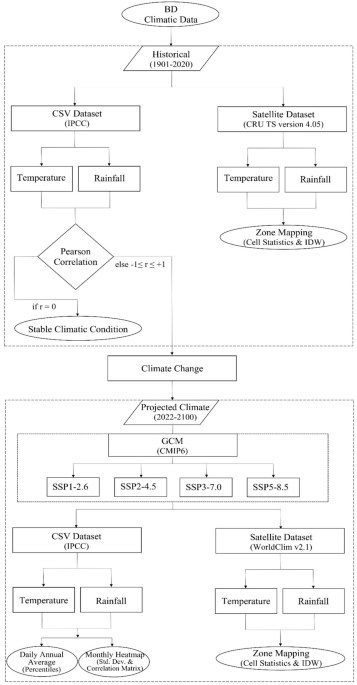
Historical climatic data (1901–2022)
Analyzing Bangladesh’s historical climate data (1901–2022) suggests a warming trend, with rising temperatures and changes in precipitation patterns34. Over the last century, average temperatures have risen, with recent decades seeing the most substantial warming. Rainfall patterns are becoming increasingly irregular, with catastrophic occurrences such as floods and droughts intensifying. These shifts are attributable to global climate change, which is providing enormous difficulties to Bangladesh’s agriculture, water resources, and public health.
Observed temperature
Figure 3 shows variations in mean temperature, Tmin, and Tmax as well as historical variations in the yearly daily average air surface temperature from 1901 to 2022. Equation y = 0.005x + 15.49 indicates a rising tendency in the annual daily average mean air surface temperature, which fluctuates between 24.64 °C and 26.60 °C. The yearly daily average air surface temperature has increased from 20.10 °C to 21.73 °C (trend y = 0.005x + 11.45) and from 29.24 °C to 31.57 °C (trend y = 0.005x + 19.64) throughout the course of the century. Interestingly, the statistics show that temperatures have been rising steadily over time.

Observed annual daily average surface air temperature of Bangladesh (1901–2022).
Observed precipitation
Figure 4 illustrates historical variations in annual precipitation from 1901 to 2022. The equation y = -2.819x + 7861.07 shows the pattern of annual precipitation, which spans from 1678.22 mm to 2843.91 mm. The equation therefore shows how Bangladesh’s yearly precipitation is expected to decrease with each subsequent year. This is concerning as it suggests that the nation may be moving toward drier weather.

Observed annual precipitation of Bangladesh (1901–2022).
Observed temperature vs precipitation trend
Figure 5 shows the intricate relationship that develops between temperature and precipitation in Bangladesh (1901–2022),. It’s a modest relationship, but hotter years often see somewhat less rain. With rising temperatures, there is a gradual drop in the yearly daily average precipitation. Within the correlation value of r = − 0.09, the link between (i) Tmin and precipitation is represented by the equation y = − 0.18x + 10.14. Moreover, for the Tmax y = − 0.65x + 25.93, r = − 0.34, and the (ii) mean y = − 0.51x + 19.28, r = − 0.23 respectively. Rainfall patterns may also be influenced by other causes, as indicated by the weak relationship revealed by all those correlation coefficients. In-depth research on this complex link is necessary because future water resource management and adaptation plans in Bangladesh depend on a knowledge of the interactions between these important climatic factors.

Observed annual daily average temperature vs precipitation relation in Bangladesh (1901–2022). [(i) Tmin–Pre; (ii) Tmean–Pre; (iii) Tmax- Pre].
Historical climatic zone mapping (1901–2020)
The analysis of climate change reveals the changes in climatic variable time series in Bangladesh during the period of 1901–2020.
Historical temperature zone mapping
Figure 6 illustrates decade-wise annual daily average Tmin mapping in Bangladesh, the given region from 1901 to 2020. Between 1901 and 1910, temperatures range from 8.79 to 14.54 degrees Celsius. Subsequent decades show fluctuations- in 1911 to 1920 the temperature varies between 10.9 °C and 15.98 °C, 1921 to 1930 it ranges from 10.7 °C to 15.99 °C, 1931 to 1940 it fluctuates between 10.5 °C and 15.66 °C. The temperature range in 1941–1950 is 9.9 °C to 15.07 °C, 1951–1960 it varies from 8.9 °C to 14.08 °C, 1961–1970 it ranges from 10.1 °C to 15.78 °C, 1971–1980 it fluctuates between 9.8 °C and 15.62 °C, 1981–1990 it spans from 10.32 °C to 15.94 °C, 1991–2000 it ranges from 9.5 °C to 14.8 °C, 2001–2010 it varies from 10.5 °C to 15.61 °C and 2011–2020 the temperature fluctuates between 9.6 °C to 14.89 °C. Also, the individual images of this clearly depict how the temperature zone shifted in different region of the country for each decade of historical time period. In fact, it’s range shifting from high to highest in the Southeast (SE) region. Similarly, Northeast (NE) and Northwest (NW) regions experienced low to high temperature. Also, the Central (M) and Southwest (SW) regions experienced high to highest temperatures at various times.

Historical annual average daily Tmin mapping in Bangladesh (1901–2020). [decadal time period- (a) 1901–1910; (b) 1911–1920; (c) 1921–1930; (d)1931–1940; (e) 1941–1950, (f) 1951–196; (g) 1961–1970; (h) 1971–1980; (i) 1981–1990; (j) 1991–2000; (k) 2001–2010; (l) 2011–2020].
Figure 7 illustrates decade-wise annual daily average Tmax mapping in Bangladesh the given region from 1901 to 2020. Between 1901 and 1910, temperatures range from 21.82 to 26.4 degrees Celsius. Subsequent decades show fluctuations- in 1911 to 1920 the temperature varies between 24.3 °C and 27.2 °C, 1921 to 1930 it ranges from 24.09 °C to 27.5 °C, 1931 to 1940 it fluctuates between 24.6 °C and 28.1 °C. The temperature range in 1941–1950 is 23.31 °C to 27.3 °C, 1951–1960 it varies from 23.5 °C to 26.8 °C, 1961–1970 it ranges from 24.22 °C to 27.8 °C, 1971–1980 it fluctuates between 23.57 °C and 26.6 °C, 1981–1990 it spans from 21.96 °C to 26.3 °C, 1991–2000 it ranges from 22.37 °C to 26.1 °C, 2001–2010 it varies from 26.1 °C to 28.3 °C and 2011–2020 the temperature fluctuates between 23.88 °C to 27 °C. Also, the individual images of this clearly depict how the temperature zone has been shifted in different region of the country for each decade of historical time period. In fact, it’s range shifting from higher to highest in the Southeast (SE) region. Similarly, Northeast (NE) and Northwest (NW) regions experienced moderate to high temperature. Also, the Central (M) and Southwest (SW) regions experienced high to higher temperatures at various times.

Historical annual average daily Tmax mapping in Bangladesh (1901–2020). [decadal time period- (a) 1901–1910; (b) 1911–1920; (c) 1921–1930; (d) 1931–1940; (e) 1941–1950, (f) 1951–1960; (g) 1961–1970; (h) 1971–1980; (i) 1981–1990; (j) 1991–2000; (k) 2001–2010; (l) 2011–2020].
Historical precipitation zone mapping
Figure 8 illustrates decade-wise annual daily average precipitation mapping of Bangladesh the given region from 1901 to 2020. Between 1901 and 1910, precipitation range from 9.52 mm to 38.99 mm. Subsequent decades show fluctuations- in 1911 to 1920 the precipitation varies between 1.4 mm and 49 mm, 1921 to 1930 it ranges from 13.03 mm to 45.49 mm, 1931 to 1940 it fluctuates between 0.10 mm and 9.49 mm. The precipitation range in 1941–1950 is 1.4 mm to 27.29 mm, 1951–1960 it varies from 0 mm to 9.69 mm, 1961–1970 it ranges from 2.30 mm to 19.09 mm, 1971–1980 it fluctuates between 6.70 mm and 30.09 mm, 1981–1990 it spans from 18.41 mm to 42.99 mm, 1991–2000 it ranges from 11.02 mm to 32.49 mm, 2001–2010 it varies from 0.11 mm to 11.2 mm and 2011–2020 the temperature fluctuates between 0.80 mm to 13 mm. Also, the individual images of this figure clearly depict how the precipitation has changed in different parts of the country every decade. In fact, it’s range low to moderate in the Southeast (S-E) region. Similarly, Northeast (N-E) and Northwest (NW) regions experienced low to very high precipitation. Also, the Central (M) and Southeast (S-E) regions experienced low to high precipitation at various times.

Historical annual average daily precipitation mapping of Bangladesh (1901–2020). [decadal time period- (a) 1901–1910; (b) 1911–1920; (c) 1921–1930; (d) 1931–1940; (e) 1941–1950, (f) 1951–1960; (g) 1961–1970; (h) 1971–1980; (i) 1981–1990; (j) 1991–2000; (k) 2001–2010; (l) 2011–2020].
CMIP6 model based projected climate (2022–2100)
In their study using CMIP6, projected shifts in precipitation and temperatures across Bangladesh. They employed Simple Quantile Mapping (SQM) to correct biases in Global Climate Models (GCMs). The Multi-Model Ensemble (MME) mean of these adjusted datasets assessed changes under SSP1-2.6, SSP2-4.5, SSP3-7.0, and SSP5-8.5 scenarios for near, mid, and far future periods compared to historical records2.
Projected temperature
Figure 9 depicts that the projected annual daily average surface air Tmin in Bangladesh is expected to increase from 1950 to 2100 under all four SSPs. However, the rate of increase will vary depending on the SSP. In the historical reference period (1950–2014), the temperature range 21.21 °C–21.6 °C. But in the projected period (2014–2100), the Tmin reach at 21.6 °C to 22.6 °C for SSP1-2.6, representing an increase of about 1 °C. Similarly, for SSP2-4.5, SSP3-7.0 and SSP5-8.5 it will reach at respectively 21.6 °C to 23.56 °C, 21.6 °C to 24.92 °C and 21.6 °C to 26.04 °C. In this case, it is clearly seen that the future temperature will increase by ~ 2 °C, 3.3 °C and 4.4 °C respectively.

Projected annual daily average surface air tmin of Bangladesh (ref. period 1995–2014), multi-model ensemble.
Figure 10 illustrate that the projected increase in annual monthly one-day average surface air Tmin in Bangladesh is expected to vary depending on the different SSP scenario. The highest SSP scenario (SSP5-8.5) projected the highest increase in Tmin, while the lowest SSP scenario (SSP1-2.6) projected the smallest increasement with fluctuation. The SSP2-4.5 and SSP3-7.0 depicts medium level of temperature variation.

Projected annual monthly one-day average surface air tmin anomaly of Bangladesh (ref. period 1995–2014), multi-model ensemble. [(a) SSP1-2.6, (b) SSP1-4.5, (c) SSP3-7.0, (d) SSP5-8.5].
Figure 11 shows that under all four SSPs, the predicted yearly daily average surface air Tmax in Bangladesh is forecast to rise from 1950 to 2100. But the pace of growth will differ according on the SSP. The temperature range in the historical reference period (1950–2014) was 30.1 °C to 30.2 °C. However, with SSP1-2.6, the Tmax reach around 30.2 °C to 31.15 °C in the anticipated period (2014–2100), indicating a rise of around 1 °C. In a similar vein, it reached 30.2 °C to 31.86 °C for SSP2-4.5, 30.2 °C to 32.78 °C for SSP3-7.0, and 30.2 °C to 34.32 °C for SSP5-8.5. In this instance, it is evident that there will be future temperature increases of 1.7 °C, 2.6 °C, and 4.1 °C, respectively.

Projected annual daily average surface air Tmax of Bangladesh (ref. period 1995–2014), multi-model ensemble.
Figure 12 shows how different SSP scenarios will have varied effects on Bangladesh’s estimated yearly monthly one-day average surface air temperature increase. The predicted medium level of temperature variation was SSP2-4.5 and SSP3-7.0. The maximum Tmax rise was predicted by the greatest SSP scenario (SSP5-8.5), whereas the minimum increase with variation was predicted by the lowest SSP scenario (SSP1-2.6).

Projected annual monthly one-day average surface air Tmax Anomaly of Bangladesh (ref. period 1995–2014), multi-model ensemble. [(a) SSP1-2.6, (b) SSP1-4.5, (c) SSP3-7.0, (d) SSP5-8.5].
Projected precipitation
Figure 13 all four SSPs predict that Bangladesh’s yearly precipitation will rise between 1950 and 2100. Nevertheless, the pace of rise varies according on the SSP. Precipitation ranged from 2195.94 mm to 2382.77 mm over the historical reference period (1950–2014). However, throughout the anticipated period (2014–2100), SSP1-2.6 had precipitation ranging from 2161.12 mm to 2325.37 mm. The same will apply to SSP2-4.5, SSP3-7.0, and SSP5-8.5, reaching 2161.12 mm to 2354.33 mm, 2495.61 mm, and 2676.32 mm, respectively. In this instance, it is evident that a very low amount of future rainfall will grow dramatically.

Projected precipitation of Bangladesh (ref. period 1995–2014), multi-model ensemble.
Figure 14 shows how different SSP scenarios will have varying effects on Bangladesh’s anticipated yearly precipitation increases. The lowest SSP scenario (SSP1-2.6) predicted the least amount of increase with little variability, whereas the highest SSP scenario (SSP5-8.5) anticipated the biggest increase in precipitation. The predicted medium level medium variation for SSP2-4.5 and SSP3-7.0 is shown.

Projected annual monthly precipitation anomaly of Bangladesh (ref. period 1995–2014), multi-model ensemble. [(a) SSP1-2.6, (b) SSP1-4.5, (c) SSP3-7.0, (d) SSP5-8.5].
Projected climatic zone mapping (2022–2100)
Projections of future climate change are crucial for understanding and preparing for the impacts of a warming planet. This is particularly relevant for Bangladesh, a nation vulnerable to the effects of rising temperatures and changing precipitation patterns. CMIP6 climate models to map projected climate changes for Bangladesh over the 21’s century.
Projected temperature zone mapping
Figure 15 depicts between double decadal projections of annual daily average Tmin in Bangladesh from 2021 to 2100. Between 2021 and 2040, the temperature ranges for SSP1-2.6, SSP2-4.5, SSP3-7.0, and SSP5-8.5 are respectively projected 20.94 °C–23.08 °C, 21.18 °C–23.18 °C, 21.13 °C–23.17 °C, and 21.14 °C–23.14 °C. Additionally, considering the period of 2041 to 2060, the temperatures for SSP1-2.6, SSP2-4.5, SSP3-7.0, and SSP5-8.5 are projected to range from 21.7 °C to 23.8 °C, 22.01 °C to 23.99 °C, 22.15 °C–24.04 °C, and 22.27 °C–24.29 °C. For the years 2061 to 2080, the projected temperatures are expected to be in the ranges of 21.92 °C–24.07 °C, 22.63 °C–24.66 °C, 23.38 °C–25.2 °C, and 23.8 °C–25.75 °C for SSP1-2.6, SSP2-4.5, SSP3-7.0, and SSP5-8.5. Finally, from 2081 to 2100, the projected temperatures are anticipated to be within the ranges of 21.83 °C–24.01 °C, 23.03 °C–25.07 °C, 24.44 °C–26.3 °C, and 25.62 °C–27.53 °C for SSP1-2.6, SSP2-4.5, SSP3-7.0, and SSP5-8.5. Also, the individual images of this clearly depict how the temperature zone shifted in different region of the country for double decadal projected time period from 2022 to 2100. In fact, it’s range shifting from higher to highest in the Southeast (SE) region. Similarly, Northeast (NE) and Northwest (NW) regions experienced low to moderate temperature. Also, the Central (M) experienced high to higher and Southwest (SW) regions experienced high to highest temperatures at future.

Projected annual daily average Tmin mapping in Bangladesh (2021–2100). [2 decadal time period- (i) 2021–2040-(a) SSP1-2.6, (b) SSP1-4.5, (c)SSP3-7.0, (d)SSP5-8.5; (ii) 2041–2060-(a) SSP1-2.6, (b) SSP1-4.5, (c)SSP3-7.0, (d)SSP5-8.5; (iii) 2061–2080-(a) SSP1-2.6, (b) SSP1-4.5, (c)SSP3-7.0, (d)SSP5-8.5; (iv) 2081–2100-(a) SSP1-2.6, (b) SSP1-4.5, (c)SSP3-7.0, (d)SSP5-8.5;]
Figure 16 illustrates between double decadal projections of annual daily average Tmax in Bangladesh from 2021 to 2100. From 2021 to 2040, the temperature ranges for SSP1-2.6, SSP2-4.5, SSP3-7.0, and SSP5-8.5 are respectively projected 30.62 °C–31.78 °C, 30.13 °C–31.42 °C, 30.13 °C–31.41 °C, and 30.38 °C–31.32 °C. Considering the period of 2041 to 2060, the temperatures for SSP1-2.6, SSP2-4.5, SSP3-7.0, and SSP5-8.5 are projected to range from 31.27 °C–32.67 °C, 31.18 °C to 32.18 °C, 30.96 °C–32.07 °C, and 31.71 °C–32.95 °C. For the years 2061 to 2080, the projected temperatures are expected to be in the ranges of 31.63 °C–33.22 °C, 32.03 °C–33.44 °C, 32.16 °C – 33.35 °C, and 33 °C to 34.45 °C for SSP1-2.6, SSP2-4.5, SSP3-7.0, and SSP5-8.5. Finally, from 2081 to 2100, the projected temperatures are anticipated to be within the ranges of 31.64 °C–33.27 °C, 32.59 °C–34.33 °C, 33.34 °C–34.63 °C, and 34.88 °C–36.67 °C for SSP1-2.6, SSP2-4.5, SSP3-7.0, and SSP5-8.5.

Projected annual average Tmax mapping in Bangladesh (2021–2100). [2 decadal time period- (i) 2021–2040: (a) SSP1-2.6, (b) SSP1-4.5, (c)SSP3-7.0, (d)SSP5-8.5; (ii) 2041–2060: (a) SSP1-2.6, (b) SSP1-4.5, (c)SSP3-7.0, (d)SSP5-8.5; (iii) 2061–2080: (a) SSP1-2.6, (b) SSP1-4.5, (c)SSP3-7.0, (d)SSP5-8.5; (iv) 2081–2100: (a) SSP1-2.6, (b) SSP1-4.5, (c)SSP3-7.0, (d)SSP5-8.5].
Also, the individual images of this clearly depict how the temperature zone shifted in different region of the country for double decadal projected time period from 2022 to 2100. In fact, it’s range shifting from low to moderate in the Southeast (SE) and Northeast (NE) region. Similarly, Northwest (NW) regions experienced low to high temperature. Also, the Central (M) experienced moderate to high and Southwest (SW) regions experienced high to highest temperatures at future.
Projected precipitation zone mapping
Figure 17 illustrates between double decadal projections of annual daily average precipitation in Bangladesh from 2021 to 2100. From 2021 to 2040, the precipitation ranges for SSP1-2.6, SSP2-4.5, SSP3-7.0, and SSP5-8.5 are respectively projected 5.13 mm–12.58 mm, 5 mm–13.37 mm, 5.28 mm–13.56 mm and 5.31 mm–13.05 mm. In the period of 2041 to 2060, the precipitation for SSP1-2.6, SSP2-4.5, SSP3-7.0, and SSP5-8.5 are projected to range from 5.53 mm–13.64 mm, 5.69 mm–14.57 mm, 5.91 mm–15.01 mm and 5.66 mm–14.4 mm. For the years 2061 to 2080, the projected precipitation are expected to be in the ranges of 5.25 mm–13.6 mm, 5.62 mm–14.63 mm, 5.88 mm–16.91 mm and 6.12 mm–17.17 mm for SSP1-2.6, SSP2-4.5, SSP3-7.0, and SSP5-8.5. Finally, from 2081 to 2100, the projected precipitation are anticipated to be within the ranges of 5.51 mm–13.55 mm, 5.59 mm–14.64 mm, 5.96 mm–18.78 mm and 6.14 mm–20.17 mm for SSP1-2.6, SSP2-4.5, SSP3-7.0, and SSP5-8.5. Also, the individual images of this clearly depict how the precipitation zone shifted in different region of the country for double decadal projected time period from 2022 to 2100. In fact, it’s range shifting from higher to highest in the Northeast (N-E) region. Similarly, Southeast (SE) and Central (M) regions experienced moderate precipitation. Also, Northwest (NW) experienced low to moderate and Southwest (SW) regions experienced low precipitation at future.

Projected annual daily average mean precipitation mapping (2021–2100). [2 decadal time period- (i) 2021–2040: (a) SSP1-2.6, (b) SSP1-4.5, (c)SSP3-7.0, (d)SSP5-8.5; (ii) 2041–2060: (a) SSP1-2.6, (b) SSP1-4.5, (c)SSP3-7.0, (d)SSP5-8.5; (iii) 2061–2080: (a) SSP1-2.6, (b) SSP1-4.5, (c)SSP3-7.0, (d)SSP5-8.5; (iv) 2081–2100: (a) SSP1-2.6, (b) SSP1-4.5, (c)SSP3-7.0, (d)SSP5-8.5].