
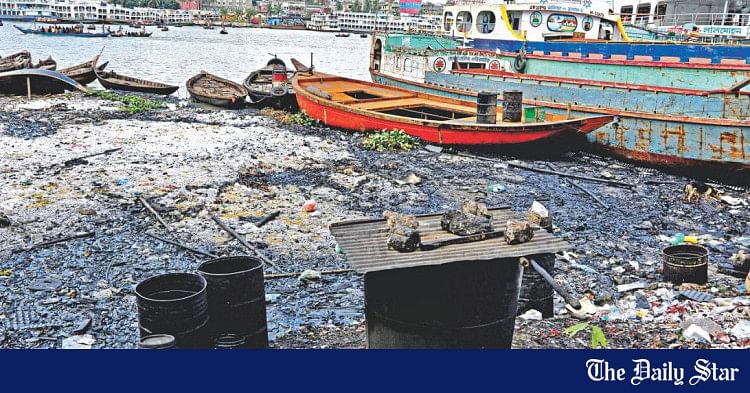

Once a vital lifeline for Dhaka, the Buriganga River now faces severe pollution from chemical waste, medical disposal, and plastic debris. FILE PHOTO: STAR
“>

Once a vital lifeline for Dhaka, the Buriganga River now faces severe pollution from chemical waste, medical disposal, and plastic debris. FILE PHOTO: STAR
Bangladesh’s industrial boom has propelled economic growth, but at what cost? Rivers that once sustained communities, such as the Buriganga and Shitalakkhya, are now some of the most polluted in the country. Industrial waste, textile dye effluents, heavy metals, and untreated sewage have turned these rivers into toxic cesspools, posing serious threats to public health and biodiversity. The Buriganga alone absorbs 21,600 cubic metres of toxic waste daily, mainly from tanneries, textile mills, and chemical factories, according to a study presented at the IICSD conference in 2015. With no robust wastewater treatment infrastructure, the challenge of industrial pollution looms large. However, an emerging technology called CO2 mineralisation offers a game-changing solution that not only captures industrial CO2 emissions but also neutralises harmful contaminants before they reach our lives.
CO2 mineralisation is a form of carbon capture, utilisation, and storage (CCUS) that converts captured CO2 into stable carbonates through reactions with alkaline industrial byproducts like cement kiln dust, steel slag, and fly ash. This process permanently stores CO2 in solid form, preventing it from re-entering the atmosphere, while also neutralising harmful contaminants in industrial wastewater. The result is a dual benefit: reducing emissions and mitigating water pollution.
 For all latest news, follow The Daily Star’s Google News channel.
 Globally, companies like Holcim, CarbonCure, and Carbon Clean are pioneering large-scale CO2 mineralisation projects. These initiatives have demonstrated that the technology is not only effective, but also economically viable. Bangladesh has already explored carbon credit markets, selling 2.53 million carbon credits worth $16.25 million since 2006. Integrating CO2 mineralisation into its industrial zones could unlock both environmental and financial rewards for the country.
The textile and tannery industries, which drive much of Bangladesh’s economy, are also among the biggest sources of pollution. In areas like Hazaribagh and Savar in Dhaka, leather processing releases highly toxic substances, including chromium, sulphides, and acids, directly into the Buriganga River. CO2 mineralisation can neutralise these hazardous chemicals by introducing CO2-reactive alkaline materials that convert them into non-leachable, harmless compounds, preventing further contamination. A similar approach can be applied to wastewater from textile dyeing, which is often laden with sulphates, phosphates, and heavy metals. Through CO2-induced precipitation, these toxic substances can be removed before they are discharged, significantly reducing water pollution. This aligns with successful global initiatives like CarbonCure’s concrete technology, which injects CO2 into concrete mixtures to enhance durability while reducing emissions.
CO2 mineralisation not only cleans wastewater but also repurposes industrial waste into valuable materials. Bangladesh’s cement and steel factories generate large amounts of slag, fly ash, and kiln dust, all of which can store CO2 permanently. Instead of accumulating hazardous waste, these materials can be converted into carbonate-rich products, providing a sustainable alternative to traditional construction materials. This approach is used in Canada, where captured CO2 is infused into concrete, strengthening the materials while permanently sequestering carbon. Adopting this method in Bangladesh could significantly reduce the cement industry’s carbon footprint and address the country’s growing industrial waste problem.
One of the biggest concerns surrounding CO2 mineralisation is its high initial cost. However, Bangladesh can offset these costs by leveraging its carbon credit market, which has already shown success in renewable energy projects. Incorporating CO2 mineralisation into its industries could generate millions of dollars annually from carbon offset sales under mechanisms such as the Clean Development Mechanism (CDM) and Article 6 of the Paris Agreement. Additionally, international climate finance, including grants from the Green Climate Fund (GCF) and loans from the World Bank, could provide the funding necessary for pilot projects and full-scale implementation. Public-private partnerships (PPPs) could also facilitate financing the transition. Beyond financial incentives, repurposing industrial byproducts into construction-grade materials could create new revenue streams for businesses, reduce dependency on imported building materials, and promote sustainable infrastructure development.
The environmental and social benefits of CO2 mineralisation are equally compelling. Restoring cleaner rivers would improve public health by reducing exposure to toxic pollutants. Fishermen, farmers, and communities that rely on these waterways would regain access to cleaner water sources, improving livelihoods. The reduced carbon footprint of major industries would contribute to Bangladesh’s climate commitments, helping the country emerge as a leader in sustainable industrial practices.
Unfortunately, despite its enormous potential, CO2 mineralisation in Bangladesh faces several obstacles. The high initial investment required for implementation, coupled with a lack of supportive policy frameworks, hinders its adoption. Additionally, many industries remain unaware of the economic and environmental benefits of this technology, creating a gap in awareness and willingness to invest. However, the landscape is shifting. The Bangladesh Climate Change Trust Fund (BCCTF) and international initiatives like the Green Climate Fund (GCF) are potential sources of financing that could help bridge the cost gap. Furthermore, the growing global interest in carbon trading markets could provide the financial incentives needed to encourage industries to integrate CO2 mineralisation into their waste management strategies. Countries like Norway and the Netherlands have already established carbon trading programmes, proving that emissions reductions can be monetised. If Bangladesh follows a similar path, it could turn CO2 reduction into an economic asset while simultaneously improving its environmental footprint.
Bangladesh’s industrial success does not have to come at the expense of environmental health. CO2 mineralisation offers a revolutionary approach to transform pollution into progress, providing a pathway to cleaner rivers, reduced carbon emissions, and new economic opportunities. Technology exists and funding mechanisms are within reach. The only question that remains is: how soon will Bangladesh take action?
Akash Talapatra is a PhD student at Virginia Tech in Virginia, US.
Views expressed in this article are the author’s own.
Follow The Daily Star Opinion on Facebook for the latest opinions, commentaries and analyses by experts and professionals. To contribute your article or letter to The Daily Star Opinion, see our guidelines for submission.