
Aligning spectrum costs with Asia-Pacific benchmarks could enable Bangladesh to achieve 17 per cent faster internet speeds and expand 5G coverage to 99 per cent of the population by 2035, a new study says.
A spectrum fee is what mobile operators pay to use radio frequencies for 2G, 3G, 4G, and 5G services.
The report titled “The Impact of Spectrum Pricing in Bangladesh”, released by the GSMA in Dhaka on Wednesday, estimates that such reforms would generate an additional US$34 billion in GDP between 2025 and 2035.
GSMA is a global industry organisation that represents mobile operators, device makers, and other companies in the mobile ecosystem.
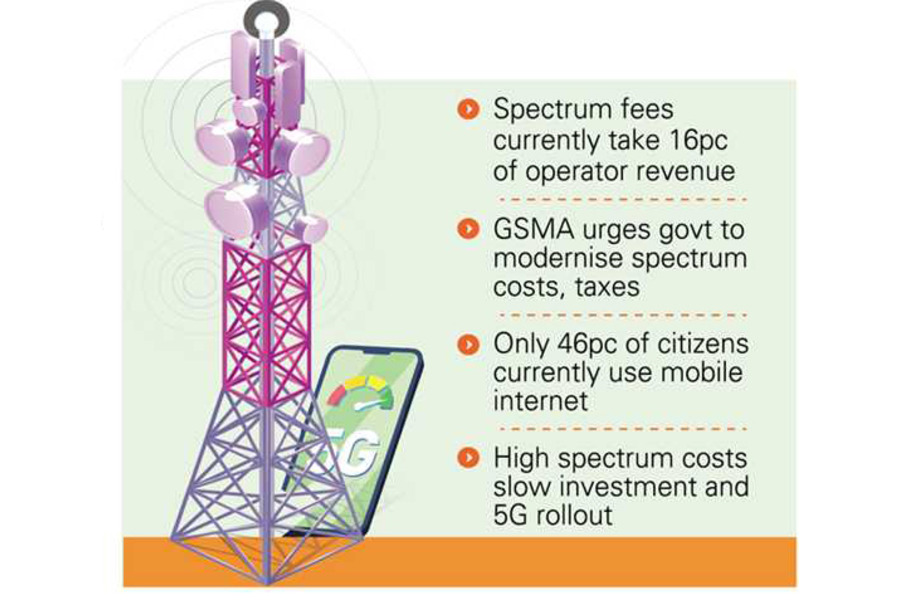
At present, spectrum fees alone consume around 16 per cent of operators’ recurring revenue – significantly higher than the Asia-Pacific median of 10 per cent and the global median of 8.0 per cent.
When revenue-sharing, universal service contributions, sector charges and consumer taxes are added, the total fiscal burden rises to an unprecedented 55 per cent of market revenue, one of the highest worldwide.
The GSMA cautioned that if spectrum renewals in 2026 and future band allocations continue at current rates, costs could rise to 21 per cent of operators’ revenue by 2035. This would likely force operators to cut back on investment, slowing internet speeds, delaying 5G expansion and even leading to the return of spectrum already in use.
By contrast, the study found that lowering spectrum costs to align with global medians could deliver far stronger outcomes. A 75-percent reduction could increase 4G speeds by 22 per cent and generate an additional $45 billion in economic value.
Despite Bangladesh’s near-universal 4G coverage, with 99 per cent of the population under network reach, only 46 per cent of citizens currently use mobile internet. Average monthly usage stands at just 5 GB per connection, far below regional levels.
As smartphone adoption accelerates, networks risk falling behind demand unless spectrum pricing and tax structures are modernised.
The report was launched in the presence of Faiz Ahmad Taiyeb, special assistant to the chief adviser on the Ministry of Posts, Telecommunications and Information Technology; Abdun Naser Khan, secretary of the Posts and Telecommunications Division (PTD); Maj Gen Md Emdad Ul Bari, chairman of the Bangladesh Telecommunication Regulatory Commission (BTRC); Md Jahirul Islam, additional secretary (Telecom), PTD; Mahmud Hossain, commissioner (Spectrum), BTRC; and Julian Gorman, head of Asia Pacific, GSMA.
“Mobile connectivity is the oxygen of Bangladesh’s digital ambition,” said Mr Gorman.
He added, “Yet operators here face one of the highest burdens globally on spectrum and sector-specific taxes. Affordable, predictable pricing and modernised licence terms are essential to expand affordable coverage and power the trillion-dollar economic vision.”
The GSMA stressed that reducing spectrum prices would not necessarily weaken public finances, as stronger connectivity and economic growth would ultimately boost tax revenues.
It urged policymakers to reset pricing to reflect market fundamentals, prioritise release of the 700 MHz and 3.5 GHz bands, streamline sector levies and device duties, and guarantee longer licence terms to cut investment risk.
The association reaffirmed its readiness to work with the government and industry stakeholders to ensure spectrum policy acts as a catalyst, not a constraint, supporting Bangladesh’s aspiration to achieve upper-middle-income status by 2031.
bdsmile@gmail.com