
The country’s economy is slowing, driven by worsening law and order, reduced private sector credit flow, uncertainty in industrial energy supply, stalled investments, and pervasive corruption. Implementation of the Annual Development Programme (ADP) now relies almost entirely on loans, and without stronger revenue generation, the economy risks a severe downturn.
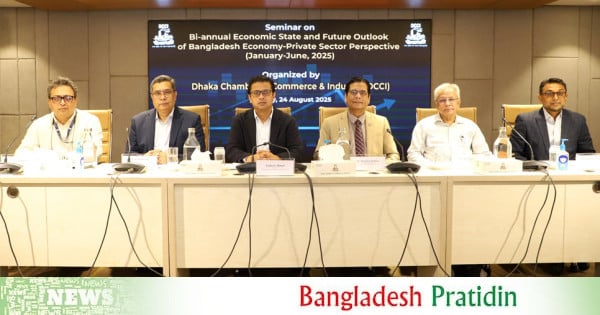
These concerns were expressed by speakers yesterday at a seminar titled “Current State and Future Outlook of Bangladesh’s Economy from the Perspective of the Private Sector”, organized by the Dhaka Chamber of Commerce and Industry (DCCI).
The seminar was chaired by DCCI President Taskeen Ahmed, and attended by notable figures including Dr. Manjur Hossain, Member (Secretary) of the Planning Commission; Dr. Mustafizur Rahman, Distinguished Fellow of the Centre for Policy Dialogue (CPD); Dr. A.K. Enamul Haque, Director General of the Bangladesh Institute of Development Studies (BIDS); Mahmud Salahuddin Naser, Director (Research, Monetary Policy Department) at Bangladesh Bank; Naushad Mustafa, Director (SME & Special Programs Department); and Md. Rabiul Islam, Economic Officer of the South Asia Department at the Asian Development Bank (ADB).
The DCCI President said that private investment has fallen to 22.48% of GDP in the 2025 fiscal year, the lowest in the last five years. In such a situation, restoring investor confidence requires stability in the banking sector, political stability, and the removal of bureaucratic bottlenecks.
He also noted that in terms of international trade, Bangladesh’s exports have declined by 3.09%, while imports have increased by 46.8%. Interest rates have also risen—from 11.52% in June 2024 to 12.11% in May 2025. He emphasized that the National Board of Revenue (NBR) must become more proactive in increasing tax collection. However, such initiatives are not visible, and instead, harassment of businesses has increased significantly.
Dr. Manjur Hossain said that economic growth has slowed down, and in this situation, there is no alternative to increasing credit flow to the private sector. The government views LDC (Least Developed Country) graduation as a positive development, but attention must be paid to overall preparedness. While various government agencies are undertaking preparatory activities for LDC graduation, private sector readiness is equally essential.
Dr. Mustafizur Rahman said that ADP implementation is now entirely debt-financed, which is not a sustainable approach. Therefore, domestic savings and tax revenue collection must be significantly increased. Although economic zones and infrastructure are developing, services like connectivity and logistics are still lagging behind.
Dr. A.K. Enamul Haque mentioned that in the Sylhet white stone (sada pathor) scandal, transactions worth 10,000 crore taka took place—outside the banking system. He said corruption has not really decreased, and to save the economy, a firm stand against corruption is essential. Merely transferring corrupt officials is not enough—a change in mindset is required. With only 2.3 million taxpayers, the country cannot progress much farther. Therefore, expanding the taxpayer base is crucial. He criticized the NBR for being more interested in harassment than in increasing taxpayers.
Mahmud Salahuddin Naser said that although the central bank’s current monetary policy is considered tight by the private sector, efforts are being made to create a more favorable environment for private businesses. He added that energy shortages and deteriorating law and order are also major reasons why investment is not coming in as expected, and high interest rates alone cannot be blamed.
Bd-pratidin English/ ANI