
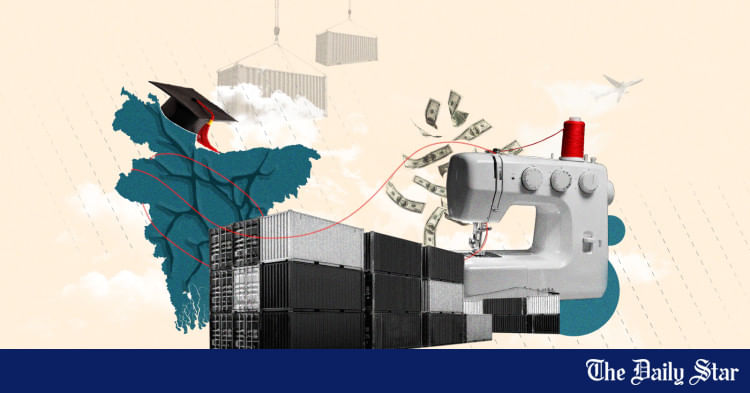

‘Bangladesh can either continue to wobble on one leg, hoping that the ground beneath it never shifts, or it can learn to stand on two, three, even four legs, spreading its weight, balancing its risks.’ VISUAL: SHAIKH SULTANA JAHAN BADHON
“>

‘Bangladesh can either continue to wobble on one leg, hoping that the ground beneath it never shifts, or it can learn to stand on two, three, even four legs, spreading its weight, balancing its risks.’ VISUAL: SHAIKH SULTANA JAHAN BADHON
Bangladesh likes to tell the world that it is marching towards middle-income prosperity. The numbers, at first glance, seem to prove the point. About $30-40 billion worth of garment exports annually over the last few years. Millions of workers—mostly women—lifted out of poverty. A name etched on the global textile map. But scratch the surface, and the shine begins to fade. This is not the story of a balanced economy, but of one standing on one leg, wobbling under the weight of its own success.
The RMG sector has undoubtedly been a blessing for the country. But it has also become a curse. Today, more than 80 percent of the country’s total export earnings come from one industry alone. When products from one sector, sold to a handful of buyers, underwrite your entire economy, what you have is not resilience, it is exposure.
 For all latest news, follow The Daily Star’s Google News channel.
 Exposure to whom? To the West, primarily. The United States and the European Union together absorb the lion’s share of Bangladesh’s exports. They know it, and they use it. Market access comes wrapped with conditions: improve labour rights, clean up environmental practices, reform your politics. These demands sound noble—and often they are—but in practice they function as pressure points. When Washington or Brussels wants something, it can reach straight into the heart of Bangladesh’s economy and twist.
And if that weren’t enough, the supply chain has its own irony. Bangladesh sources most of its raw materials and machinery from China. But the finished products are shipped to the very markets that are not friendly to Beijing. That means Bangladesh is caught in the middle: dependent on China to produce, dependent on the West to sell. As the world polarises, Dhaka is left to juggle its diplomatic relations.
Graduation from the Least Developed Country (LDC) status adds yet another complication. The tariff cushions that sheltered exports for decades are about to disappear. Once those vanish, Bangladesh will find itself in direct competition with Vietnam, India, and Indonesia—countries that did their homework and diversified their export portfolios. While they built resilience, Bangladesh kept its eggs in one basket and called it development.
The consequences are already visible. When the US recently reduced tariffs, it was not an act of generosity. It was a transaction. In return, Bangladesh agreed to buy more American agricultural goods and aircraft. That is what happens when your economy is one-dimensional: your bargaining power collapses, and trade deals start to look more like ultimatums.
Economists have been warning for decades about the dangers of overreliance on the RMG sector. Successive governments have pledged diversification. Leather was touted as the next big thing. Frozen food once had promise. Agro-processing, IT services, pharmaceuticals, light engineering—all carried potential. But none of these have been allowed to grow into true counterweights. Risk aversion and policy inertia kept everything else stunted.
The private sector is not without blame either. Too many entrepreneurs chose the comfort of garments over the challenge of new ventures. The profits were immediate, the risks minimal, the model already tested. Instead of spreading capital across industries, they funnelled it into the same familiar ground. Short-term gain became long-term vulnerability.
The irony is that the government even had a ready-made diversification plan. Back in 2017, the World Bank-backed Export Competitiveness for Jobs (EC4J) project was launched with a clear mandate: strengthen leather, footwear, plastics, and light engineering, and create 90,000 jobs. Since then, the project has become a case study in slow motion. Delays in land acquisition. Delays in procurement. Blame passed from one desk to another. Meanwhile, costs ballooned from Tk 941 crore to Tk 1,264 crore, thanks partly to exchange rate changes. And what has happened to export dependence in all this time? It has increased: from 81.23 percent in FY17 to 81.49 percent in FY25. A project meant to diversify has coincided with even greater concentration.
Officials sound optimistic. Construction is nearly complete, tenders will be floated, machinery will be installed. Technology centres in Gazipur, Chattogram and Munshiganj will finally emerge. But even if they do, the delay has cost the country dearly. Each year wasted means more loans to repay in devalued local currency. Each year wasted means fewer industries developed before LDC graduation. Each year wasted means the RMG sector increasingly becomes the only pillar holding up the economy.
This is the paradox of Bangladesh’s growth story. The very sector that powered its rise is now the lever others can pull at will. Garments gave jobs, dignity, and foreign exchange—and also dependency, vulnerability, and imbalance. It is no longer a question of whether diversification is desirable. It is a question of whether survival without diversification is even possible.
The way forward is not to abandon the RMG sector. That would be folly. The industry will remain central to the country’s economy for decades to come. The task is to build alongside it. Higher-value apparel products, technical textiles, IT-enabled services, pharmaceuticals, agro-processing, renewable energy technologies—all need investment, policy attention, and export promotion. And just as importantly, the export map must shift. The West will remain vital, but Asia, Africa, and the Middle East must be turned into real markets, not afterthoughts.
The window is closing fast. Graduation from the LDC status is not a distant prospect anymore—it is imminent. Tariff shields will fall away. Climate compliance will become a trade condition, not an option. Buyers will tighten standards on governance, labour rights, and carbon footprints. In this new world, a country that depends on one product and two buyers is not a rising economy; it is a hostage waiting to be taken.
Bangladesh has two choices. It can continue to wobble on one leg, hoping that the ground beneath it never shifts. Or it can learn to stand on two, three, even four legs, spreading its weight, balancing its risks. The time for promises and plans is over. Diversification is not an agenda item; it is an existential demand. Without it, Bangladesh’s much-celebrated strength may yet prove to be its greatest weakness.
H.M. Nazmul Alam is an academic, journalist, and political analyst, currently teaching at the International University of Business Agriculture and Technology (IUBAT). He can be reached at [email protected].
Views expressed in this article are the author’s own.
Follow The Daily Star Opinion on Facebook for the latest opinions, commentaries and analyses by experts and professionals. To contribute your article or letter to The Daily Star Opinion, see our guidelines for submission.