
The country’s small and medium enterprise (SME) sector is facing severe pressure due to economic strain, market uncertainty, and financing challenges, with many entrepreneurs reporting a significant drop in sales and an inability to sustain physical operations.
TBS spoke with around 40 entrepreneurs at the National SME Product Fair, with almost all confirming a recent drop in business due to economic pressure, market instability, and a severe financing crunch, leading many to write off 2025 but look to 2026 as a potential year for recovery.
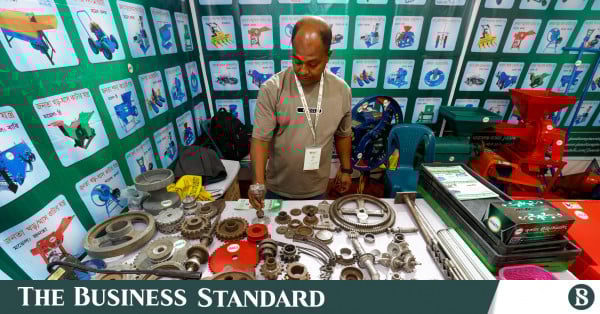
The SME fair, organised by the SME Foundation, which began at the Bangladesh-China Friendship Conference Centre in Dhaka’s Agargaon on 7 December, featuring over 350 SME enterprises, with nearly 60% of participants being women entrepreneurs, will continue until 14 December.

Toll of economic stress
The difficulties facing the sector were highlighted by Mahmuda Akter, founder of AM Fashion, who was forced to close her Uttara showroom in early 2024 after nine years in business.
Speaking at the National SME Product Fair in Dhaka’s Agargaon, she explained to TBS that rising costs – particularly showroom and staff rent – made the business unsustainable after a strong run following the Covid-19 pandemic.
“My business has shrunk by more than half,” Mahmuda stated, attributing the decline to reduced purchasing power among consumers whose incomes have not kept pace with rising overall living expenses. She also suggested that the political climate had led to a group of high-spending consumers leaving the country, impacting high-end purchases.
Another major constraint is access to finance. Mahmuda, who previously paid off a Tk10 lakh bank loan, has struggled for months to secure a new Tk15 lakh loan amid the current downturn.
Other entrepreneurs echoed these sentiments. Elora Parvin, owner of Bahari Rong, noted that sales are “very low,” saying, “Many acquaintances have closed shop. Some are barely surviving online.” She added that even the sales at the ongoing fair have been disappointing.
Shahina Akhter, owner of AEgis Shield, from Chattogram, agreed that business has worsened, suggesting that people are withholding cash amid market uncertainty. “If the political situation stabilises, business might turn around,” she said.
Sectoral challenges and policy gaps
Rubina Akter Munni, owner of Design by Rubina, highlighted bureaucratic complications with VAT, compliance, and trade licensing. She noted that after moving her factory to Gazipur, it took two months and two different lawyers to secure a trade licence because officials “do not understand SMEs.”
Several entrepreneurs, including Shahina Akhter, pointed out that the SME ecosystem is almost entirely Dhaka-centric, forcing those outside the capital to incur significant time and cost to access training, supplies, and official processes.
Zuena Ferdous Mitul, owner of Ahllad Fashions and winner of this year’s Micro Category Best Entrepreneur Award, stressed the need for better training to align products with international standards and criticised the documentation complexities that deter exports.
Jannatul Maoya, an entrepreneur focusing on premium tea and women’s economic empowerment, identified the biggest challenges for female entrepreneurs as a lack of family support, capital crises, and licensing issues.
SME Foundation Acknowledges Constraints
Anwar Hossain Chowdhury, managing director of the SME Foundation, admitted the significant challenges, especially concerning finance. He stated that access to finance remains a major hurdle for grassroots entrepreneurs, particularly women and new entrants in rural areas, who are often denied support due to documentation issues, skills gaps, and the “unwillingness of bankers.”
He said that the Foundation’s own fund is limited, starting at Tk200 crore in 2007. While partnerships with banks offer interest support, he conceded that “very few genuine grassroots entrepreneurs benefit.” Anwar also noted the difficulty of reaching distant regions due to the Dhaka-centric setup and a lack of regional centres.
He called for policy support for backward linkages, as small entrepreneurs struggle to source quality domestic raw materials as large industries do.
Sector importance and optimism
According to the Bangladesh Economic Survey 2024, the SME sector contributes around 30% to the national GDP and 37.95% to the industrial sector participation. However, the SME Foundation points out that this is considerably lower than in neighbouring countries like India (around 45%) and Vietnam (40%).
The Foundation believes that with proper financing and technological support, the contribution of SMEs in Bangladesh can be significantly increased.
Despite the current difficulties, there is a cautious optimism. Hasina Mukta of Natunatta Boutique and Handicrafts said that interim government steps to support businesses may yield positive results next year, following the expected February elections.
Rubina Akter Munni of Design by Rubina believes that 2026 could be a significant opportunity for the sector, especially for leather, jute, and ceramics.