
Muhammad Mahmood
| Published: February 22, 2026 20:55:29
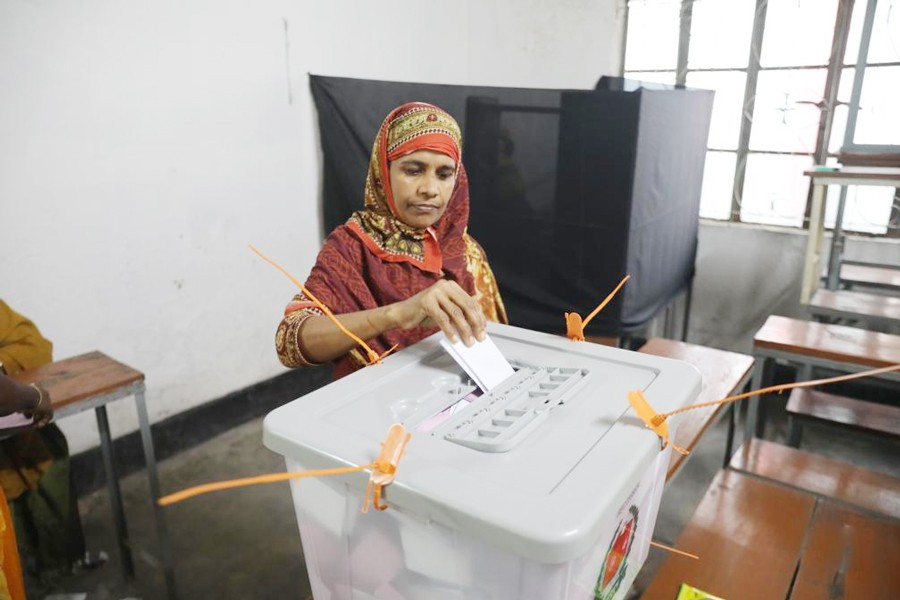
The Bangladesh Nationalist party (BNP) has won a landslide majority in the country’s election held on February 12, 2026, following an uprising that ended the 15-year rule of Sheikh Hasina in 2024. In the interim period, a transitional government headed by Professor Mohammad Yunus ran the country. To its credit, the interim government was able to hold a fair and free election.
Results from the Election Commission confirmed that the BNP alliance had secured 212 of the 297 parliamentary seats announced so far. Jamaat-e-Islami, which was banned by Hasina’s government, came second with 77 seats along with its coalition partners and left-oriented parties were decimated. Only seven women will sit in parliament from the nationally contested seats.
Unlike the 2001-2006 era, the BNP and the Jamaat contested the election as bitter rivals. The Jamaat now occupies the position of the principal opposition party in parliament, a position it never held in Bangladesh’s history. In fact, the Jamaat has been able to build a hegemonic influence with unprecedented institutional recognition. Despite the opposition Jamaat-e-Islami positioning itself as a vehicle for change, voters ultimately placed their trust in the Bangladesh Nationalist Party (BNP) – a party firmly rooted in the country’s political establishment.
The BNP won the election not because it inspired the nation, but it knew how to use the arithmetic of first-past-the post system as well as able to use the intricate patronage networks to its advantage. For rural voters in Bangladesh the patronage networks offer safety net, jobs, stability and avenues for dispute resolution. The interplay of patron-client relationship is starkly evident in that voters opted for existing elites at the expense of the Gen Z, which is now at the fringe of Bangladesh political scene and dispersed across incompatible political vehicles.
Held alongside Bangladesh’s parliamentary election was a referendum on sweeping constitutional reforms rooted in the anti-corruption and pro-democracy demands that fuelled the mass protests of 2024. The BNP is now dragging its feet on constitutional reform- to which most Bangladeshis have since given their assent through the referendum – on the excuse that the Referendum and proposed reforms have no constitutional backing. As such its MPs did not take oath on the constitutional reforms.
Michael Kugelman, a Senior Fellow at the Atlantic Council said in an interview, “If the party (BNP) is truly ready to break with the past, and show that it’s no longer a reflection of the old politics that so many Bangladeshis deplore and want expunged, then it will implement the reforms. This is especially the case since the public gave the reforms such a ringing endorsement in the referendum vote”.
Leader of the opposition and Jamaat chief Shafiqur Rahman on Feb 17 said not taking oath as a member of the State Reform Council is tantamount to dishonouring ‘July 2024’. He further added ‘it was because of July that this election was held, and Tarique Rahman became the Prime Minister, and I became the Opposition Leader’.
The voting marked a significant political shift in Bangladesh, a country of more than 170 million people. Polls offered Bangladesh a rare window to democratic transformation. The 2026 vote marked a qualitative improvement over Bangladesh’s previous elections. According to the Bangladesh Election Commission, the BNP Alliance received 49.97 per cent and the Jamaat Alliance received 34.08 per cent of total votes cast. But the BNP won 71 per cent of parliamentary seats despite receiving 50 per cent of votes. The National Citizen Party (NCP) which is comprised of student protest leaders, won 6 seats out of 30 seats contested (20 per cent) will likely play a robust role in the opposition. Given a highly polarised political environment in the country, that is a significant achievement for the NCP.
Bangladesh has long been characterised by dynastic power politics and cronyism. The concentration of power has been a recurring theme in Bangladeshi politics. For decades, Bangladesh had few political alternatives. Besides periods of military rule, the country has been dominated by two political dynasties: one led by late Begum Khaleda Zia, wife of former president Ziaur Rahman and mother of the current prime minister, and the other by her rival, Sheikh Hasina, daughter of Sheikh Mujibur Rahman, the founding president of the country. Hasina is now a death row convict.
Tarique Rahman, the BNP leader who spent 17 years living in self-exile in London, assumed the leadership of the government on February 17. Rahman is the son of the former president and BNP leader, Ziaur Rahman, and his wife Khaleda Zia, who previously served three terms as the country’s prime minister.
A strong mandate does not automatically generate stability. The central political question now is whether the BNP could reinvent itself after years defined by corruption allegations and confrontational politics. Also, failure to break with old patronage networks could rapidly erode public trust. 41 out of 50 cabinet members have crores of taka assets and that will worry many about the direction of the new government.
The new policy direction is important now because political stability based on a well-functioning democratic process is the most essential prerequisite for the government to not only attain political stability but to attain ability to reform and revive the economy. Major economic risks facing Bangladesh include political instability, rising import and living costs, unemployment and inflation, climate vulnerability and debt, and a weakened governance framework.
A defining feature of the election was that the interim administration banned Hasina’s party, the Awami League (AL) from contesting. The AL remains one of the largest political forces in the country as such many argue that the race was not entirely pluralistic. But banning political parties involved in terrible human right violations is not new. The National Socialist German Workers’ Party commonly known as the Nazi Party, was a far-right political party in Germany that operated between 1920 and 1945 under the leadership of Adolf Hitler. This party was involved in terrible human right violations but following Germany’s defeat by the Allied forces in 1945, the Nazi Party was banned and declared a criminal organisation. Today, the use of Nazi symbols is prohibited in Germany and Austria. The National Fascist Party of Italy was a political party in Italy created by Benito Mussolini. The party ruled Italy from 1922 to 1943. Italian Fascism was very similar to Nazism in its ideological orientation. The party was officially dissolved and banned by the Constitution of Italy and clearly stated, “It shall be forbidden to reorganise, under any form whatsoever, the dissolved fascist party.”
Whether similarities exist between the AL with those two parties need further discussion. But it is evidently clear that the AL under Hasina was fundamentally a reincarnation of the BAKSAL, a one-party dictatorial system introduced by her father in 1975. During her 15-year rule (2009-24) she exercised significant power which led to high levels of white-collar crimes and extensive financial corruption. She also ran a brutal repressive regime marked by unlawful killings, enforced disappearances, and brutal repression of dissent. Her regime for all practical purposes was run like a criminal syndicate. Yet surveys suggest that 5-7 per cent of voters remain staunchly loyal to the AL and they will never defect.
For decades, Bangladeshi politics has centred around rivalry between the AL and the BNP. Both the parties belong to the political right as well as the Jamaat. Removing the AL from the ballot fundamentally altered the competitive landscape. Whether the Awami League’s absence is temporary or prolonged will shape Bangladesh’s future political stability. The BNP holds a powerful parliamentary mandate. But the scale of its victory should not be mistaken for unconditional endorsement.
Prime Minister Rahman in his televised address on February 18 highlighted the challenges faced by the new administration, which include a fragile economy, weak governance structures, and deteriorating law and order left behind by previous authoritarian rule, and widespread corruption. He further added that restoring peace and security through improved law and order and strict anti-corruption measures would be the foremost priority of his government.
During the election campaign corruption was suddenly back in the headlines. Corruption did not suddenly appear. It has been embedded in the country’s economic and political system for decades reinforced by the patron-client relationship in Bangladesh politics. Bangladesh tends to languish near the bottom of corruption-watchdog Transparency International’s Corruption Perceptions Index.
The BNP victory at the election reflects a combination of structural and political factors. The newly formed government under the leadership of Tarique Rahman faces an uphill task restoring democracy, law and order, and stimulating economic growth. Furthermore, the spirit of the July revolution which underscores a strong desire for political change continues to resonate throughout the society. That will require the government to embrace the referendum verdict, both in letter and spirit. This will also create pressure for the new government to pursue cleaner and more open governance.
muhammad.mahmood47@gmail.com