
As voters prepare to go to the polls in February 2026, hopes are rising that democracy will reignite Bangladesh’s economic momentum. This optimism may be misplaced unless elections are followed by tough, politically costly reforms in banking, taxation, and governance
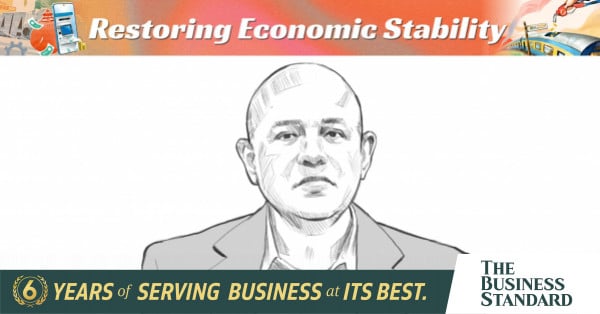
Dr KAS Murshid, former director general, Bangladesh Institute of Development Studies (BIDS). Sketch: TBS
“>

Dr KAS Murshid, former director general, Bangladesh Institute of Development Studies (BIDS). Sketch: TBS
Bangladesh stands at a critical juncture. Parliamentary elections scheduled for 12 February 2026 arrive amidst a period of extraordinary political turbulence and economic stress. Following the student-led uprising that removed Sheikh Hasina from power, the interim government has managed to stabilise certain macroeconomic indicators, yet the country’s economic trajectory remains profoundly worrying.
Real GDP growth has moderated sharply to around 4% in FY2025, significantly below the historical average that once positioned Bangladesh as a development success story. General inflation, though marked significant fall in recent months, has still remained well above 8%, whilst private investment has fallen to 22.48% of GDP, its lowest level in five years. These numbers paint a sobering picture of an economy in distress.
The forthcoming elections are widely anticipated to restore democratic legitimacy and, by extension, catalyse economic recovery. The electoral process will include a referendum on state reforms known as the July Charter, which proposes curbing executive powers, strengthening judicial independence, and enhancing Election Commission autonomy. These are laudable objectives that speak to fundamental governance deficiencies. However, the critical question remains whether credible elections alone can arrest Bangladesh’s economic decline and set the stage for renewed growth. The answer, regrettably, is more nuanced than many would hope.

The relationship between elections and economic performance in developing countries has been the subject of considerable scholarly inquiry. Research demonstrates that electoral processes exert both structural and cyclical effects on economic policy. The structural effect operates through enhanced government accountability, potentially improving governance and policy quality over time. Elections, when conducted freely and fairly, create mechanisms through which citizens can discipline governments, rewarding competent management and punishing misrule. This accountability channel can, in principle, lead to superior policy choices and better developmental outcomes.

Moreover, the quality of elections matters enormously. Badly conducted elections have no structural efficacy for policy improvement. Indeed, infrequent or uncompetitive elections may actually worsen economic governance rather than enhance it. This suggests that whilst Bangladesh’s February polls represent a necessary step towards restoring democratic legitimacy, their impact on economic outcomes will depend critically on their credibility and the extent to which they genuinely enable accountability.
The relationship between political stability and economic growth adds another layer of complexity. Substantial research indicates that political stability, regardless of the level of democracy, exerts the greatest effect on a country’s economic growth. Yet this relationship is not linear. Recent scholarship suggests that excessive or extended stability might result in institutional sclerosis, where entrenched elites and stagnant policies hinder reform. Stability must be paired with institutional flexibility through electoral turnover and civic participation. Bangladesh’s challenge, therefore, is not simply to achieve stability through elections, but to construct durable institutions that can accommodate political change whilst maintaining policy continuity.
Turning to Bangladesh’s immediate economic reality, the picture is deeply concerning. Private sector credit growth fell to just 6.23 per cent in October, the lowest in four years, reflecting high interest rates, dollar shortages, and acute policy uncertainty. The interim government’s economic stabilisation has come at the cost of growth, investment, and the welfare of the poor. Whilst foreign exchange reserves have recovered somewhat and inflation has eased statistically, the economy remains in what could be characterised as a state of survival rather than recovery.
Perhaps most alarmingly, the non-performing loan ratio stood at 35.73 per cent of total disbursed loans as of September 2025, primarily due to recent scrutiny of several banks’ health by Bangladesh Bank. This represents years of weak regulation and political interference finally being exposed. The banking sector’s fragility poses systemic risks that cannot be addressed through elections alone, regardless of their credibility.
Bangladesh also confronts significant external pressures. The country faces the loss of Least Developed Country status in November 2026, which will gradually withdraw trade preferences covering approximately 70 per cent of total exports. Simultaneously, US tariffs on garments continue to constrain one of Bangladesh’s most important industries. These are structural challenges that require sophisticated policy responses extending far beyond the electoral cycle.
The temptation to believe that credible elections will resolve Bangladesh’s economic difficulties is understandable but misguided. Elections can send positive signals to investors and international partners. They can restore a measure of democratic legitimacy that has been sorely lacking. They may even generate psychological lift that temporarily improves business confidence. However, what Bangladesh requires is far more fundamental than a change in political leadership or even a restoration of democratic process.
The International Monetary Fund has emphasised that addressing Bangladesh’s challenges will require reforming the tax system to build a simple and fairer taxation environment and tackling financial sector vulnerabilities. These are not matters that can be accomplished through electoral mandate alone. They require sustained technical capacity, political will to confront powerful interests, and institutional independence from political interference. The question is whether any elected government will possess the combination of legitimacy, capacity, and courage to implement such reforms.
Many investors remain concerned that a future elected government could reverse current decisions, leading them to stay on the sidelines despite stabilisation efforts. This speaks to a deeper problem of policy credibility and institutional consistency. Bangladesh has historically suffered from what might be termed ‘business as usual’ approaches to economic management, characterised by politicised courts, weak banking regulation, and crony capitalism. The danger now is that elections, whilst changing the political personnel, may not fundamentally alter these underlying governance patterns.
What Bangladesh requires is not simply electoral legitimacy but a transformation in how economic policy is formulated and implemented. This means building genuinely independent regulatory institutions, particularly in the financial sector. It means constructing a tax administration that is both efficient and equitable, capable of mobilising domestic resources at levels commensurate with the country’s developmental needs.
The forthcoming polls represent a necessary but insufficient condition for Bangladesh’s economic revival. They may provide the political legitimacy required for difficult reforms, but legitimacy alone does not guarantee implementation. The real test will come after February, when the elected government confronts the fundamental question: will it resist the temptation to return to familiar patterns of patronage politics and short-term economic management? Can it implement the structural reforms that Bangladesh desperately requires, even when these reforms create short-term pain and antagonise powerful interests?
Bangladesh’s developmental journey over the past five decades has been remarkable in many respects, defying the dire predictions that accompanied independence. Yet the current crisis reveals vulnerabilities that have long been obscured by headline growth figures. The country faces a choice between genuine institutional reform and a return to the dysfunctional economic governance patterns of the past. Credible elections can create the political space for reform, but they cannot substitute for the hard work of building effective institutions and implementing sound policies. Bangladesh’s economic future depends not on the electoral moment itself, but on what follows in its wake.
The author is a former director general of the Bangladesh Institute of Development Studies (BIDS).