
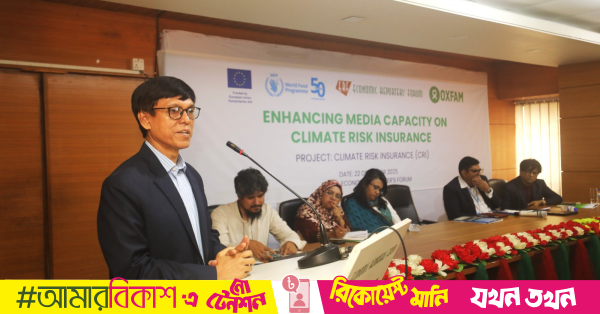
Organised by Oxfam in Bangladesh, the Economic Reporters’ Forum (ERF) and the World Food Programme (WFP) with support from the European Union, the workshop brought together senior economic and environmental journalists, alongside government regulators, climate change experts and CRI specialists, to deepen understanding of climate risk insurance and its role in protecting vulnerable communities. Photo: Courtesy
“>

Organised by Oxfam in Bangladesh, the Economic Reporters’ Forum (ERF) and the World Food Programme (WFP) with support from the European Union, the workshop brought together senior economic and environmental journalists, alongside government regulators, climate change experts and CRI specialists, to deepen understanding of climate risk insurance and its role in protecting vulnerable communities. Photo: Courtesy
As Bangladesh confronts increasingly frequent climate disasters, senior journalists, policymakers, and experts gathered in Dhaka today (22 December) for a workshop titled ‘Enhancing Media Capacity on Climate Risk Insurance (CRI)’, calling for climate risk insurance and stronger media engagement to inform the public and shape national policy on climate resilience financing.
Organised by Oxfam in Bangladesh, the Economic Reporters’ Forum (ERF) and the World Food Programme (WFP) with support from the European Union, the workshop brought together over 80 senior economic and environmental journalists, alongside government regulators, climate change experts and CRI specialists, to deepen understanding of climate risk insurance and its role in protecting vulnerable communities, reads a press release.
Bangladesh is among the world’s most climate-vulnerable countries. Between 2016 and 2020, the country faced repeated climate disasters that cost an estimated 1% of its GDP annually. Yet insurance penetration remains critically low — non-life insurance covers just 0.48% of GDP, leaving millions exposed to economic ruin from floods, cyclones, and droughts.

Dr M Aslam Alam, chairman of the Insurance Development and Regulatory Authority (IDRA), said, “Every year, people are losing their homes and livelihoods due to climate change. That’s why building strong social protection and sustainable insurance systems is absolutely critical. Traditional insurance relies on past losses, but climate risks are forward-looking — which calls for parametric or weather-based insurance.”
“To truly protect our citizens, we must take joint action to build a sustainable climate risk insurance system — this includes legal reform, robust databases, technology, and strong regulatory backing,” he added.
Recent pilots in Kurigram have demonstrated CRI’s promise in 2024; more than 20,000 flood-affected farmers received immediate mobile payouts under an index-based flood insurance scheme jointly led by WFP, Oxfam, and Green Delta Insurance Company. The product, calibrated with more than 40 years of flood data, offered relief within days — without the need for individual damage verification.
Husne Ara Shikha, executive director of Bangladesh Bank, said, ” As climate risks rise, financial institutions must evolve. Climate insurance can help absorb shocks and prevent poor households from falling into debt after disasters.” “Women are among the most at risk from the impacts of climate change. If we can support them in a timely manner during these times of crisis, we can protect countless livelihoods and unlock significant potential for the country,” she added.
Moderated by Md Sariful Islam, head of Influencing, Communications, Advocacy and Media, Oxfam in Bangladesh, journalists at the workshop received technical understanding on CRI models, data sources, and policy trends. Participants were encouraged to focus not only on post-disaster payouts but also on proactive solutions, fiscal protection, and justice-based narratives.
Norul Amin, programme policy officer at WFP Bangladesh, stressed the importance of fast, reliable instruments. “Climate-vulnerable families should not have to wait for aid or rely on uncertain humanitarian responses,” he said. “With CRI, we are embedding predictability into disaster response — and journalists have a vital role in making this known.”
The workshop also recognised the importance of translating technical mechanisms into public understanding. Doulot Akter Mala, president of the Economic Reporters’ Forum, said, “We economic journalists are the bridge between complex fiscal tools and public policy. It’s time we amplify stories of climate insurance not just as development pilots, but as financial justice for the people.”
Dr Mohammad Emran Hasan, head of Climate Justice and Natural Resource Rights at Oxfam in Bangladesh, said, “Bangladeshis living in climate hotspots did not create the climate crisis—but they pay the highest price. We must ensure it reaches the poorest, and media can drive that transformation.”
Nafisa Tasnim Khan, senior programme officer, Oxfam in Bangladesh and SM Saify Iqbal, climate policy specialist, Oxfam in Bangladesh gave a detailed presentation on climate change and CRI, while Fakhrul Islam Harun, special correspondent, Prothom Alo, reflected on the different reporting dimensions on insurance and CRI, sharing hands-on experience. Abul Kashem, general secretary, Economic Reporters’ Forum, gave an opening remark.