
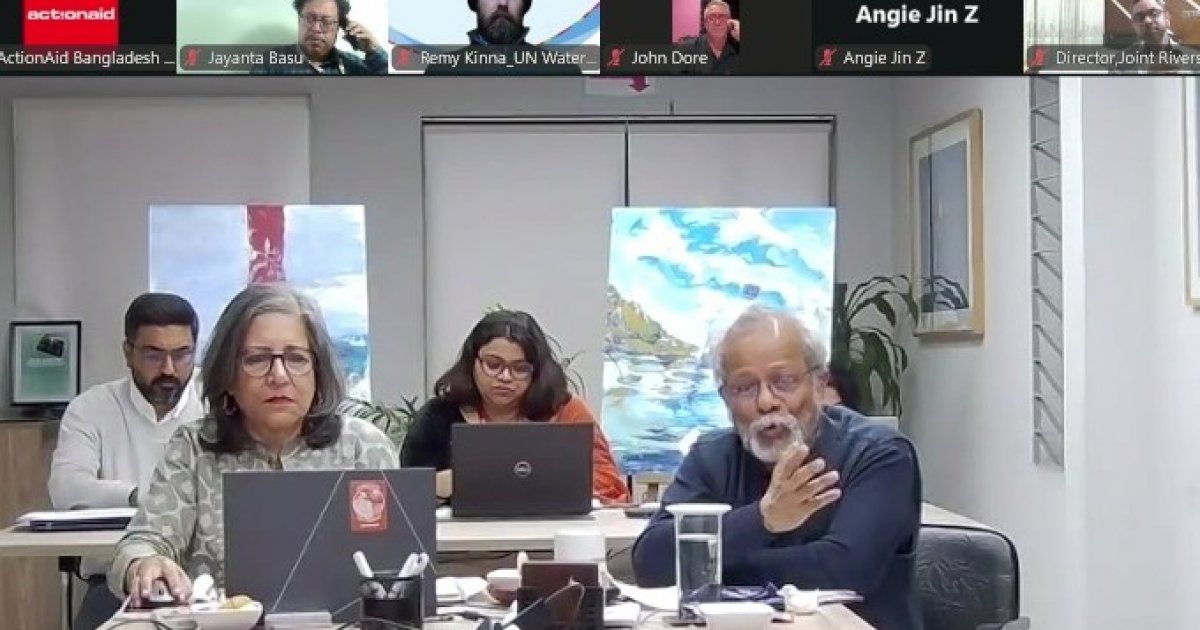
Global water experts and researchers on Thursday called for an end to the deepening “trust deficit” in South Asia’s transboundary water governance, stressing that transparent data-sharing and basin-wide cooperation are critical for the region’s survival amid accelerating climate impacts.
The call came on the concluding day of the 11th International Water Conference, a two-day virtual event titled “Reimagining Water Governance for Just and Sustainable Futures,” organized by ActionAid Bangladesh.
Speakers at the final session said traditional, state-centric water diplomacy has failed to keep pace with climate volatility and rising human vulnerability, urging a shift towards a “hydro-social” approach that prioritizes river health, environmental flows and shared accountability across borders.
Speaking at the conference, Farah Kabir, country director of ActionAid Bangladesh, warned that climate change has eroded long-standing water predictability, putting livelihoods and food security at risk.
“Water is changing faster than our systems are responding. We have lost predictability; how we plant, how we harvest, and how we live is at risk. Climate justice is not only an environmental issue; it is fundamentally a justice issue,” she said, calling for a move “from borders to bridges”.
The session on Transboundary Water Accountability, moderated by Professor Imtiaz Ahmed, executive director of the Centre for Alternatives, underscored the limitations of conventional diplomacy.
He advocated a post-disciplinary approach bringing together hydrologists, social scientists, activists and young professionals.
“If we can build a critical mass of people who see water beyond borders, we can move towards a truly cooperative South Asian framework,” he said.
Emphasizing the role of credible information, Dr Jayanta Basu of Calcutta University said data transparency is essential to rebuilding trust in geopolitically sensitive river basins.
“Data gives clarity and sanity. We must rely on shorter, more relevant data cycles rather than 50-year-old records that no longer reflect today’s climate realities,” he said.
Mohammad Abu Sayed, director of Bangladesh’s Joint Rivers Commission, stressed the need to move beyond narrow water-sharing debates.
“We often forget the most important stakeholder — the river itself,” he said, adding that basin-wide cooperation is essential to ensure environmental flow and water security for millions dependent on the Teesta and Ganges systems.
From a global legal perspective, Remy Kinna of the UN Water Convention Secretariat described Bangladesh’s accession to the convention as a “powerful signal” for transparency and cooperation, enabling countries to learn collectively and institutionalize accountability.
Drawing lessons from the Mekong River Commission, John Dore of Australia’s Department of Foreign Affairs and Trade highlighted the importance of multi-track engagement involving governments, researchers, civil society and youth.
The conference concluded with a call to institutionalize seasonal data-sharing protocols and establish a regional water school, alongside community-led initiatives to keep affected populations at the center of water governance.
During the closing day, a digital exhibition of water museums was showcased in collaboration with the Global Network of Water Museums. The exhibition featured Morocco’s Oasis Eco-Museum alongside Bangladesh’s first-ever water museum — also the first of its kind in Asia.
The event also highlighted the deep relationship between rivers, culture and human life through a special theatre performance on water by the girls of Happy Home, accompanied by other artistic presentations.
The session was attended by Dr Mansee Bal Bhargava, national president of the Water Resources Council of the Women’s Indian Chamber of Commerce & Industry (India); Fayyaz Baqir, director of Pakistan’s Akhtar Hameed Khan Resource Centre; and Dr Zhang Jin, associate professor at Shanghai Normal University (China), along with more than 100 river experts, researchers, policymakers and climate advocates from several countries.