

Illustration: Oishik Jawad
“>

Illustration: Oishik Jawad
“I will not tolerate any kind of corruption and irregularity. My goal is to ensure transparency and accountability in all areas, including government procurement,” Prime Minister Sheikh Hasina declared during her introductory speech at the cabinet meeting of the new government. During her speech, she acknowledged the pervasive presence of corruption in governance, recognising it as a serious stain on the otherwise commendable reputation of the country.
From a global perspective, Bangladesh is ranked 149th out of 180 countries in the Corruption Perceptions Index (CPI) 2023 by Transparency International. However, it is important to recognise that this ranking does not implicate every citizen in the web of corruption. I firmly believe that the majority of Bangladeshis are honest and possess integrity. Only a handful of individuals within key sectors such as government offices, businesses, healthcare, education, and political institutions are involved in corrupt practices, tarnishing the image of the entire country. Nevertheless, the PM’s commitment to combat “corruption in any form” is welcome news.
 For all latest news, follow The Daily Star’s Google News channel.
 When we think of corruption, bribery often comes to mind first. However, bribery is just one facet of this complex problem, which manifests in various forms. Notable figures such as businessmen, politicians, government officials, and celebrities are involved in various forms of corruption, including bank loan scams, tax evasion, embezzlement of public funds, money laundering, under- and/or over-invoicing, and accepting kickbacks from international contracts. Furthermore, corruption expands its influence to cover illegal promotions, postings and recruitment of public officials and employees. Some individuals even engage in the adulteration of food and drugs, massive wetland seizures for mega construction projects and deception of the public through various unfair means.
According to Genevan philosopher Jean-Jacques Rousseau, the belief holds that individuals are inherently pure at birth; it is the influence of political and social institutions that makes them bad and corrupt. People frequently look up to individuals in high-status positions, such as politicians, teachers, business leaders, and celebrities, considering them as ethical role models. Notably, ethical values, including honesty, are often transmitted from these influential figures. Conversely, the potential for corruption exists when these authority figures engage in dishonest practices, setting unfavourable examples. For instance, when politicians resort to fraudulent tactics like election rigging, nepotism or bribery, or when prominent business leaders exhibit high levels of tax evasion and loan fraud, or doctors take kickbacks from pharmaceutical companies for prescribing their medications, such reprehensible behaviour has a trickle down effect on the general population. The repercussions of such actions contribute to a broader erosion of moral values within society. Hence, the actions of those in positions of “power” play a pivotal role in determining the moral trajectory of society.
Unfortunately, over the years, we have observed a disheartening trend where specific business entities and individuals, responsible for causing considerable harm to our economy, continue to enjoy official favour. We have seen how certain officials and politically influential figures, including public representatives, exploit their connections and take advantage of weak institutional safeguards, and then go unpunished. A striking example is the alarming increase in non-performing loans (NPLs) in the banking sector, attributed to lax policies, political interference, and a pervasive lack of good governance. Rather than holding the most powerful or influential loan defaulters accountable, laws have been repeatedly amended to protect their interests. And this protective stance extends beyond the banking sector, covering individuals engaged in misconduct across non-bank financial institutions, capital market, insurance sector, health sector, market syndicates, and those involved in illegal land-grabbing.
The intricate connection between politics and corruption in Bangladesh raises profound concerns that demand immediate attention. It should be noted that when citizens lose faith in their leaders, it undermines the democratic process and hinders the development of a robust and accountable political system. Moreover, corruption creates an uneven playing field in the business sector, favouring those with connections and financial resources. This discourages foreign investments, hinders economic growth, and perpetuates income inequality. Bangladesh could have achieved greater and more inclusive growth and development for its people if accompanied by higher standards of governance and improved control over corruption.
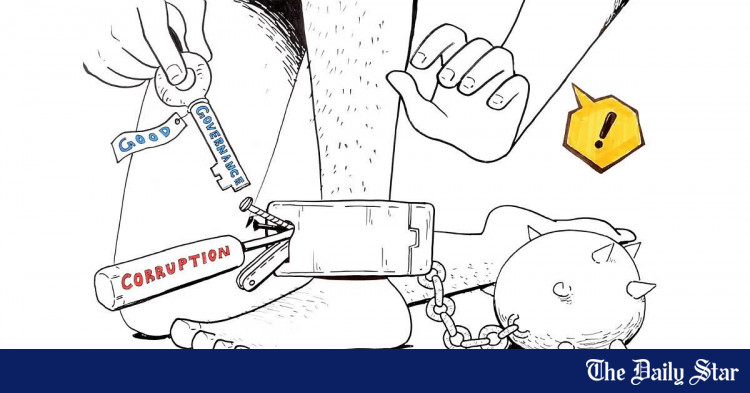
Therefore, it is high time for the government to address institutional and structural corruption, which currently holds the nation and the economy hostage. It is crucial to note that instances of overlooking or condoning corrupt practices among associates, friends, and political supporters not only undermine the foundations of trust, but also contribute to the perpetuation of a culture where dishonesty is seemingly justifiable. Social scientists argue that human goodness thrives on positive influences. Hence, holding powerful wrongdoers accountable, regardless of political affiliations, and implementing stringent anti-corruption measures are crucial steps. Going after individuals at the pinnacle of power sends a potent signal that resonates throughout society, reinforcing the principle that “no one is above the law.”
This unwavering commitment to justice serves as a guiding light, inspiring both citizens and future leaders to uphold the highest ethical standards and support the creation of a community built on principles of honesty and integrity. Therefore, to achieve meaningful progress, the new government must ensure that those involved in corruption face justice, and that the culture of impunity is dismantled. Doing so will pave the way for sustainable development, creating a brighter and more promising future for our country.
Abu Afsarul Haider is an entrepreneur. He can be reached at [email protected]
Views expressed in this article are the author’s own.
Follow The Daily Star Opinion on Facebook for the latest opinions, commentaries and analyses by experts and professionals. To contribute your article or letter to The Daily Star Opinion, see our guidelines for submission.