
Close Menu
  • Home
  • Editorial
  • Politics
  • Economic
  • Sports
  • Religion
  • Contact us
  • About Us
Donate
Hand picked for you
  • Bangladesh’s political reset and the regional ripple effect
  • Jamaat chief flays Bangladesh president for interview, exposing political fault line again
  • Six seats, big goals: What’s next for Bangladesh’s student-led NCP party? | Bangladesh Election 2026 News
  • Is Bangladesh ready for environmental democracy?
  • Economic recovery still fragile: MCCI

Subscribe to Updates

Get the latest news from raznitee.

Reach out to us
  • Facebook
  • Twitter
  • Pinterest
  • Instagram
  • YouTube
  • WhatsApp
Facebook X (Twitter) Instagram
raznitee
Contact us
  • Home
  • Editorial
  • Politics
  • Economic
  • Sports
  • Religion
  • Contact us
  • About Us
raznitee
Facebook X (Twitter) Instagram
Contact us
Home»Environment»Foreign sources responsible for 30-35pc of Bangladesh’s air pollution: Adviser Rizwana
Environment

Foreign sources responsible for 30-35pc of Bangladesh’s air pollution: Adviser Rizwana

January 29, 2025No Comments3 Mins Read
Facebook Twitter Pinterest LinkedIn Tumblr Email
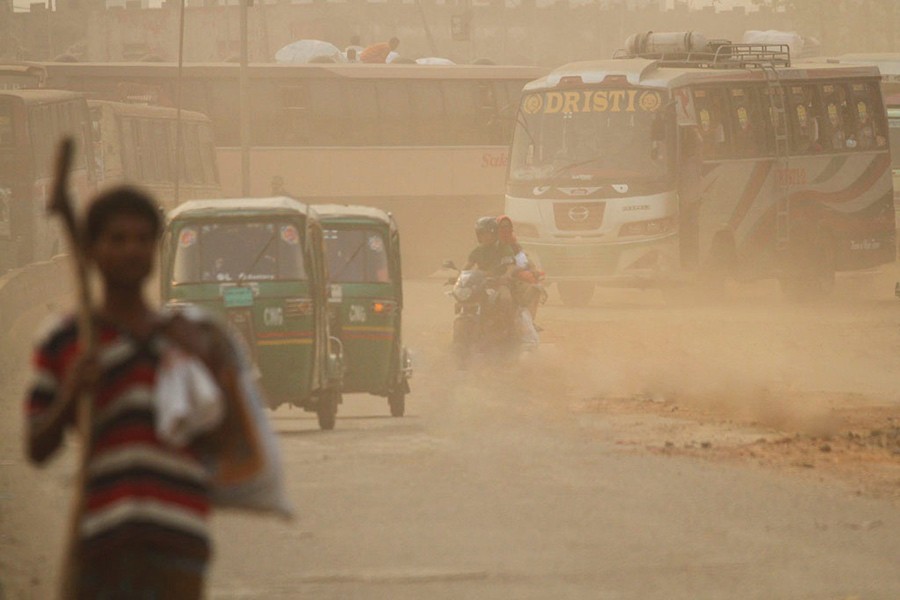
Air Pollution.jpg
Share
Facebook Twitter LinkedIn Pinterest Email

Foreign sources are responsible for 30-35 per cent of Bangladesh’s air pollution, environment adviser Syeda Rizwana Hasan said on Wednesday at a workshop. 

The adviser stated that reducing air pollution is a time-consuming process dependent on economic capacity, development patterns, communication infrastructure, and the transport system.

She noted that 30-35 per cent of Bangladesh’s air pollution originates from foreign sources, while 28 per cent comes from power plants, underscoring the need for a well-defined action plan to control pollution.

She emphasized that reducing air pollution is impossible without improving fuel quality and increasing refinery capacity.

Even neighbouring countries that have enhanced their refineries still struggle with air pollution, often ranking among the most polluted cities. Therefore, Bangladesh must adopt a long-term strategy to combat pollution effectively.

She made these remarks as the chief guest at a Stakeholder Consultation Workshop on the Bangladesh Clean Air Project held at the Department of Environment in the city.

The environment adviser further stressed that for this project to be meaningful, tangible progress in pollution reduction must be visible.

Merely monitoring and reporting the deterioration of air quality is not enough; concrete actions must be taken. The Department of Environment will launch a hotline where citizens can report air pollution issues during the winter months.

She highlighted that planting trees along road dividers can help reduce dust pollution, as already observed in the areas surrounding the Padma Bridge.

The Department of Environment has been directed to implement effective measures to control air pollution during the winter months in the coming year.

Calling for bold economic decisions to combat air pollution, she stressed the need for strict measures against polluting brick kilns and proposed that some steel mills may need to suspend operations for 2-3 months during winter to reduce emissions.

Additionally, she emphasized the importance of strictly enforcing the ban on buses older than 20 years.

She stated, “This project must be designed in a way that ensures visible improvements in air quality. If we can reduce dust pollution by 13 per cent and control industrial emissions, we will make significant progress.”

She further mentioned that the World Bank has already joined the project, and more development partners should be engaged to ensure that it meets the country’s real needs and provides practical solutions for the people.

The event was also addressed by Farhina Ahmed, Secretary, Environment Ministry; Md. Kamruzzaman, Director General, Department of Environment; Christian Albert Peter, Manager-Environment, World Bank and Anna Luisa Lima, Senior Environment Specialist, World Bank.

[email protected] 

Share. Facebook Twitter Pinterest LinkedIn Tumblr Email

Related Posts

Is Bangladesh ready for environmental democracy?

February 23, 2026

Low pressure over equatorial Indian Ocean, Southeast Bay: BMD

February 21, 2026

Signing of the Memorandum of Cooperation between the Ministry of the Environment of Japan and the Ministry of Environment, Forest and Climate Change of the Government of the People’s Republic of Bangladesh on Environment | Press Release

February 21, 2026

How thousands of Bangladeshis fight climate-fueled disease

February 20, 2026
Add A Comment
Leave A Reply Cancel Reply

Subscribe to Updates

Get the latest news from raznitee.

We are social
  • Facebook
  • Twitter
  • Pinterest
  • Instagram
  • YouTube
  • WhatsApp
Latest Posts

Bangladesh’s political reset and the regional ripple effect

February 27, 2026

Jamaat chief flays Bangladesh president for interview, exposing political fault line again

February 27, 2026

Six seats, big goals: What’s next for Bangladesh’s student-led NCP party? | Bangladesh Election 2026 News

February 27, 2026
Follow us on social media
  • Facebook
  • Twitter
  • Pinterest
  • Instagram
  • YouTube
  • WhatsApp
Categories
  • Corruption (409)
  • Culture & Society (114)
  • Economic (1,904)
  • Environment (1,314)
  • Foreign Relations (359)
  • Health & Education (70)
  • Human Rights (5)
  • Politics (2,176)
  • Uncategorized (2)
Facebook X (Twitter) Instagram Pinterest Vimeo YouTube
  • About Us
  • Contact us
  • Disclaimer
  • Privacy policy
© 2026 Designed by raznitee.com

Type above and press Enter to search. Press Esc to cancel.