
In an interview with The Daily Star, German vice minister says Rohingya issue demands more global attention

Johann Saathof Photo: wikipedia
“>
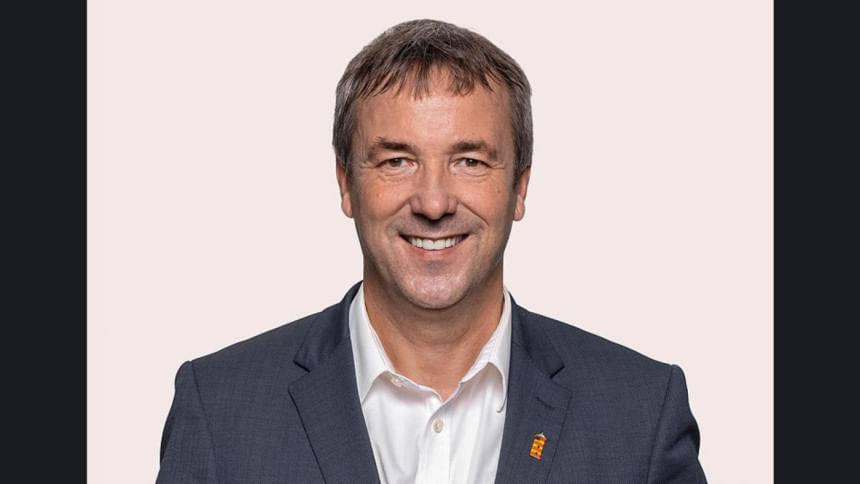
Johann Saathof Photo: wikipedia
Germany wants to see stability in Bangladesh as it undergoes a democratic transition following last year’s mass uprising, while deepening cooperation in green energy and sustainable development.
“My key message would be: even when it’s difficult, strive to understand one another, maintain peace, and promote development based on economic stability,” said Parliamentary State Secretary Johann Saathoff from Germany’s Federal Ministry of Economic Cooperation and Development.
 For all latest news, follow The Daily Star’s Google News channel.
 Saathoff, the German vice minister, visited Bangladesh from October 27–29, meeting Economic Relations Division Secretary Shahriar Kader Siddiky, development partners, and visiting Rohingya camps in Cox’s Bazar.
In an interview with The Daily Star, he said one key objective of his visit was to support Bangladesh’s democratic transition.
“There are challenges in Bangladesh, and I find it important to discuss how valuable it is to live in a democratic system where people work with each other, not against each other,” he said.
Germany is Bangladesh’s top European trade partner, with bilateral trade reaching around $10 billion in 2024. Since 1972, Germany has provided more than €3.5 billion in development assistance to Bangladesh.
Saathoff said every country must chart its own path. “Stability in governance, society, and politics always helps economic growth and mutual understanding.”
He noted that cooperation between Bangladesh and Germany has been strong for decades and has evolved with global shifts.
“Awareness of climate issues has increased, and Bangladesh’s economic situation has dramatically improved,” he said.
“We must continuously find new answers. But one thing remains constant: we are reliable partners who work closely together.”
As Bangladesh graduates from Least Developed Countries (LDC) status, Germany aims to ensure a smooth transition and continued collaboration.
“We will focus on energy — especially renewable energy — as there are so many opportunities here. We’ll also work on urban development, sustainable economic growth, vocational training and employment, biodiversity, and, last but not least, on all the issues related to climate change and building the country’s resilience.”
Saathoff said cooperation is not only about financial support but about mutual growth and learning.
Referring to his meeting with ERD Secretary Shahriar Kader, he said they discussed renewable energy challenges and opportunities for expanding collaboration.
Regarding global development budgets, he reaffirmed Germany’s commitment. “We must find new solutions for various situations. However, I want to clearly state that Germany remains a reliable partner for Bangladesh. That’s an important message, even though the international situation is strained.”
Germany’s current priorities include tackling climate change, promoting renewable energy, ensuring access to clean water, conserving biodiversity, and improving flood protection.
Sharing lessons from his country’s own experience, Saathoff said, “Germany has made many mistakes during its own energy transition, and so wants others to avoid repeating them. For example, we’re still developing our smart grid systems — we can learn from how other countries, including Bangladesh.”
Germany, a leader in renewable energy with 63 percent of total production from renewables, also supports rooftop and large-scale solar projects and energy efficiency.
“Learning how to use energy more efficiently are key areas for collaboration,” he said.
“We also talked about traffic and transport. When it comes to combustion engines or electric vehicles, the debate continues in Germany. I personally believe electric vehicles are the most efficient and responsible choice for future generations.”
As a major importer of Bangladeshi textiles, Germany works closely with the RMG sector to enhance labour and safety standards.
“Germany itself has evolved in this regard — decades ago, conditions were very different. There’s always room for improvement, but cooperation remains strong,” Saathoff said.
On the Rohingya crisis, he called for an end to Myanmar’s civil war as a prerequisite for repatriation.
“I was part of the parliamentary group between Germany and ASEAN for more than eight years, and I believe ASEAN could take more responsibility for ending the civil war and pressuring parties to maintain peace. That’s the first step before the Rohingya issue can be properly addressed.”
He said the Association of Southeast Asian Nations like the European Union, could play a greater role in ensuring regional stability. “This issue must be raised again internationally and demands more global attention,” he added.
Addressing funding shortages for Rohingya aid, Saathoff said, “We are doing our best — providing freshwater systems, supporting education, and helping prevent conditions that could lead to extremism. Education is key. We have been supporting for years, and we continue to do so.”