
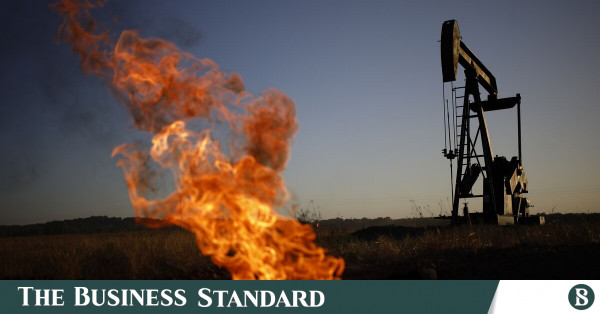
A natural gas flare burns near an oil pump jack. Subsidies for fossil fuels have risen over the past two years despite nations’ commitments to phasing them out and reducing emissions. Photo: Bloomberg
“>

A natural gas flare burns near an oil pump jack. Subsidies for fossil fuels have risen over the past two years despite nations’ commitments to phasing them out and reducing emissions. Photo: Bloomberg
A new report has revealed that governments around the world are planning higher fossil fuel production than ever before, threatening the global climate goals and undermining the commitments of the Paris Agreement.
The 2025 Production Gap Report, released Monday by the Stockholm Environment Institute (SEI), the International Institute for Sustainable Development (IISD), and Climate Analytics, highlights a widening divide between climate promises and actual fossil fuel production strategies.
According to the report, fossil fuel production projected for 2030 will exceed levels consistent with limiting global warming to 1.5ºC by more than 120%, and overshoot the 2ºC limit by nearly 77%, said a press release.

It said that governments are now collectively planning even higher levels of coal production through 2035 and gas production through 2050 compared to their plans in 2023. Oil production is also projected to rise steadily until 2050.
The report mentions that just three countries – China, the United States, and the Russian Federation – are responsible for over half of global extraction-based emissions from fossil fuels in 2022. “This concentration of emissions highlights the role of a few major players in driving the climate crisis.”
At the COP28 summit in Dubai in 2023, nations agreed to transition away from fossil fuels in a manner that is both “just” and “equitable.” This included commitments to phase out inefficient subsidies that perpetuate fossil fuel dependence. Yet, as the new report underscores, production plans remain incompatible with those commitments.
“The continued collective failure of governments to curb fossil fuel production means that future cuts will need to be even more drastic to keep the world on track for net-zero emissions,” said Derik Broekhoff, lead author of the report and Climate Policy Program Director at SEI’s US Center.
The analysis profiles 20 major fossil-fuel-producing nations, responsible for about 80% of global fossil fuel output, including the United States, China, India, Saudi Arabia, and Russia.
It finds that 17 of these countries plan to increase production of at least one fossil fuel by 2030, with 11 countries — among them China, India, Germany, and the US — planning even higher production than they projected just two years ago. Only six countries have aligned their production with net-zero goals, underscoring the urgent need for coordinated action.
The report stresses that as governments prepare their third round of nationally determined contributions (NDCs) ahead of the UN COP30 summit in Brazil this November, they must integrate fossil fuel production limits directly into their climate strategies.
“In 2023, governments formally recognized the need to move away from fossil fuels. Yet many remain locked into old, fossil-fuel-dependent playbooks,” Broekhoff noted.
“Countries must act now to reverse this trend and embed just transition measures in their climate plans.”
The consequences of inaction are particularly stark for climate-vulnerable nations such as Bangladesh, where rising seas, extreme weather events, and health impacts of air pollution are already disproportionately affecting millions.
Experts warn that without immediate reductions in fossil fuel use, adaptation costs for developing countries will skyrocket, deepening inequality and worsening humanitarian risks.
Emily Ghosh, co-author and director of the Equitable Transitions Program at SEI US, said “To keep 1.5ºC within reach, fossil fuel production must decline rapidly. But this cannot come at the expense of vulnerable communities. A fair, equitable, and community-centered energy transition is essential,” she said.
“The 2025 Production Gap Report serves as a stark warning: unless countries immediately curb fossil fuel production and accelerate investment in renewable energy, the world risks locking in catastrophic levels of greenhouse gas emissions. Such a path not only undermines the Paris Agreement but also threatens the survival and livelihoods of billions,” reads the press release.