
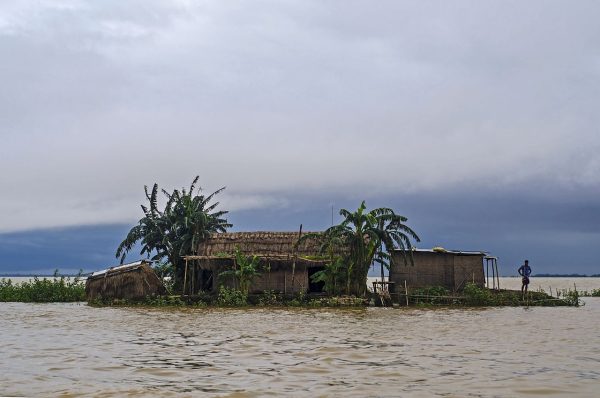
For people living in Bangladesh, home to the world’s largest river delta, disasters such as floods and cyclones are routine, especially during the monsoon season. Almost, every year, people experience floods in various parts of the country.
However, the devastating flood that hit the northeastern and southeastern districts of Bangladesh in August this year that has affected over 5.8 million people is being described as one of the worst in recent memory.
Just two years ago in 2022, another unprecedented flood occurred in the region of Sylhet, a northeastern division of the country. The 2022 flood affected more than 7.2 million, claimed dozens of lives, and caused severe damage and suffering to the communities.
Bangladesh is one of the world’s most climate-vulnerable countries. Erratic and extreme rainfall are among the growing climate impacts that are becoming evident. Perhaps the time has come for Bangladesh to seriously rethink its development strategies and policies related to river and water management and food security.
Recent Flood Toll
The recent floods, especially in Feni, Noakhali, and Cumilla districts, have claimed 71 lives so far, and left millions displaced and homeless. Beyond the heavy toll on human lives, it has caused massive damage to crops, homes, sanitation, and public facilities on a scale not seen before. On September 6, one of the country’s leading English dailies, The Daily Star, reported that the recent flood in Moulvibazar district damaged 512 km of roads and 12 bridges. Another report said that 1,258 km of roads, 32 bridges and culverts were damaged in Akhaura and Cumilla, areas bordering India.
Global charity Oxfam unveiled its assessment on the impact of the flood in Feni and Noakhali, the hard-hit southeastern districts. The charity says over 90 percent of the population in the two districts has been affected, with an increasing risk of waterborne diseases such as diarrhea and cholera. Additionally, the flood has disrupted education, with many schools being used as shelters. It has severely impacted local economies, making recovery a long and arduous process.
In 2023, Bangladesh saw catastrophic flash floods in southern Chittagong that wreaked havoc on lives and livelihoods. There was major destruction to the newly-built rail line and public facilities like roads and bridges. Many blamed the construction of Dohazari-Cox’s Bazar rail line for the flood, as the railway blocked water flow at many points.
Similarly, in 2022, Sylhet division was hit by a catastrophic flood, causing record-high damages. That was also widely blamed on the unplanned construction of roads and dams in haors (wetlands) in the region. In addition, this year Bangladesh, like other South and Southeast Asian countries, has seen an unprecedented rise in temperature.
Fastest Rising Seas
To the south of Bangladesh lies the Bay of Bengal, often called a hotbed for deadly tropical cyclones. Due to global warming, the waters of this sea are said to be rising at a faster rate than any other sea. Deadly cyclones causing flooding and destruction of coastal embankments heap misery and damage on coastal communities every year. And the intensity of these events is growing every year.
In May this year, Cyclone Remal crashed into coastal parts of southern Bangladesh, including the Sundarbans and also parts of India, leaving a trail of deaths and destruction.
In the north, one of the world’s largest river networks, the Ganges-Brahmaputra-Meghna (GBM) river system flows through Bangladesh. The rivers mostly originate from outside of the country, from the Himalayas and India.
Dams, water diversions, encroachment of rivers, and various pollutions driven by climate change are taking a huge toll on the millions living along the river basin. In the dry season, many rivers are dying up and during monsoon, water overflows causing floods. While extreme rainfall and pollution on both sides of the rivers are mostly responsible for it, there is also a lack of coordination and cooperation between neighboring countries like India and Bangladesh over river and water management.
Bangladesh is located in between two major climate-driven forces — fading and controlled rivers and rising seas. Both are turning unfriendly and often deadly. People in this river delta have a deep relationship with water. Rivers have been a lifeline sustaining communities. But in this era of rapid climate change, the connection is often turning into an existential threat. Bangladesh is being engulfed by cyclones from the south and floods from the north and east.
Food Insecurity
Bangladesh is a developing country of more than 160 million people. In recent years, its economy is also said to be one of the fastest-growing in the region. It has a large vulnerable population that is involved in agriculture and solely dependent on the market for their daily food access.
The recent flood waters have receded from the affected area, but according to a report by the Center for Agricultural Policy Studies, 2,91,333 hectares of paddy fields are damaged, an estimated $285 million worth of crops have been damaged, and about 1.41 million farmers in 23 districts affected. In the meantime, due to these massive losses, the impact on the rice market is visible, with the price of rice rising. Food security remains a big concern, given that natural disasters like floods and cyclones keep causing massive damage to agriculture and livelihoods.
Bangladesh Cannot Look Away Anymore
Climate change has been declared a global emergency as it poses a fundamental threat to human health and the physical environment of the world. It also threatens international peace and security as it has enhanced competition and conflict relating to control over water, food, and land among countries. Bangladesh has been caught in this conflict.
While Bangladesh displayed a heartwarming humanity in its flood aid response, it is still rare to see climate issues shaping its political narratives and debates.
However, there is hope that some concrete action against river pollution and environmental degradation will be taken as one of Bangladesh’s environmental champions, Syeda Rizwana Hasan, has been appointed the environment, forest, and climate change adviser of the interim government led by Nobel Peace Laureate Mohammad Yunus. In a recent interview with The Daily Star, she issued a stern warning against the pollution of rivers.
Developing countries like Bangladesh have focused so far on economic growth, energy, and infrastructural development. However, the toll of climate change is getting too high for Bangladesh to ignore global warming any longer.