
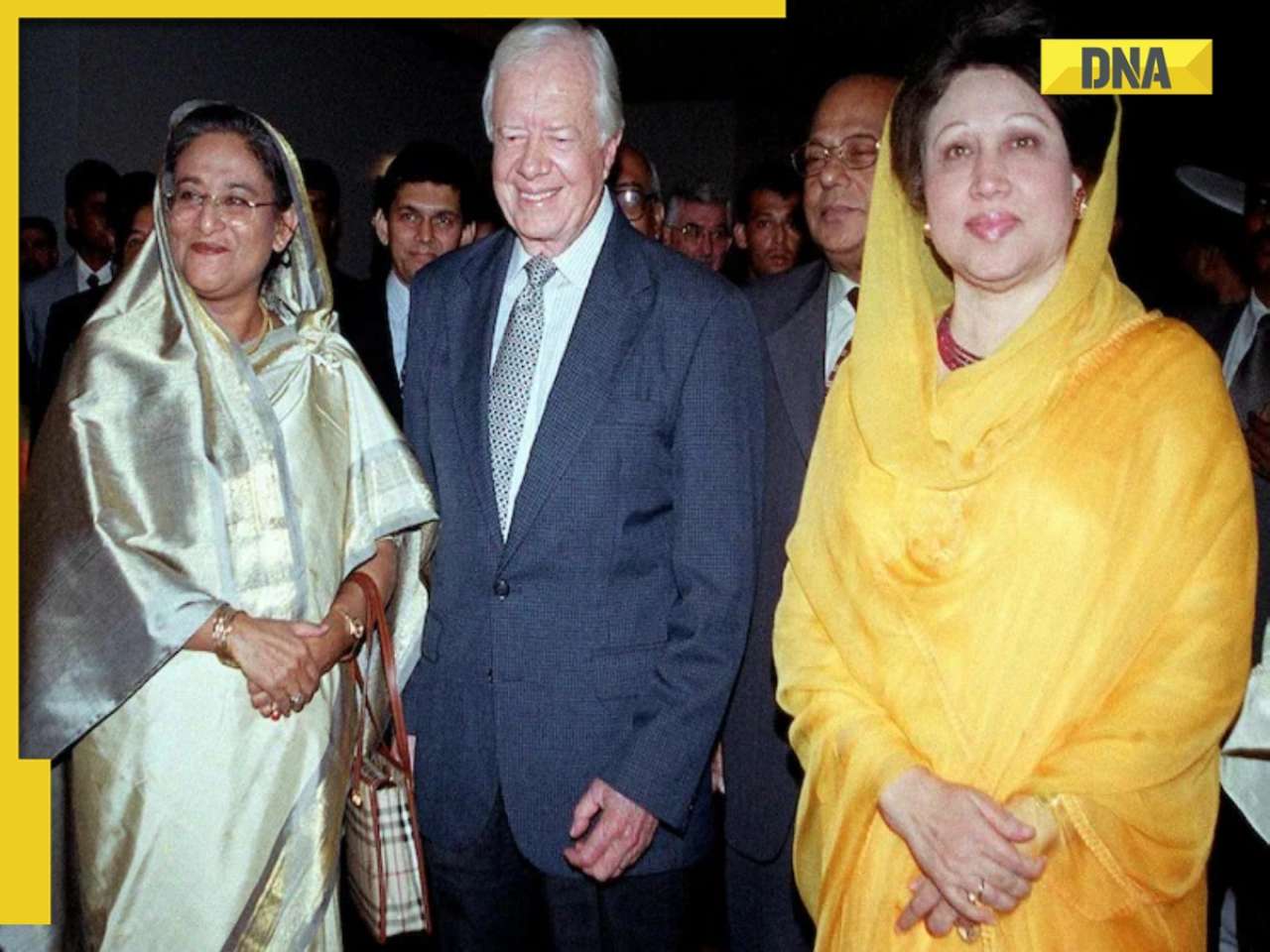
The ICT’s death sentence for former Bangladesh Prime Minister Sheikh Hasina has revived the decades-long “Battle of Begums” — the bitter political rivalry between Hasina and Khaleda Zia.
Sheikh Hasina and Khaleda Zia with former US President Jimmy Carter. (File Image)
The International Crimes Tribunal (ICT) in Bangladesh awarded a death sentence to former Prime Minister Sheikh Hasina on Monday. It found her guilty of committing crimes against humanity during the nationwide protests in July 2024. Reacting to it, the Khaleda Zia-led Bangladesh Nationalist Party (BNP) hailed it as the delivery of justice and urged the government to ensure fair and impartial trials in other pending cases. It was the tip of the iceberg of what is called the “Battle of Begums,” the rivalry between two former prime ministers. The battle has changed the course of Bangladesh politics in a big way.
Mujibur Rehman assassinated
The Bangladesh Army stormed the official residence of President Sheikh Mujibur Rehman on August 15, 1975, and killed him along with most of his family members. It was alleged that then-deputy army chief Major General Ziaur Rahman was behind the assassination and had provided support and later rehabilitation to the killers. Khalida Zia is the widow of Ziaur Rehman.
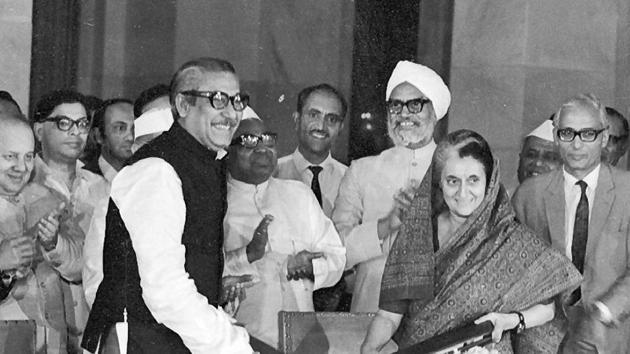
(Sheikh Mujibur Rehman with Indira Gandhi and other leaders in India)
Battle of Begums
The Battle of Begums began with this assassination that changed Bangladesh forever. General Ziaur Rahman, the then army chief, deposed President Khondoker Mostaq Ahmad, seized power, and established a military dictatorship in 1977. He not only granted amnesty to Mujib’s assassins but also appointed them to diplomatic positions. He allowed leaders of Jamaat-e-Islami (JeI) and the Razakars, who had collaborated with the Pakistani army during the genocide, to return. Earlier in 1975, Ziaur Rahman introduced an indemnity law, granting immunity to those involved in the assassination conspiracy.
Awami League vs BNP
Ziaur Rehman was killed in a military coup in 1981. His wife came forward to take the reins of the party, the BNP, founded by her husband. She became the first female prime minister of the country with the help of the Islamist radical organisation the JeI in 1991. Sheikh Hasina escaped death in 1975 because she was in Germany on a vacation. She came to India. Hasina returned to Bangladesh on May 17, 1981. Her party, the Awami League, defeated the BNP in 1996 and grabbed power from Khaleda Zia. Khaleda regained power in the 2001 elections.

(Ziaur Rehman was accused of hatching conspiracy to assassinate Sheikh Mujibur Rehman.)
Sheikh Hasina-Khaleda Zia feud
About 20 people were killed and more than 50 were injured when a public rally, attended by Sheikh Hasina, was attacked by grenades in 2004. Khaleda Zia’s government was held responsible for the attack. Her eldest son, Tarique Rehman, was tried in absentia and sentenced to life imprisonment for his role in the attack. An army-backed interim government assumed control in 2006 amid political turmoil and street violence. Both ladies were taken into custody and were released in 2008 before the general elections. While Khaleda Zia boycotted the parliamentary elections, Hasina became the prime minister for the second time in 2009.
Sheikh Hasina gets death sentence
Khaleda Zia and her party, BNP, have not returned to power since then. Zia was sentenced to a total of 17 years in prison for the Zia Orphanage Trust corruption case and the Zia Charitable Trust corruption case in 2018. Her eldest son, Tarique Rehman, and others too were convicted. She was transferred to a hospital for medical treatment in April 2019. Khaleda Zia was released on house arrest for six months on humanitarian grounds. Subsequently, she was conditionally freed for medical treatment. Khaleda Zia was released on August 5, 2024, the day when Sheikh Hasina was forced to flee the country and take refuge in India. Hasina was awarded a death sentence on November 17, 2025.