
Close Menu
  • Home
  • Editorial
  • Politics
  • Economic
  • Sports
  • Religion
  • Contact us
  • About Us
Donate
Hand picked for you
  • Bangladesh’s political reset and the regional ripple effect
  • Jamaat chief flays Bangladesh president for interview, exposing political fault line again
  • Six seats, big goals: What’s next for Bangladesh’s student-led NCP party? | Bangladesh Election 2026 News
  • Is Bangladesh ready for environmental democracy?
  • Economic recovery still fragile: MCCI

Subscribe to Updates

Get the latest news from raznitee.

Reach out to us
  • Facebook
  • Twitter
  • Pinterest
  • Instagram
  • YouTube
  • WhatsApp
Facebook X (Twitter) Instagram
raznitee
Contact us
  • Home
  • Editorial
  • Politics
  • Economic
  • Sports
  • Religion
  • Contact us
  • About Us
raznitee
Facebook X (Twitter) Instagram
Contact us
Home»Politics»How USAID was used for regime change in Bangladesh: Former US State Dept official Mike Benz reveals
Politics

How USAID was used for regime change in Bangladesh: Former US State Dept official Mike Benz reveals

February 11, 2025No Comments3 Mins Read
Facebook Twitter Pinterest LinkedIn Tumblr Email
Photo.jpg
Share
Facebook Twitter LinkedIn Pinterest Email
How USAID was used for regime change in Bangladesh: Former US State Dept official Mike Benz reveals
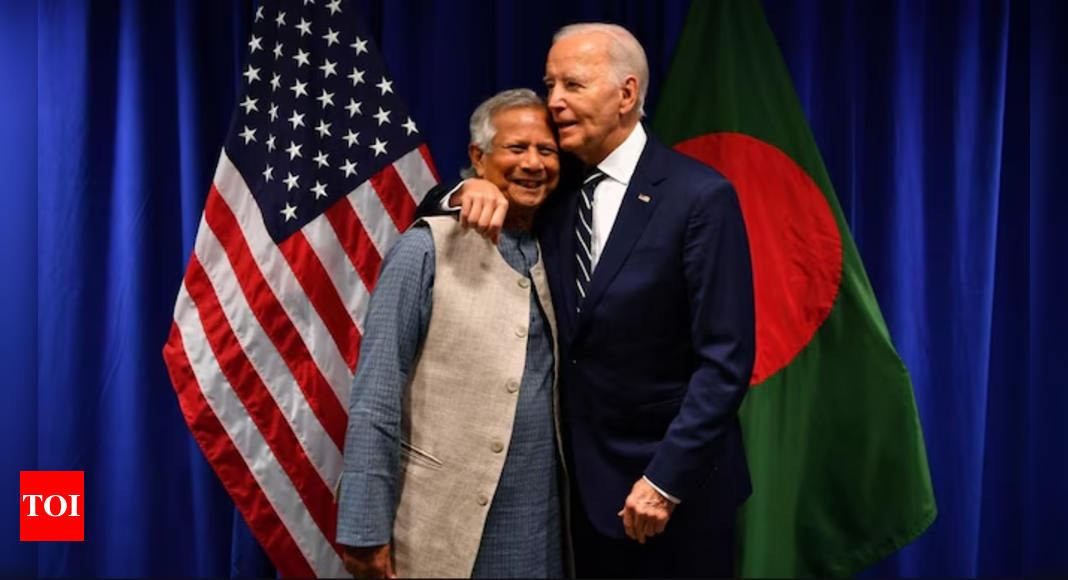
US President Joe Biden and Muhammad Yunus (L)in New York.

Did the US government actively work to destabilize Bangladesh using taxpayer-funded programs? Former US State Department official Mike Benz has made explosive claims that USAID and affiliated organizations orchestrated efforts to undermine the Bangladeshi government in a bid to secure American strategic interests.

Regime change for a military base?

Speaking about US foreign policy planning, Benz laid out a hypothetical—but eerily specific—scenario: “Let’s say it is vital to US national interest to build a military base in Bangladesh to counter China, but the Bangladeshi Prime Minister refuses. Our foreign policy planners then decide that regime change is necessary.”
Benz explained that once such a decision is made, “all options to destabilize the country” come into play. These range from backing opposition forces to orchestrating a color revolution, a reference to past US-backed uprisings where leaders have been ousted, sometimes fleeing in helicopters.

Leaked documents: Destabilization strategy in action

Benz also explained, according to leaked documents published by The Grayzone, US agencies, including the National Endowment for Democracy (NED), worked to “destabilize Bangladesh’s politics”—a direct quote from the documents. The International Republican Institute (IRI), one of NED’s political branches, submitted a plan to the State Department in 2019-20, after previously failing to install the opposition Bangladesh Nationalist Party (BNP) in power.
The strategy involved recruiting-

  • 170 pro-democracy activists
  • 304 key informants
  • Ethnic and cultural fault lines that could be exploited
  • Minority groups, LGBT communities, and student protestors

Weaponizing Rap music to spark protests?

In one of the more striking revelations, Benz claimed that US taxpayer money was used to fund Bangladeshi rap groups to produce protest songs. The goal? Encourage street demonstrations disguised as “peaceful protests”—which often spiral into riots.
“One song was designed to sow resentment against the sitting government, another was meant to make people distrust their leaders,” Benz explained. These songs were then strategically promoted among students who had already been protesting over local political issues, increasing tensions on the ground.

Soft power or covert destabilization?

The IRI’s baseline assessment identified the most effective ways to stir unrest. Benz noted that these methods often rely on fringe elements within society. “This is how we end up funding terrorists, paramilitaries, criminals, and even prostitutes in the name of soft power projection,” he said.

Bigger picture: US influence operations abroad

While Benz did not weigh in on the morality of these actions, his claims paint a troubling picture of US foreign policy. If true, they expose how democracy promotion efforts may, in reality, serve as tools for regime change, shaping governments to align with US strategic goals.

Share. Facebook Twitter Pinterest LinkedIn Tumblr Email

Related Posts

Bangladesh’s political reset and the regional ripple effect

February 27, 2026

Jamaat chief flays Bangladesh president for interview, exposing political fault line again

February 27, 2026

Six seats, big goals: What’s next for Bangladesh’s student-led NCP party? | Bangladesh Election 2026 News

February 27, 2026

A historic mandate and a defining responsibility: Tarique Rahman’s new chapter in Bangladesh politics

February 22, 2026
Add A Comment
Leave A Reply Cancel Reply

Subscribe to Updates

Get the latest news from raznitee.

We are social
  • Facebook
  • Twitter
  • Pinterest
  • Instagram
  • YouTube
  • WhatsApp
Latest Posts

Bangladesh’s political reset and the regional ripple effect

February 27, 2026

Jamaat chief flays Bangladesh president for interview, exposing political fault line again

February 27, 2026

Six seats, big goals: What’s next for Bangladesh’s student-led NCP party? | Bangladesh Election 2026 News

February 27, 2026
Follow us on social media
  • Facebook
  • Twitter
  • Pinterest
  • Instagram
  • YouTube
  • WhatsApp
Categories
  • Corruption (409)
  • Culture & Society (114)
  • Economic (1,904)
  • Environment (1,314)
  • Foreign Relations (359)
  • Health & Education (70)
  • Human Rights (5)
  • Politics (2,176)
  • Uncategorized (2)
Facebook X (Twitter) Instagram Pinterest Vimeo YouTube
  • About Us
  • Contact us
  • Disclaimer
  • Privacy policy
© 2026 Designed by raznitee.com

Type above and press Enter to search. Press Esc to cancel.