
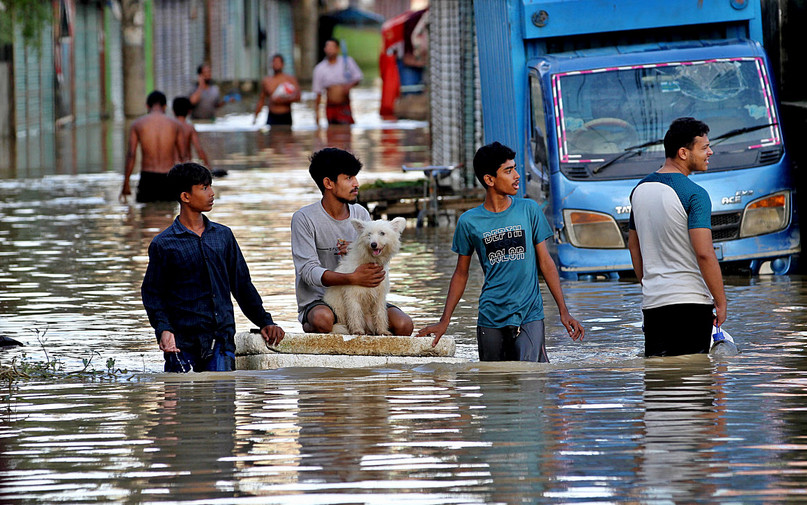
DHAKA – Environment Adviser Syeda Rizwana Hasan termed climate change as an existential threat to Bangladesh’s national security, territorial integrity, and social stability.
“Imagine a third of Bangladesh underwater… The remaining two-thirds, already overburdened, will face unprecedented pressure to feed and house millions. Instability will become the norm,” she said today during a lecture titled “Impact of Climate Change on National Security,” at the Defence Services Command and Staff College, Dhaka.
She said rising seas, vanishing coastlines, and climate-induced displacement could force Bangladesh to “redraw its map” within decades.
Rizwana warned that a one-metre sea-level rise — a plausible scenario by mid-century — would submerge 21 coastal districts, displacing millions and salinising the rivers that sustain agriculture and fisheries.
“When we speak of climate change, we are not just talking about sweet water turning salty,” she said.
“We are talking about the surrender of sovereignty, the loss of national territory, and the erasure of communities,” she added, citing projections that 52 small island nations, including the Maldives, could disappear by 2100.
For Bangladesh, the stakes are even higher: 65 percent of the population relies on freshwater fisheries for protein, and saline intrusion threatens to collapse this lifeline.
Rizwana dismantled the notion of climate change as a distant environmental concern, reframing it as a multiplier of instability.
Floods, cyclones, and droughts already cost Bangladesh one percent of its GDP annually—a figure set to double by 2050. But the rising crises of crop failures, water scarcity, and mass migration will ignite conflicts over dwindling resources, she argued.
Lambasting the “tactical opposition” of oil-producing nations, Rizwana criticised the failure of the Kyoto Protocol and the voluntary loopholes of the Paris Agreement. While G20 nations emit 80 percent of global greenhouse gases, Bangladesh, which is ranked the seventh most vulnerable to climate impacts, bears the brunt. She highlighted the grim reality of 2024 being the hottest year on record, with ocean warming and glacier melt accelerating at twice the rate of that of previous decades.
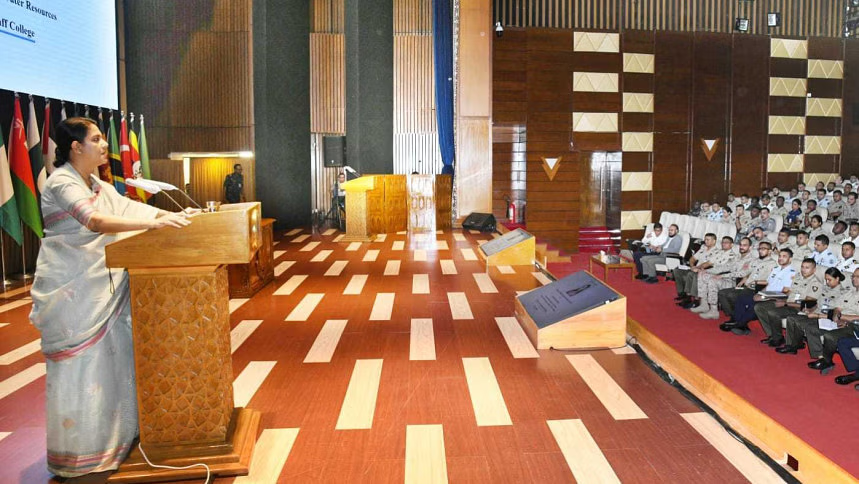
Environment Adviser Syeda Rizwana Hasan speaks during a lecture titled “Impact of Climate Change on National Security,” at the Defence Services Command and Staff College, Dhaka, on April 7. PHOTO: THE DAILY STAR
“The world’s inaction is a death sentence for nations like ours,” she said, noting that even if all countries meet their climate pledges, temperatures will still rise by 3 to 4.5 degrees Celsius — far beyond the 1.5 degrees Celsius threshold for survival.
The environment adviser outlined Bangladesh’s National Adaptation Plan, which identifies 11 climate “stress zones” and demands $230 billion by 2050 for resilience projects. Yet she stressed that money alone is insufficient.
“We must redesign our development model,” she insisted, urging a shift from fossil fuels to regional renewable energy partnerships, like importing hydropower from Nepal. She called for architectural reforms such as natural ventilation over air conditioning and daylight over electric lights and stricter enforcement of environmental laws
She said the current measures are being hindered by corruption and understaffing.
“Every time I order an enforcement raid, my team says they’ve only got six magistrates for the entire country,” she said, appealing to the armed forces for support in regulating polluting industries.
The lecture also touched upon the accounts of coastal women suffering skin lesions from saline water and farmers praying against untimely rains.
Rizwana praised the army’s rapid response to river erosion in Kurigram but underscored the need for long-term rehabilitation strategies.
“The military’s role will evolve from disaster relief to managing climate refugees and securing water-sharing treaties,” she said, citing tensions over transboundary rivers.
In her closing statement, she said, “This is not about saving trees. It’s about saving our nation. If we fail, future generations will inherit a country unrecognisable on today’s maps.”
Commandant of Defence Services Command and Staff College (DSCSC) Maj Gen Chowdhury Mohammad Azizul Haque Hazary, Deputy Commandant of DSCSC Commodore Mustaque Ahmed, Brig Gen Mohammad Mehedi Hasan, were present among others.