
Economists blame rising bad debt, soaring prices and illicit fund flows on central bank’s waning independence
- Bad loans balloon under weak regulation
- Persistent inflation erodes real household incomes
- Illicit fund flows deepen liquidity shortages
- Rising poverty reflects financial system instability
 For all latest news, follow The Daily Star’s Google News channel.
 The rise in non-performing loans, red-hot inflation, illicit fund flows and lately an uptick in the poverty rate are the direct outcomes of the Bangladesh Bank (BB) losing its autonomy, according to economists.
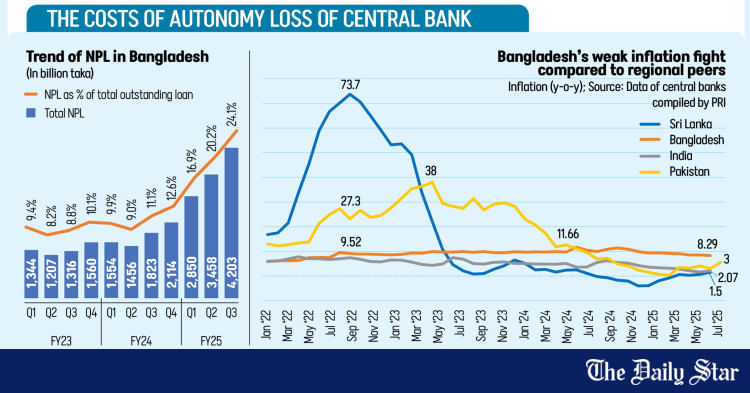
In its paper, local think tank Policy Research Institute (PRI) says regulatory forbearance had allowed bad debts to balloon to Tk 420,335 crore by March this year.
Besides, inflation reached 11.66 percent in July last year and has stayed high compared to neighbouring countries, eroding real incomes, said PRI’s Principal Economist Ashikur Rahman while presenting the paper at a roundtable.
The programme, titled “The Imperative for Central Bank Independence”, was organised by PRI with support from the UK International Development (UKID) in Dhaka yesterday.
According to the paper, widespread money laundering and capital flight have deepened liquidity shortages and weakened public trust in the financial system. Meanwhile, persistent inflation and financial instability have reversed the poverty reduction progress.
PRI recommended insulating monetary policy, bank licensing, regulation, supervision and government debt financing from political or executive interference.
The paper also said that the Bangladesh Bank Order-1972, despite its 2003 amendments, is outdated and unsuited to the needs of a modern central bank tasked with ensuring price and financial stability and encouraging sectoral development.
“The establishment of the Financial Institutions Division under the Ministry of Finance and weak central bank leadership over the past decade have severely curtailed Bangladesh Bank’s operational independence,” says the paper.
Amir Khosru Mahmud Chowdhury, standing committee member of BNP and also a former minister, attended the event as the chief guest.
Khosru said the BNP believes in central bank autonomy, but he argued that independence alone will not work unless other financial institutions are also strengthened.
“No matter how much independence we grant, if we cannot develop the capital market and implement necessary reforms, the pressure on the central bank will remain,” said the BNP leader and former commerce minister.
He added that major financial reforms took place during the BNP regime.
Referring to the issue of dual regulation in the banking sector, the BNP leader said, “We did not make any political appointments anywhere. We even abolished the Financial Institutions Division of the finance ministry, but the succeeding government reinstated it.”
Fahmida Khatun, executive director of local think tank Centre for Policy Dialogue (CPD), said macroeconomic stability had weakened over the past decade.
“Naturally, many economic indicators reflected this deterioration, particularly those related to the banking sector, including inflation and price levels, which became highly unstable. This instability has had an overall impact on the economy,” she said.
The economist noted that countries with independent central banks find it easier to maintain price stability. “Ensuring price stability is the primary responsibility of a central bank. Economic growth and employment come as secondary objectives.”
Fahmida also questioned the appointment process for the central bank governor and deputy governors. “Because even if you enact a strong law, if the person appointed to the position does not have academic excellence, accountability, transparency, and commitment, then that law will remain only on paper.”
Syed Nasim Manzur, president of the Leathergoods and Footwear Manufacturers and Exporters Association of Bangladesh, said, “Since 2019, we have been proposing to increase the dollar rate. Instead of doing that gradually, it was raised by 41 percent in 2022, and everyone had to bear the shock.”
He called for greater policy consistency from BB and urged the abolition of the banking division, saying this should form part of BNP’s political agenda.
“Now those who pay taxes and repay loans are the ones facing the burden. No matter how much legal independence is granted, who is appointed as the governor is what truly matters,” said the footwear manufacturer.
Syed Mahbubur Rahman, managing director of Mutual Trust Bank, said political will matters more than legislation for developing the banking sector.
“Injecting high-powered money into the economy will have to be stopped,” he added.
Showkat Aziz Russell, president of the Bangladesh Textile Mills Association (BTMA), said those who remain in the country, those who did not flee, are now being forced to bear higher financing costs. “It is unfair,” he said. “We cannot survive in such a competitive market. That is the reality.”
M Masrur Reaz, chairman and CEO of the Policy Exchange of Bangladesh, said people used to talk about crony capitalism, which has now evolved into oligarchy. “They have captured the banking sector and driven it into losses,” he said.
“The biggest reform took place in 2007-08. When the national ID card was introduced, it was said that no one would be able to vote on behalf of another. Yet, afterwards, the most disgraceful elections took place,” he commented.
PRI economist Ashikur Rahman said discussions around the independence of the BB have long continued.
“Theoretical models and cross-country experiences suggest that inflation can be effectively controlled when inflation expectations are anchored at low levels, money supply is properly managed, and the exchange rate remains stable,” said Rahman.
He added that such macroeconomic management is only possible when the central bank enjoys credibility, which comes from its independence.
“This is why, since the 1990s, central bank independence has become a dominant doctrine in economic management. Politicians must internalise lessons from past mistakes in the financial sector and do better in the future,” he commented.
Abdul Hai Sarker, chairman of the Bangladesh Association of Banks, and Mohammad Akhtar Hossain, chief economist of BB, also spoke at the discussion.
PRI Vice-Chairman Sadiq Ahmed gave the opening remarks, while its Chairman Zaidi Sattar delivered the closing remarks.