
About 150 participants from different churches and faith-based organisations in Bangladesh and representatives from various faiths attended as well. Pillay addressed the gathering, emphasising that interfaith dialogue is key to lasting peace. He noted that, unfortunately, we do not give enough priority to dialogue to stop wars and conflict.
Climate change a “cruel reality”
On 11 April, Pillay participated in a WCC Conference entitled “Climate Justice and a Nexus Approach to Land, Water, and Food,” hosted by the Christian Commission for Development in Bangladesh (CCDB).
The event brought together global faith leaders, development practitioners, climate experts, and policy makers, offering a platform to discuss the linkages between climate justice and the land-water-food nexus.
Juliate Keya Malakar, executive director of the CCDB, said: “Climate change is not abstract—it is a cruel reality for people in Bangladesh and we need to find solutions for our resilience together.”
NCCB president Christopher Adhikari echoed this urgency, noting, “We live on a planet where the climate is changing. Addressing climate change is not optional—it is an undeniable task.”
The keynote address was delivered by Pillay, who emphasized that climate change reduces agricultural production, worsens existing vulnerabilities, and contributes to rising food insecurity. “Our land, water, and food systems are deeply impacted by the changing climate,” he said. “We need a holistic, ethical, and integrated approach to tackle this crisis.”
This was followed by a panel discussion with several climate scientists and practitioners from Bangladesh.
Dr Ahsan Uddin Ahmed, executive director of the Centre for Global Change remarked, “Climate change is an intergenerational crisis that we have contributed to. We must be conscious of our carbon footprint. Unfortunately, there is no new or additional financing available for tackling climate change—but although we are among its worst victims, we have the courage to fight back.”
Farid Uddin Ahmed, former executive director of the Arannak Foundation, highlighted the alarming rate of deforestation and its impact on water availability and food production. He added, “Water is a serious concern. Yet people’s traditional knowledge and experience are valuable assets in adapting to climate change.”
The panel discussion was moderated by Dinesh Suna, WCC programme executive for Land, Water and Food Advocacy.
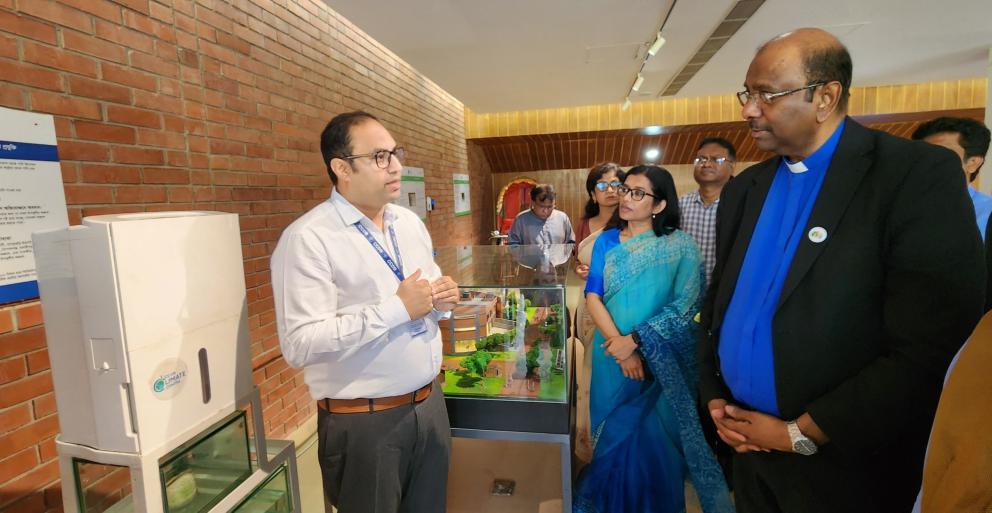
Pillay planted a tree at the CCDB Climate Park, which models various climate zones of the nation, and demonstrates sustainable practices to combat climate change, water scarcity, and food insecurity.
The general secretary also unveiled a plaque in the park which acknowledges the WCC for its contribution in founding the CCDB in 1973.
Pillay expressed: “I am very impressed by the work undertaken by the NCCB in a context where Christians are in the minority. Their programmatic work and the CCDB Climate Park is a leading model to be replicated elsewhere.“
WCC expresses solidarity with peace efforts in Bangladesh
Students in Bangladesh share challenges and stories with WCC
WCC general secretary to visit churches and communities in Bangladesh