
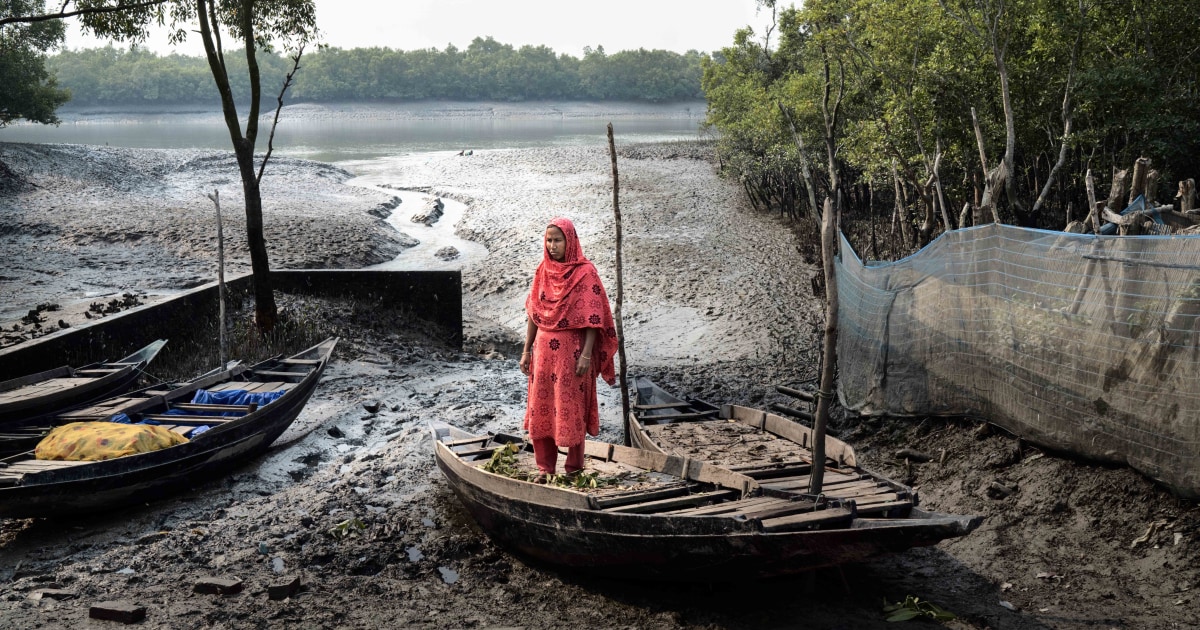
Research published last year by Ipas, a United States-based NGO that focuses on reproductive justice, found that global warming exacerbated existing gender inequalities and directly and indirectly affected women’s sexual health, pregnancy outcomes, contraceptive use and fertility intentions in Bangladesh and Mozambique, two climate-vulnerable countries.
The report found that during extreme weather events made worse by climate change, such as cyclones, access to health care and contraceptives was limited. The researchers also found that the climate crisis deepened economic instability and added extra burdens on women’s caregiving responsibilities.
In some cases, that could mean women need to take up risky work to provide for their families, said Sally Dijkerman, a senior research scientist at Ipas who worked on the report.
“You might as a woman be forced to wade in waist-deep waters where you’re fishing for fingerlings to feed your family, and those rivers have been polluted not just by the cyclones and the destruction to the sanitation systems, but also by the sea levels rising and putting more and more salinization in the water,” she said. “That directly impacts their reproductive organs, causing infections, cancers and injury.”
In Satkhira, saltwater intrusion has choked off access to clean drinking water, according to Akhter.
“There is not a single drop of fresh water in the entire area,” she said. “It takes two hours to get fresh water.”
Fatima Idris Eva, a medical officer in the town of Shyamnagar in Satkhira, said she has noticed an increase in the number of patients, including men, with sexual or reproductive ailments over the past two years. This includes women reporting irregular periods, discharge and sores around the uterus, according to Eva.
“The water in different areas of Shyamnagar is excessively salty,” she said in Bengali. “We get many patients here who have uterine problems due to saltwater use. It’s alarming.”
But the burden on some women can come long before climate-related health problems develop. Poor families may force their daughters to drop out of school to work, or opt to marry off their girls at young ages, in order to alleviate financial stress. Akhter said she herself stopped going to school and got married after Cyclone Aila, which hit Bangladesh in 2009, left her parents in a financial crisis.
“This salt water has destroyed my childhood, school, and life,” she said.
Twelve-year-old Sakila Akhtar was similarly robbed of her childhood years to help lift her family out of poverty. She said she once dreamed of becoming a politician to change the fate of the people in her hometown, but she is now mother to a 1½ -year-old daughter.
“I wanted to discover the world in many ways and know how to make many things like handicrafts, but now I have to work as a day laborer with my baby in my arms,” Akhtar said in an interview in Bengali. “My father has nothing. I had to accept it and get married. My husband is poor too.”

Akhtar said she has been dealing with irregular periods and heavy discharge, and her doctor recommended bathing in fresh water, but none is available nearby.
Jahanara Begum, 65, remembers when that was not always the case.
“Once upon a time, fresh water was available here,” she said in Bengali, adding that she now has to journey more than 4 miles to fetch drinking water.
Even during the monsoon season, households cannot save enough rainwater to last long periods of time.
Begum said her husband is sick and she suffers from uterine cancer and diabetes. Prolonged exposure to brackish water has also made her whole body itch.
“I see doctors and take medicine, but there is no solution,” she said. “So many diseases have settled in my body in these few years.”
The risks to women’s reproductive health is expected to increase as cyclones and flooding events become more frequent and intense due to global warming, and as sea levels continue to climb. Studies suggest that global average sea levels have risen by more than 8 inches since 1880, and scientists have predicted that roughly 17% of Bangladesh could be submerged by 2050.
“Here, everything becomes locked in a cyclone,” 12-year-old Akhtar said. “Here, while thinking about people’s future, a storm breaks the house, also breaking people’s lives. Here, everyone is happy, but everyone is sick.”