
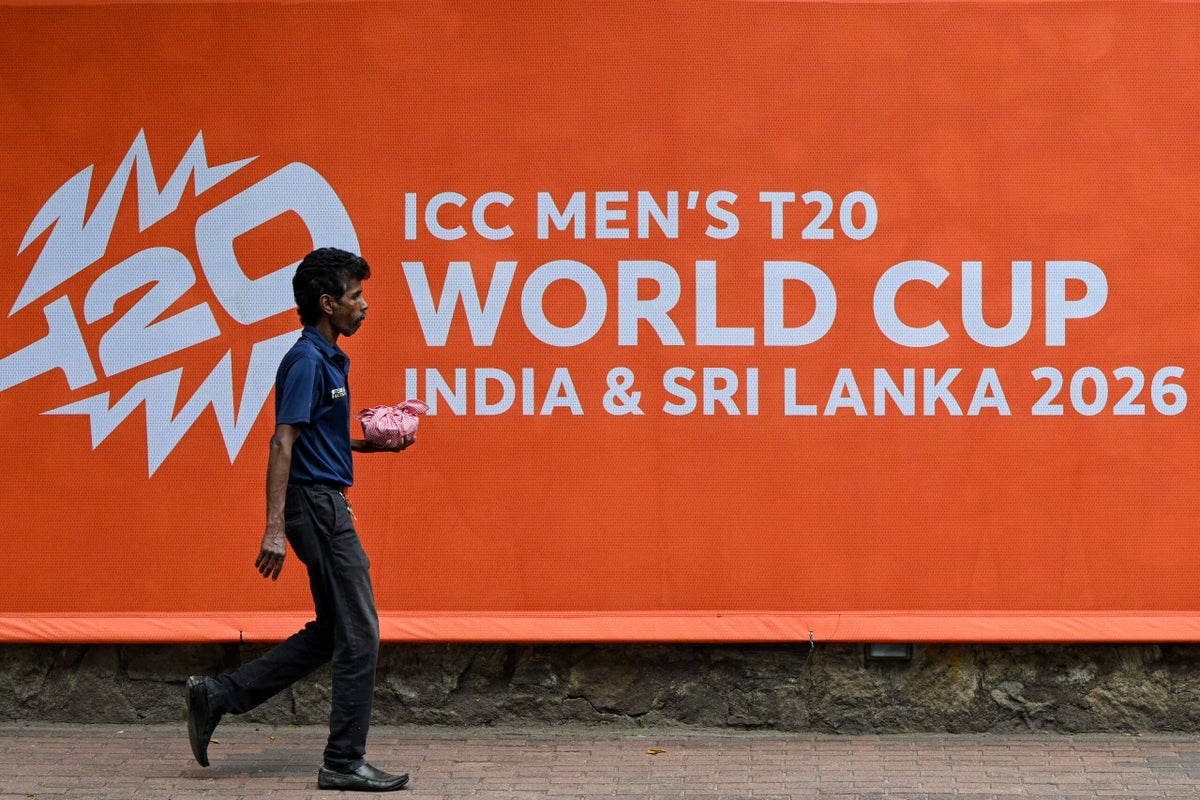
The men’s Twenty20 World Cup is supposed to be a celebration of cricket.
It is underway with three matches per day in the group stage of the sport’s most profitable format. The tournament is meant to fuse the modernity of big-hitting, fast-moving matches with the tradition of international prestige and long-held rivalries.
The build-up, however, was overshadowed by diplomatic tensions between nations on the Indian subcontinent.
Cricket has often been a conduit for such issues, with matches becoming symbolic of a wider, deeply complex geopolitical situation. That extra needle and sharpened identity has contributed to the sport’s mass popularity in the region, but now it is threatening to unravel.
Co-hosted by India and Sri Lanka, the 2026 edition has been hit by the withdrawal of Bangladesh — the world’s eighth-most populous nation, replaced by Scotland at the last minute — over its refusal to play in India.
That tumultuous decision was followed by the Pakistan government announcing that the national team would boycott their scheduled match against India on February 15 in Colombo, Sri Lanka. The Pakistan Cricket Board (PCB) has not communicated why its side will not fulfil the fixture, but Pakistan’s prime minister, Shehbaz Sharif, said the move was a show of solidarity with Bangladesh.
He has since described that decision as a “clear stand”. “There should be no politics in sport,” he added. All of Pakistan’s matches had been scheduled to be played in Sri Lanka due to their refusal to participate in India.
It is hard to underestimate the ramifications of that India-Pakistan fixture not being played. Not only is it cricket’s most anticipated match, but it is arguably the definitive rivalry in any sport. A report in the Times of India projected the value of a match between the two as generating $250million (£183.6m) in revenue.
If the tournament’s most valuable fixture does not take place, it would inflict significant damage at a financially precarious time for world cricket’s governing body, the International Cricket Council (ICC). In December, the Economic Times outlined how India’s media rights holder, JioStar, was attempting to renegotiate its $3billion (£2.2bn) agreement with the ICC due to losses incurred.
The neighbouring countries are the first and fifth-most populous in the world, respectively, and cricket is the unofficial religion for both. In 2019, the ICC highlighted how a World Cup match between the two brought 273 million unique viewers watching on TV, with a further 50 million digital-only viewers.

Bangladesh refused to play T20 World Cup matches in India (Matt Roberts-ICC/ICC via Getty Images)
The political situation is complex. India and Pakistan gained independence from British rule in 1947. The partition of British India created two separate nations: Hindu-majority India and Muslim-majority Pakistan, the latter of which was divided into West Pakistan and East Pakistan (divided by over 1,000 miles of Indian territory).
In 1971, East Pakistan won independence and was renamed Bangladesh.
Relations between the three nations have not been without turbulence, but, for a while, cricket existed as a constant platform for a degree of normality. More recently, that has changed.
Follow cricket on The Athletic
In cricket, India and Pakistan do not meet in bilateral series. They have not faced each other outside men’s major tournaments since 2013, and India have not played in Pakistan since 2008. Pakistan did not host any touring nations between 2009 and 2019 following the Lahore attack on Sri Lanka’s team bus, which killed six policemen and two civilians.
Since the two nations’ independence in 1947, they have fought a number of wars and had several military stand-offs. Most recently, a four-day military conflict occurred in April 2025 following a deadly militant attack on tourists in India-administered Kashmir — a disputed region that India and Pakistan have fought over since their independence. The attack resulted in the deaths of 26 civilians, the deadliest incident since 2008.
Pakistan hosted the 2025 ICC Champions Trophy, but all of India’s matches were played in Dubai due to India’s refusal to play in Pakistan. Now, for this month’s T20 World Cup, Pakistan will not play in India.
Bangladesh’s original request to not play in India followed, they could argue, in the footsteps of those precedents. The Bangladesh Cricket Board (BCB) referenced “the growing concerns regarding the safety and security of the Bangladesh contingent in India”, but the ICC refused this request, concluding “there was no credible or verifiable security threat” to Bangladesh playing there.
In 2024, Bangladesh’s long-serving prime minister, Sheikh Hasina — a long-standing ally of India — was overthrown, and she fled to Delhi. India has not responded to Bangladesh’s calls for her extradition, and relations between the two have deteriorated.
After the fall of Hasina, a series of killings and arson attacks were reported in Bangladesh against Hindus and other religious minorities. There are approximately 13.1 million Hindus in Bangladesh, accounting for 7.95 per cent of the nation’s 165 million population, as per the Bangladesh census. Hinduism is Bangladesh’s second-largest religion behind Islam.
On December 18, Dipu Chandra Das, a 27-year-old Hindu garment worker in Bangladesh, was beaten, hanged from a tree, and burned alive in a mob lynching.
Such a volatile climate transcends sport and presents unique challenges, but cricket institutionally has become mired in the situation.
Last month, pace bowler Mustafizur Rahman — the only Bangladeshi cricketer in the auction for this year’s Indian Premier League (IPL), the world’s biggest domestic T20 cricket tournament — was released by Kolkata Knight Riders (KKR) after what the IPL franchise said was the “instruction of the Board of Control of Cricket in India (BCCI)”.
In response, Bangladesh’s interim government instructed the nation’s broadcasters not to air the upcoming IPL season.

Mustafizur, one of the format’s best bowlers, will not participate in this year’s men’s IPL (Munir Uz Zaman/AFP via Getty Images)
Pakistani players have been excluded from the IPL since the November 2008 terrorist attacks in Mumbai by the Pakistan-based terrorist group Lashkar-e-Taiba, which left 174 people dead.
These events speak to the significance of cricket diplomatically, but also of how cricket had become politicised in a broader conflict.
Sport can become intertwined with politics. In 1996, Australia and the West Indies refused to send their teams to Sri Lanka during the World Cup (co-hosted by Sri Lanka, India, and Pakistan) over security concerns. England decided not to play their 2003 World Cup match against Zimbabwe in Harare, citing security concerns and social unrest in the country, then governed by Robert Mugabe. In each case, no nations were fined or punished by the ICC, but they did forfeit the games.
However, on the Indian subcontinent, cricket has increasingly become political.
Imran Khan, widely regarded as Pakistan’s most famous and iconic cricketer, served as Pakistan president between 2018 and 2022. Pakistan Cricket Board (PCB) chief Mohsin Naqvi is the country’s interior minister.
ICC chairman Jay Shah assumed his position immediately after serving as secretary of the BCCI, which at the time had been lobbying the ICC to allow them not to play their 2025 Champions Cup matches in Pakistan. He is the son of Amit Shah, one of the most powerful politicians in India. IPL chairman Arun Dhumal, meanwhile, is the brother of Anurag Thakur, president of the BCCI between 2016 and 2017, and a government minister between 2019 and 2024.
India is the world’s dominant cricket nation; nowhere can match its 1.4 billion population, and its passion for the sport has led to the unprecedented success of the IPL.
This has not only changed the landscape of the sport but has turbocharged the BCCI’s coffers. India generate an estimated 80 per cent of the game’s global revenue, dwarfing those of the next highest nations, England and Australia, with other countries almost entirely reliant on the money they receive from broadcasting deals when hosting India and in their ICC hand-outs.
Of all ICC profits, India receives almost 40 per cent, with England next-highest on the list at less than seven per cent. India’s power and influence within cricket is unquestionable, but that provides a responsibility to place the health of the sport at the centre of its decisions.
From those on the outside looking in, the skewed distribution model may be seen as entrenching India’s power and restricting the growth of the global game.
This year’s tournament brings together 20 nations in a format that encourages playing with positive intent. Yet before the first ball was bowled, it was deprived of Bangladesh, one of the most colourful and passionate cricketing nations, and its marquee match-up.
That has led to hastily rearranged matches, last-minute negotiations, and the likelihood of an automatic India group-stage victory via forfeit.
These developments may help India’s chances of success, but they undermine the power of the event.