
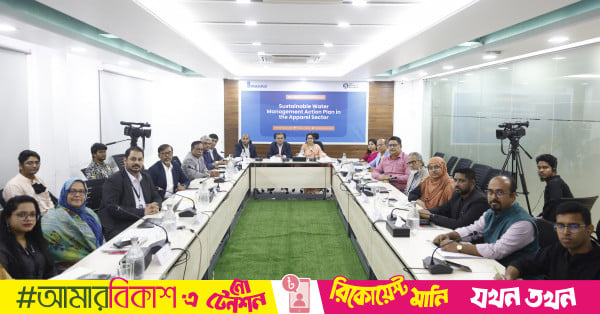
Bangladesh must introduce pricing for industrial water use to curb excessive extraction and wastage, and avert a looming groundwater crisis, experts warned today (29 November).
At a roundtable organised jointly by WaterAid and The Business Standard in Dhaka, they painted a stark picture: In Gazipur – the heart of the country’s manufacturing hub – groundwater is falling by 2-3 metres every year, sucked out relentlessly by factories that treat water as an inexhaustible free good.
This continued decline, they argued, is pushing Bangladesh toward a point where industries may simply no longer be able to draw the water they need to operate.

The concern is compounded by another troubling trend. Despite a prolonged monsoon this year, the soil is losing its natural ability to absorb and hold water, meaning even the rains are failing to recharge aquifers. The country’s industrial engine, powered by groundwater, is running on a shrinking reserve.
“Water is being wasted in many cases. To prevent wastage, imposing a price on industrial water use can be considered,” said Hasin Jahan, country director of WaterAid Bangladesh, at the roundtable titled “Strategic Consultation on Sustainable Water Management Action Plan in the RMG Sector.”
She pointed out that the government has already imposed restrictions on groundwater extraction in several industrial pockets. But the warning signs are now much more ominous.
“If groundwater levels fall further in Gazipur,” Hasin asked, “what happens to industries there? What happens when they can’t pull water out anymore?”
If optimal use of water is ensured, industries will be compelled to adopt alternative measures such as rainwater harvesting and proper use of effluent treatment plants (ETPs), which can help protect industries, agriculture, and the people from future water scarcity, she said.
A draft guideline on water use has also been prepared by the Water Resources Planning Organization (WARPO), which includes mandatory permission from local authorities. However, no decision has yet been made regarding water tariffs, added Hasin Jahan.
Representatives from factories, development organisations, and water specialists echoed similar worries. The message was unmistakable: unless Bangladesh begins treating water as a finite economic resource – not a free commodity – the country’s industrial zones may soon hit a wall no policy can cheaply fix.
Speakers expressed disappointment that Bangladesh does not have policies to prevent water discharge (untreated water), even though such laws exist in various states in neighbouring countries. Because of the absence of such policies, industries access water for free and use it excessively, they said.
To reduce industrial water misuse, they emphasised not only water pricing but also awareness building, coordinated efforts from all parties, and ensuring low-cost, sustainable financing.
AKM Masum Ul Alam, adjunct faculty at Bangladesh University of Health Sciences, said, “Policies are needed to determine whether a metering system will be used to measure water usage… The government should introduce a unified inspection policy for industries to ensure optimal use of water.”
He urged the relevant government agencies and private sectors to collaborate, pointing out that although ETPs have been installed in many industries, most of them are not operated regularly due to additional costs. They are often used only when government officials visit for inspections.
“There should be technologies to measure ETP usage,” Masum added.
Md Yakub Hossain, executive director of Village Education Resource Centre (VERC), said, “Groundwater levels in some areas, including Savar, have fallen so much that even submersible pumps are failing to extract water. Shallow tube wells are also dry. Because of pollution and unplanned industrialisation, farming is no longer possible there – people cannot even use river water from Dhamrai to Munshiganj.”
“Industries are necessary, but people also need to survive,” he said.
Delowar Hossain, joint director of the Sustainable Finance Unit at the Bangladesh Bank, citing the failure of the CETP in Savar’s tannery estate, emphasised the need for private-sector management over government management in such cases.
He added that initiatives are underway to allow banks to offer low-cost financing for green projects beyond Bangladesh Bank’s refinancing schemes.
70% of RMG factories not ready for zero-discharge
At the roundtable, garment industry entrepreneurs highlighted issues such as a lack of space for zero-discharge facilities, the absence of incentives, and the failure to obtain fair prices despite additional investment.
A zero-discharge facility refers to an industrial setup where all wastewater and effluents are fully treated and recycled.
Nafiz-ud-Doula, a director of Bangladesh Garment Manufacturers and Exporters Association (BGMEA), said, “To achieve zero-discharge, factories need space, which 70% of factories do not have. Small and medium factories also face challenges in accessing low-cost funds needed for such investments. This must be ensured.”
He said that green production – including ETPs – requires 30% additional investment, but factories do not receive higher product prices in return.
Nafiz added that producing one kilogram of cotton fabric requires more than 70 litres of water, although some factories have reduced this to 40 litres through additional investment.
Admitting that ETPs exist in many factories but are not used properly, he said there are currently 268 green factories in the country, some of which practice rainwater harvesting and make significant contributions.
Hafizur Rahman, chief textile officer of Fakir Fashions Ltd, said that factories that invest in reducing water use are not getting fair judgment in product pricing.
Delowar Hossain of the Bangladesh Bank added, “We can encourage banks to provide low-cost funds for green financing in the SME sector, but we cannot force them. However, an initiative has been taken to introduce a credit guarantee scheme.”
Others who spoke included Partha Hefaz Sheikh, director of WaterAid Bangladesh; Azman Ahmed Chowdhury, director of WaterAid; Mostafizur Rahman, senior programme officer at the Embassy of Sweden, Dhaka; Farhana Bari, representative of Swedish brand Lindex; Kazi Matin Uddin Ahmed, a professor at the Department of Geology, University of Dhaka; and Faria Fahim Badhon, a WASH (water, sanitation, and hygiene) officer at Unicef Bangladesh.
TBS Deputy Editor Sajjadur Rahman moderated the roundtable.