
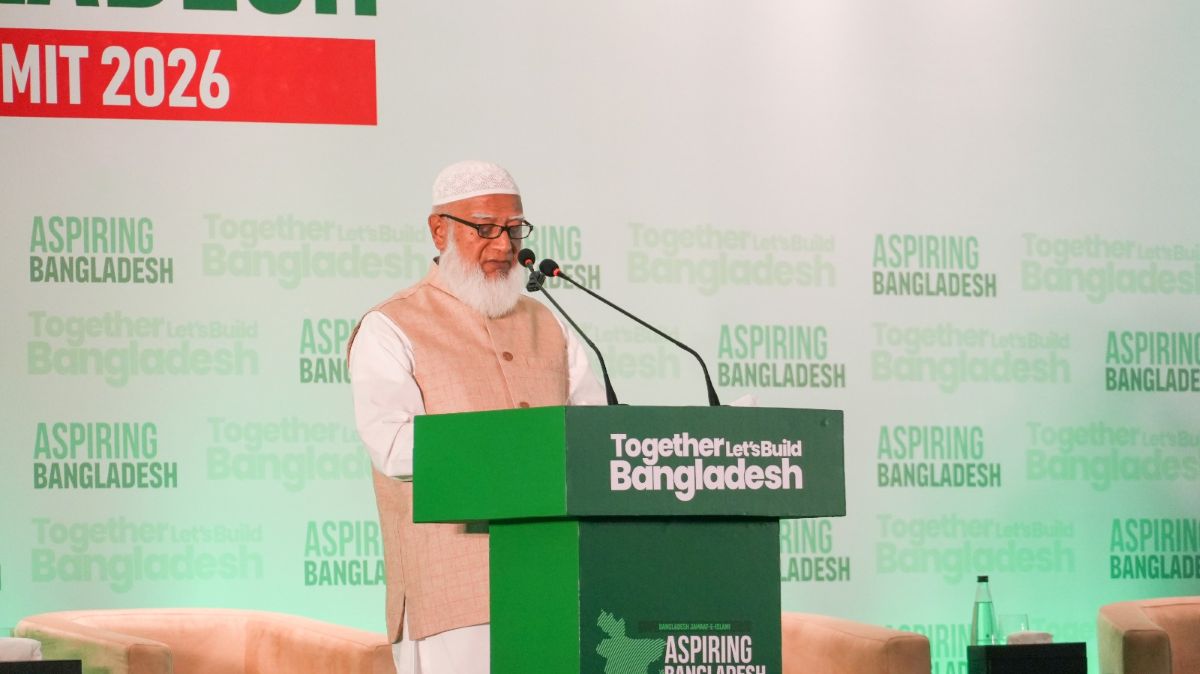
For decades, the political narrative in Bangladesh has been dominated by a cycle of unrest, retributive justice, and fragile transitions. For the first time, the conversation has shifted from who should rule to how the nation should be run. The ‘Policy Summit 2026’, organized by Bangladesh Jamaat-e-Islami, hints at a new direction in the country’s political culture. Instead of traditional slogans, the summit advocated a shift from a ‘labor-dependent economy’ to a ‘Knowledge-based Economy.’ The specific proposals creating a skilled workforce, zero tolerance for corruption, reducing bureaucratic red tape, and utilizing the intellectual capital of expatriates align perfectly with the theoretical framework of modern Development Economics. According to Human Capital Theory, investing in human skills yields greater long-term returns than investing in physical infrastructure a strong pillar of the policy proposed by Bangladesh Jamaat-e-Islami.
In this summit, Jamaat-e-Islami correctly identified the three primary barriers to the Bangladeshi economy: ‘Skills Mismatch,’ ‘Financial Wastage,’ and ‘Corruption.’ Crucially, the party diagnosed corruption not merely as a moral issue, but as a ‘Managerial Problem.’
Therefore, to curb corruption, they prioritized Digital Transformation and Structural Reform over the traditional application of laws. In their ICT policy, they proposed a ‘Zero-Cash’ system to eliminate bribery in government services. To support this, they suggested creating a digital platform named the ‘GovIntel System.’ Furthermore, proposals included making ‘e-tendering’ mandatory for all government procurement and abolishing the TIN system in favour of using only the NID (National ID) for filing income tax returns to make the tax system harassment-free and transparent. The party pledged to introduce a ‘Rule-Based’ economic system that grants no special privileges and ensure economic good governance. If these proposals are implemented properly, it will not only bring administrative transparency but also plug the leakage of state resources, injecting speed into GDP growth. If this technology-dependent ‘preventive’ strategy is utilized, it will be possible to build a justice-based and accountable state system that rises above nepotism and partisanship something indispensable for the Bangladesh of tomorrow.
Some innovative ideas proposed at the Policy Summit could emerge as true game-changers. The most notable among them is the ‘Smart Social Security Card,’ which integrates NID, TIN, and healthcare data. Once implemented, this will not be just a card; it will become a ‘Single Source of Truth.’ It can play an effective role in determining the correct beneficiaries of government benefits by automatically verifying people’s income and overall status. Such an ‘Integrated Digital ID’ is highly effective in preventing waste in social safety net programs and curbing corruption. According to World Bank research, due to weak databases in Bangladesh, about 76% of social allowances in rural areas and 32% in urban areas reach the wrong people. Integrating this into a single digital card would make the beneficiary verification process completely automated. This would minimize human intervention, reducing the chance of ineligible persons receiving benefits through nepotism to near zero. It would also prevent the same person from taking benefits multiple times and remove non-existent beneficiaries from the list. This ensures that government aid reaches the rightful recipients by reducing financial leakage. The World Bank’s ‘ID for Development’ (ID4D) research shows that such digitalization can save up to 1-2% of GDP by increasing administrative efficiency. Therefore, if Jamaat-e-Islami can launch a single integrated card, it will serve as a game-changer in establishing good governance and justice in the social safety net. However, considering the high cost of technology and cyber security risks, a ‘Phased Implementation’ would be the most appropriate strategy.
The ‘Policy Summit 2026’ proposed giving 500,000 fresh graduates a monthly interest-free loan of 10,000 BDT until they find employment (for a maximum of 2 years), as well as providing education loans to 100,000 students. From the perspective of Welfare Economics, this is a highly attractive proposition. During the frictional unemployed period, many talented students, driven by a lack of funds, are forced into ‘Underemployment’ jobs far below their qualifications. The proposed 10,000 BDT support would help them survive this ‘job search period,’ allowing them to find work that matches their skills. Furthermore, access to interest-free loans would encourage youth to become small entrepreneurs rather than just chasing jobs. According to Dr. Muhammad Yunus’s ‘Social Business’ model, the availability of capital acts as a catalyst for new innovation and job creation at the grassroots level. Aligned with Paul Romer’s ‘Endogenous Growth Theory’, which posits that knowledge and innovation, not physical capital, are the main drivers of long-term growth. Jamaat has proposed establishing a ‘Youth Job Bank’ and ‘Skill Mapping’ from the grassroots level. In its youth policy, the party has set a target to train 10 million youth over the next 5 years, according to market demand. This aims to ensure employment for 5 million youth, 2 million of whom will be in the ICT sector. There are also plans to create 500,000 new entrepreneurs and 1.5 million freelancers. To prioritize youth employment, the proposal suggests forming a ‘Unified Ministry for Workforce Development’ by merging various scattered departments.
Two revolutionary proposals emerged in the Industrial and Energy policy of the summit. The first is to revive closed factories and grant workers 10% ownership; the second is a Moratorium on gas, electricity, and water price hikes for the next 3 years for all industries. If the proposal to grant workers 10% ownership in revived factories can be implemented, it could be effective in the Bangladeshi context. Research shows that companies with ‘Employee Stock Ownership Plans’ (ESOPs) have 4-5% higher productivity and significantly less labor unrest compared to ordinary companies. In the context of Bangladesh’s Ready-Made Garment (RMG) industry, where labor unrest is a daily occurrence, this 10% ownership system, modeled after Germany’s ‘Co-determination’, could be a game-changer in establishing ‘Industrial Peace’ and increasing production. For business, the most critical factor is the predictability of future costs. If prices can be kept stable for 3 years, entrepreneurs can make long-term plans and investments. This will reduce the ‘Cost of Doing Business.’ Consequently, the country’s export-oriented industries will remain competitive in the global market, and it will help control domestic inflation. However, its success will depend on ‘Fiscal Space’ the government’s financial capacity. This ownership model will only be sustainable if built on a solid legal framework and the Moratorium model will work if alternative sources for energy subsidies (such as savings from reduced corruption) are secured.
In terms of economic and foreign policy, the summit provided a roadmap for a ‘Pro-Bangladesh Policy’ and a ‘Rule-Based’ economy. The core vision of this roadmap is democracy, economic prosperity, justice, and national unity. This roadmap is based on four pillars of good governance: Political Governance, Economic Governance, Macroeconomic Stability, and Local Government & Small-Town Development. To change the negative trends of political culture, the summit emphasizes ‘Dialogue and Dispute Resolution.’ It also proposes forming an effective and accountable government system by preventing the centralization of power and resources. To reduce the population influx toward Dhaka and ensure balanced development, the governance roadmap proposes developing every Upazila as a ‘Growth Center.’ It speaks of ensuring four basic amenities: quality education, health, housing, and local employment. If ‘Job Hubs’ or Growth Centres are created at the local level, the flow of rural money will increase. This will help reduce ‘Income Inequality’ between villages and cities.
However, there are economic challenges or ‘Trade-offs’ on the path to realizing these ambitious dreams. The primary consideration here is balancing revenue policy with social spending. First, consider the proposal for tax and VAT reform. The goal is to lower the corporate tax to 19% and the VAT to 10%. Theoretically, according to the ‘Laffer Curve,’ lowering tax rates increases investment and stimulates the economy. But the context of Bangladesh is different. Currently, Tax and VAT are the government’s biggest sources of income (about 60-65% of total revenue). Yet, the Tax-to-GDP ratio fluctuates between 7.6% and 8.5%, the lowest in South Asia (Nepal is at 17%, India at 12%). According to the IMF’s ‘Article IV Consultation’ report, this ratio needs to be at least 15% for sustainable growth in a developing country. Therefore, if the VAT rate is lowered to 10% without expanding the ‘Tax Net’ by at least four times, it could immediately create a revenue deficit of 50-60 thousand crore BDT. To meet this massive deficit, the government would have to rely on bank borrowing, which could hinder private investment through the ‘Crowding Out Effect.’ So, Jamaat-e-Islami must proceed with a concrete blueprint to expand the Tax Net. In the summit, the party proposes to cover this massive expenditure by stopping NBR corruption to save 200,000 crore BDT and reforming 76 struggling state institutions to earn 6,000 crore BDT. Additionally, they plan to save about 33,000 crore BDT by restructuring loan conditions.
Secondly, the proposal to allocate 6-8% of GDP to the health sector is undoubtedly pro-people. But whether this target is realistic, given the ‘Absorptive Capacity’ the institutional ability to spend money effectively requires deep analysis. Currently, government spending on health in Bangladesh is only 2.39% of GDP. Raising this suddenly to 6-8% carries a risk of massive waste or ‘mismanagement.’ According to international standards, developing countries need to spend at least 5% of GDP to ensure Universal Health Coverage. Therefore, rather than aiming for an ambitious 6-8%, achieving the international standard of 5% first would be a realistic and sustainable strategy. Consistent with the concept of ‘Opportunity Cost,’ excess allocation to health (the portion above 5%) might be more logically spent on increasing institutional capacity or on other productive sectors like defence, ICT, and R&D. Other proposals, such as free healthcare for those over 60 and children under 5, are undoubtedly positive. But Jamaat-e-Islami must think separately about healthcare costs for the rest of the population. According to the WHO, ‘Out-of-Pocket Expenditure’ in Bangladesh is about 74%, one of the highest in the world. A detailed discussion is needed on how to move Bangladesh toward a functional Universal Insurance System to improve health standards and reduce financial burdens.
The plan to bring back expatriate researchers and professionals as ‘Intellectual Remittance’ alongside traditional financial remittance is a visionary step. In economics, this is called ‘Brain Circulation,’ which played a major role in the technological revolutions of China, Taiwan, and South Korea. Furthermore, the proposal to send talented students to top global universities annually under interest-free loans is undoubtedly positive. Additionally, Jamaat’s ‘Women in Action’ policy introduces two modern concepts to ensure women’s economic independence. One is the ‘Re-entry Pathway’ for women who dropped out of careers for family reasons; the second is ‘Flexible Working Hours’ for working women. In Bangladesh, a large portion of educated women quit jobs after marriage or childbirth. When skilled professionals (doctors, engineers) drop out, the state’s massive investment in them is wasted. With ‘Re-entry’ benefits and ‘flexible hours’, this vast talented demographic can rejoin the economy.
In conclusion, the ‘Policy Summit 2026’ does something rare in Bangladeshi politics. For the first time in history, Bangladesh Jamaat-e-Islami has not only knocked on the door of power but has presented the keys to unlock a prosperous future. It trades populism for pragmatism. The proposals of ‘Policy Summit 2026’ break the cycle of traditional politics to dream of a modern, pragmatic Bangladesh and show a new direction for the economy of Bangladesh. The structural and techno-political solutions sought here to help a skeletal economy stand up from the debris of 55 years of ups and downs and the ‘loot-ocracy’ of the last decade and a half are undoubtedly promising. There is no doubt that balancing tax cuts with massive social spending is a complex economic equation that will test any administration. But the very existence of this detailed roadmap offers a profound sense of hope. It demonstrates that Jamaat-e-Islami has the institutional maturity and intellectual depth required to steer the ship of state. If the vision of ‘Zero Tolerance’ against corruption and ‘Digital Good Governance’ is truly implemented, tackling these challenges is not impossible. If this vision of building an efficient, humane, and knowledge-based state is implemented through sound planning, institutional reform, and political will, it has the capacity to transform the trajectory of Bangladesh’s economy forever.
[Image Credit: Bangladesh Jamaat-e-Islami / Official Facebook Page]
Dr. Muhammad Salah Uddin is an Assistant Professor in the Department of International Trade and Logistics at Sakarya University of Applied Sciences, Türkiye. His research focuses on political and financial economy, sustainable development, and institutional quality. He previously served as a researcher at the University of Foggia in Italy.
Shaon Hossen Bappi is a researcher in Economics and Finance based in Manisa, Turkey, originally from Bangladesh. His work focuses on development economics and the political economy of South Asia. He currently serves as a Research Fellow at the Center for Policy and Social Research in Türkiye. The views and opinions expressed in this article are those of the authors.