
Have we ever truly considered conducting elections using environment-friendly paper—paper that doesn’t just end as waste, but eventually grows into a tree?
In a country grappling with floods, rising heat, vanishing rivers, and vulnerable communities, even the smallest act of care for the environment becomes revolutionary. As new political narratives emerge—driven by youth movements, civic activism, and global climate commitments—the question arises: Is Bangladesh ready to align democracy with environmental justice?
The use of seed paper has already begun in the Ducsu election. Seed paper is made by recycling paper and embedding seeds within it, so that once the paper is discarded, it can grow into a plant or a tree. Even during the intense political movements of the BNP, leaders such as Tarique Rahman and Zaima Rahman have used this eco-friendly paper in election-related activities. If those who speak of people-centered politics also show genuine concern for the environment and climate, then through their vision, the youth can hope to see a new and greener world.

Bangladesh’s geography makes it uniquely exposed to climate risks. According to the Intergovernmental Panel on Climate Change (IPCC), the country is highly vulnerable to sea-level rise, salinity intrusion, and climate-induced displacement. Millions living in coastal belts, riverine islands (chars), and hilly regions face repeated loss of livelihoods. The World Bank estimates that by 2050, climate change could internally displace over 13 million people in Bangladesh if adaptive action remains insufficient.
Despite notable achievements in disaster preparedness and early warning systems, structural environmental problems persist. Rivers are being encroached upon, wetlands filled for urban expansion, air quality in cities like Dhaka regularly ranks among the worst globally, and plastic pollution continues unchecked. While environmental laws exist, enforcement remains weak due to political influence, institutional limitations, and a lack of accountability.
Politics and environment: A missed opportunity?
On 1 February 2026, Dhaka witnessed more than just another conference. Under the banner of the Energy Transition Conference 2026, the room came alive with conversations shaped by urgency, empathy, and political possibility. The theme- “Voices for a gender-responsive energy future” was not treated as a slogan, but as a shared responsibility.
From the NCP, voices emerged that spoke clearly about prioritising women in their manifesto—not as beneficiaries, but as leaders of change. They acknowledged an uncomfortable truth: climate change does not affect everyone equally. Women, particularly in vulnerable communities, bear a heavier burden—whether through energy poverty, unpaid care work, or displacement. The conversation moved beyond recognition toward action, emphasising the need to expand women’s participation and leadership in the renewable energy sector.
What made the moment powerful was not the agreement of one party alone. Representatives from the BNP and other political groups echoed similar commitments. They spoke of carrying these priorities into their manifestos—and more importantly, into their own political thinking. In a country where political divides often dominate public life, this convergence felt rare and significant.
This was not about erasing differences. It was about creating a space where leaders from different political ideologies could sit together, listen, and reflect on shared challenges. That possibility—of dialogue, of accountability, of collective imagination—is what inspires faith in a new kind of leadership.
In that forum, the future felt tangible. A future where energy transition is not only about technology, but about justice. Where women’s voices are central, not peripheral. And where politics, when guided by responsibility and empathy, can still be a force for meaningful change.
Is Bangladesh ready?
What kind of country do young voters want? And what do they expect from their elected representatives? These questions were at the center of a program arranged by Jamuna Television.
One young voter shared something very simple but meaningful—this would be the first time in his life he could vote freely, according to his own choice. For him, that alone felt like change.
Bangladesh faces immense challenges—but the energy, vision, and leadership of its youth and women offer hope. Real change will not come from empty promises but from politics that listens, acts, and centers both people and the planet.
After a long time, we are seeing young people stepping into politics with confidence. Their leadership and participation have shaped what many now call the July movement, showing that youth are no longer just observers but active voices in political change.
At the same time, we are witnessing the rise of new women leaders. From Dr Tasnim Zara in Dhaka to Dr Manisha Chakraborty in Barishal, women candidates are visible on the ground. They have been working closely with communities for years, especially with women, and are now stepping forward as leaders.
For many young people, this kind of leadership feels new. Seeing women lead from the front, speak clearly, and stay connected to people gives us hope—hope for a more accountable, inclusive, and people-centered politics.
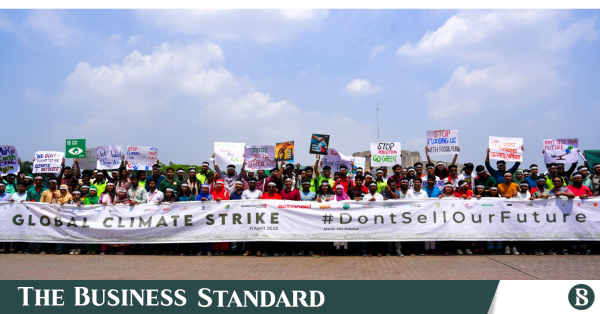
Platforms such as youth parliaments, climate strikes, and citizen-led monitoring of rivers and canals reflect a growing demand for accountability, echoing concerns raised in environmental transparency and accountability studies by TIB. These movements connect environmental degradation with broader political issues: corruption, unequal development, lack of transparency, and exclusion of vulnerable voices.
Bangladesh faces immense challenges—but the energy, vision, and leadership of its youth and women offer hope. Real change will not come from empty promises but from politics that listens, acts, and centers both people and the planet.
Sketch: TBS
“>

Sketch: TBS
Irin Akter Shuchana is a Research Intern at the International Centre for Climate Change and Development (ICCCAD).
Disclaimer: The views and opinions expressed in this article are those of the author and do not necessarily reflect the opinions and views of The Business Standard.