
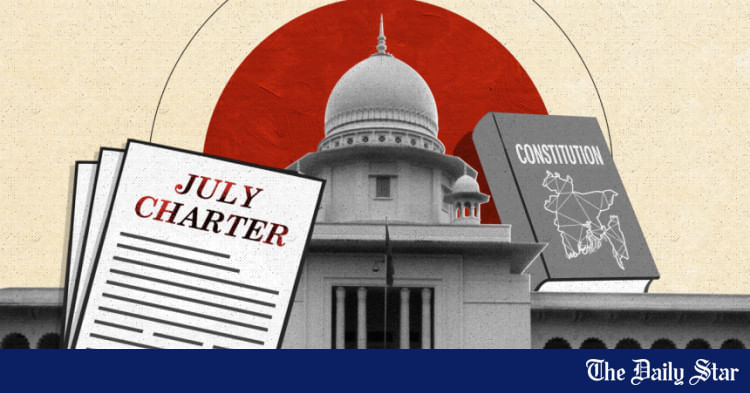
With just a day remaining before the interim government’s preferred timeframe for political parties to resolve their differences over the July charter, there are barely any signs that the deadlock is easing.
The BNP yesterday said it would join talks with other parties only if the invitation came from Chief Adviser Muhammad Yunus.
 For all latest news, follow The Daily Star’s Google News channel.
 Rejecting Jamaat-e-Islami’s call to engage in dialogue on the charter’s implementation, it questioned why another political party was issuing the invitation.
Meanwhile, nine parties — the NCP, Amar Bangladesh Party, Gono Odhikar Parishad, and six from the Ganatantra Mancha alliance — are in talks to find ways to break the deadlock. A Ganatantra Mancha leader said they were yet to hold discussions with the BNP and Jamaat.
In a separate development, a liaison committee of eight political parties, including Jamaat, which is carrying out a simultaneous movement, warned yesterday that if their demands are not met, they will announce tougher programmes at their November 11 rally.
The demands include the issuance of the July charter implementation order and holding a referendum on it within this month.
Amid ongoing disputes over the timing of the referendum, the charter’s implementation order, and the fate of the notes of dissent, the government on Monday called on parties to settle disputes and reach a unified decision, preferably within a week.
Law Adviser Asif Nazrul, speaking after a special advisory council meeting that day, told reporters: “We haven’t issued any ultimatum. We’ll wait. After that, the government will act as necessary.”
Speaking at a discussion on “Revolution and Solidarity Day”, organised by the Jatiyatabadi Chhatra Dal yesterday, BNP Standing Committee Member Salahuddin Ahmed urged the interim government to remain neutral.
“We have and will continue to support you … But if you think you can invite us to dialogue through another political party… who are they? If the chief adviser invites us to discuss any issue, we’re always willing to engage. But why are we being invited through another party?”
He said his party maintains political communication and dialogue with others as part of democratic culture. “However, if you indirectly invite us by assigning a referee role to another party, that may not be appropriate.”
Salahuddin added that the interim government does not have the authority to impose “such deadlines.” “You are not an elected government, please remember that. You don’t have the mandate to dictate terms by saying, ‘If you don’t reach a decision within seven days, we will make one.’ Such a display of power may not suit you.”
Addressing Jamaat-e-Islami, he said the party took a contrary path in 1947 and again in 1971. “Jamaat became companions of Hussain Muhammad Ershad through the Jatiya Party. Now, if you seek a political revival by aligning with the Awami League, only God knows what the outcome will be. What you have initiated could encourage the fallen fascists and other undemocratic forces.
“However, if you claim that since you’re not getting your share, you’ll spoil the pot for everyone, the people of Bangladesh will not accept that. They won’t give you that opportunity.”
He added, “If you [Jamaat] want to enjoy the benefits, go ahead. But we will not allow the democratic battlefield of Bangladesh to burn again.
“You have declared an ultimatum until November 11. Who is issuing ultimatums to the government? The government has already made recommendations in your favour. The National Consensus Commission has given you everything you asked for. That’s why you’re echoing its position.”
Salahuddin said there was “no need” for a referendum. “This referendum will result in legislation and constitutional changes. However, it will also impose a moral obligation on current and future MPs — whether the people want these reforms implemented or not. If it is to be held, there is no alternative but to hold it on election day.”
Speaking at an event titled “Janatar Ishtehar”, organised by Trace Consulting Firm, a civic organisation, yesterday, Jamaat’s Assistant Secretary General Hamidur Rahman Azad said, “We invited the BNP secretary general to sit for a dialogue. They responded by saying they would not accept Jamaat’s call.”
Speaking to The Daily Star, Azad, also part of a two-member committee formed to prepare a “consensus framework” on the electoral structure, implementation of the July charter, and conduct of the referendum, said most parties had given a positive response to their proposal for talks. “However, the BNP was negative when we contacted them on Thursday.”
At yesterday’s event, Azad said the Awami League regime had followed a similar pattern: agreeing to sit with some parties while refusing others. “Can’t we move beyond that culture? If you invite us, we’ll come. If the BNP extends a call, Jamaat will be the first to respond — and we’ll encourage others to join as well.”
He added that a referendum before the polls is necessary so that people understand what the proposed reforms actually mean. “The public may know a little, but a referendum would allow for broader awareness.”
Explaining why Jamaat began its current movement regarding the referendum and charter implementation, Azad said they were advancing through a democratic process to reach out to the public rather than acting as a pressure group.
Speaking at the same event, BNP Standing Committee Member Amir Khosru Mahmud Chowdhury said the country’s people respect differences of opinion.
“That culture must remain among us. You can’t just take to the streets at the drop of a hat. If another party then takes to the streets, what happens? If they respond with counter-protests, won’t that lead to clashes? Is this why we removed Sheikh Hasina?”
He said everyone has the right to protest. “But the people of Bangladesh do not want confrontational politics. They want stability.”
The BNP leader added, “The issues on which we haven’t reached consensus, we’ll take those to the people in the upcoming election. And the points on which we’ve agreed, we’ll implement them.”
At the same programme, Chief Adviser’s Press Secretary Shafiqul Alam said many parties are still saying there is uncertainty surrounding the July charter. “But debates like these continue for 10 to 15 years in many parts of the world. There is no ‘quick fix’ to this constitutional debate.”
He said he hoped that although there were differences, consensus would emerge. “If political parties fail to make a decision, the interim government — in line with the responsibility entrusted to it — will take one. And that will happen soon.”