
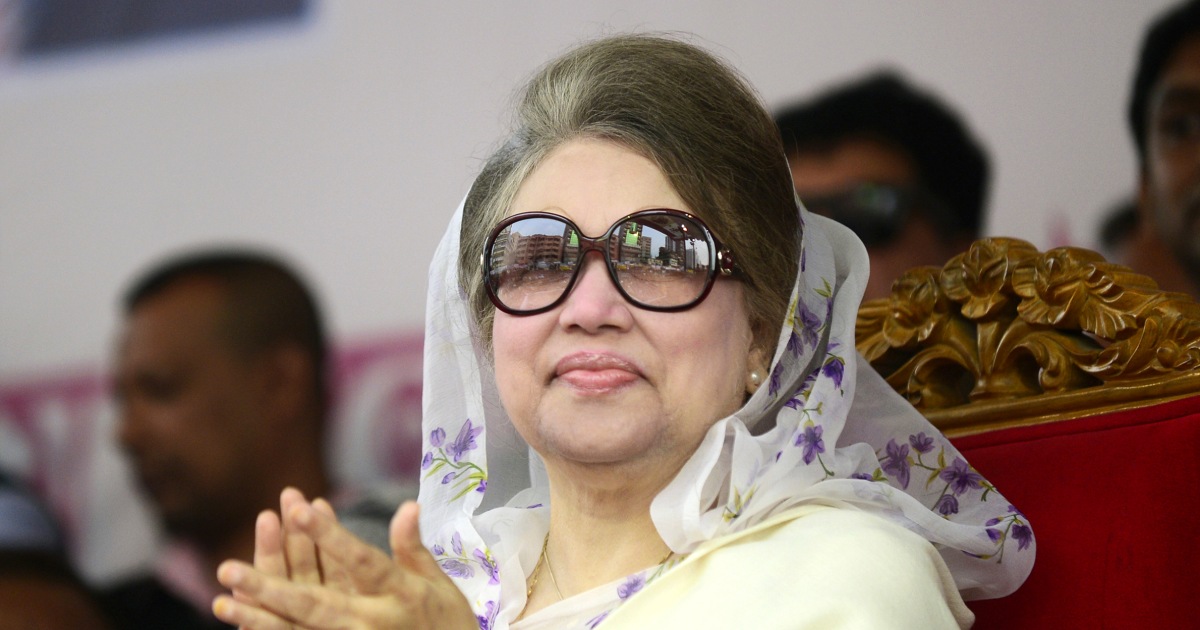
But their cooperation did not last long. Their bitter rivalry would lead to the two being dubbed “the battling Begums” — a phrase that uses an Urdu honorific for prominent women.
Supporters saw her as polite and traditional yet quietly stylish, someone who chose her words carefully. But they also viewed her as a bold, uncompromising leader when it came to defending her party and confronting her rivals.
Hasina, by contrast, was far more outspoken and assertive. Their opposite personalities helped fuel the rivalry that dominated Bangladesh’s politics for decades.
In 1991, Bangladesh held what was hailed as its first free election. Khaleda won a surprise victory over Hasina, having gained the support of the country’s largest Islamic party, Jamaat-e-Islami.
In doing so, Khaleda became Bangladesh’s first female prime minister and only the second woman to lead a democratic government of a mainly Muslim nation after Benazir Bhutto, elected to lead Pakistan three years earlier.
Khaleda replaced the presidential system with a parliamentary one, so that power rested with the prime minister. She also lifted restrictions on foreign investment and made primary education compulsory and free.
She lost to Hasina in the 1996 general election but came back five years later with a surprise landslide win.
Her second term was marred by the rise of Islamist militants and allegations of corruption.

In 2018, after Hasina had reclaimed Bangladesh’s highest office, Rahman was tried in absentia and sentenced to life for the attack. The BNP denounced the trial as politically motivated.
Although Khaleda later clamped down on Islamist radical groups, her second stint as prime minister ended in 2006 when an army-backed interim government took power amid political instability and street violence.
The interim government jailed both Khaleda and Hasina on charges of corruption and abuse of power for about a year before they were both released ahead of a general election in 2008.
Khaleda never regained power. With the BNP boycotting the 2014 and 2024 elections, her feud with Hasina continued to dominate Bangladeshi politics.
Tension between their two parties often led to strikes, violence and deaths, impeding the economic development of Bangladesh, a poverty-stricken country of about 175 million that is low-lying and prone to devastating floods.
In 2018, Khaleda, Rahman and aides were convicted of stealing some $250,000 in foreign donations received by an orphanage trust set up when she was last prime minister — charges that she said were part of a plot to keep her and her family out of politics.
She was jailed but moved to house arrest in March 2020 on humanitarian grounds as her health deteriorated.
Khaleda was freed from house arrest in August 2024 after Hasina’s ouster.
In early 2025, Khaleda and Rahman were acquitted by Bangladesh’s Supreme Court in the corruption case that resulted in the 2018 jail sentences. Rahman had been acquitted of the 2004 grenade attack on Hasina a month earlier.