
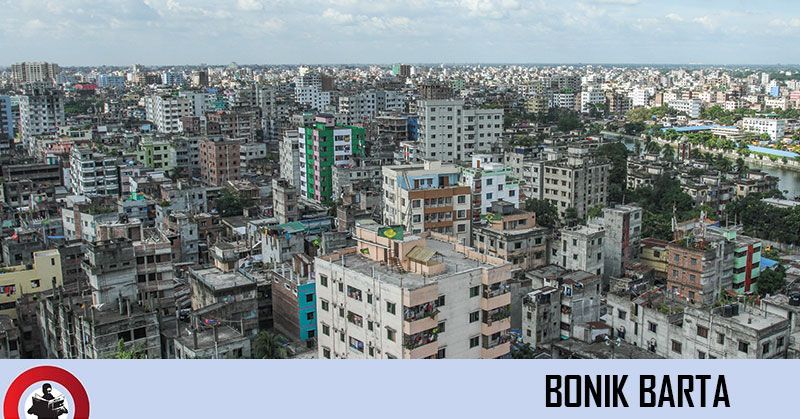
The issue of climate change received overwhelming international attention in the 1980s as industrialization and greenhouse gas emissions increased. In the 1990s, different initiatives and plans were taken to deal with its impacts throughout the world. But in Bangladesh, even the master plans of major cities such as Chattogram, Cox’s Bazar, and Khulna did not incorporate the issue of climate change. According to experts, this has happened because there is a policy mindset that perceives environmental protection and development as two opposing goals.
For Dhaka, the capital, Rajdhani Unnayan Kartripakkha (RAJUK) prepared the Dhaka Metropolitan Development Plan (DMDP) for 1995–2015. This plan did not consider climate change. However, RAJUK’s Detailed Area Plan (DAP) in 2016 brought in the climate change factor into urban planning. Similarly, the Chattogram Development Authority (CDA) prepared the Chattogram Metropolitan Master Plan (1995–2015) and the Urban Development Plan (1995–2005); neither of these plans considered climate issues.
Adjacent to Chattogram is the seafront district of Cox’s Bazar. Back in 2011, the Cox’s Bazar Development Authority (CoxDA) adopted the “Development Plan for Cox’s Bazar Town and Sea Beach upto Teknaf,” valid until 2031. Although a climate-vulnerable area, the plan for Cox’s Bazar did not include the issue of climate change.
In Khulna, the Khulna Development Authority (KDA) prepared three master plans: the Structural Plan for Khulna Metropolitan Area (2001–2021), the Detailed Area Plan for Khulna Master Plan Area (2018–2023), and the Khulna Metropolitan Development Plan Mongla (2011–2031). None of these adequately addressed climate change, even though Khulna is among the regions most affected by its impacts.
The Rajshahi Development Authority (RDA) also excluded climate change issues in its first master plan that covered 2004–2024. However, the authority has considered it in the new plan covering 2022–2041.
A publication issued by the Ministry of Housing and Public Works (MoHPW) marking World Habitat Day 2025 shows that Bangladesh’s urban master plans had not considered climate change. The book includes a research paper by Abul Baker Md Touhid, Joint Secretary at the Planning and Development Wing-1 of the ministry, which revealed that climate change was not appropriately addressed in the master plans prepared by the development authorities under the ministry between 1995 and 2010. He said failing to do so is not an option in a climate-vulnerable country like Bangladesh and attributed the gap to limited understanding among the urban planners and related stakeholders.
On the issue, Abul Baker Md Touhid told Bonik Barta, “The concept of climate change is relatively new. Master plans prepared before 2010 didn’t prioritize environmental issues. After 2010, climate change was incorporated into the planning process.”
The master plans for Khulna and Cox’s Bazar were both done after 2010. In reply to why those did not consider climate change issues, he said, “There are many aspects to planning, including strategic and urban area planning. Broadly speaking, these cities may have some gaps regarding climate issues, and those must be addressed. The new plans will incorporate those elements.”
Mohammad Ashraful Islam, Project Director of DAP 2022–2035, and Chief Town Planner at RAJUK, said it is highly important to integrate climate change into the planning of Dhaka and other major cities. Speaking to Bonik Barta, he said, “Bangladesh ranks among the most climate-vulnerable countries. Storms, tidal surges, droughts, floods, and heavy rains have long been our challenges. Now we are also facing new urban problems like scarcity of water, extreme heat, and shorter winters. To address those challenges and increase resilience, city infrastructure, buildings, roads, density zoning, and green spaces can play a vital role. With that in mind, we have given special emphasis on climate considerations in the DAP.”
Mentioning that the absence of clear guidelines is the main reason why climate issues still receive little attention in the plans of other development authorities across Bangladesh, he added, “When planning for a major city, the terms of reference should include guidelines on how to address climate impacts. But in many master plans, this has been overlooked. This is because those involved lacked awareness. Otherwise, how is it possible that climate considerations were ignored in the master plans of coastal cities like Cox’s Bazar and Chattogram? Cox’s Bazar faces storms and tidal surges throughout the year. The issue should have been addressed more thoroughly there. It’s simply unacceptable.”
He added that climate issues only began to become a mainstream concern following the 1992 Earth Summit, and since then have been part of urban planning globally.
Urban planners say that the failure to give priority to climate change in master plans reflects both ignorance and negligence among government policymakers. Professor Dr. Akter Mahmud of the Department of Urban and Regional Planning (URP) at Jahangirnagar University (JU) told Bonik Barta, “Considering climate change issues in urban planning is a basic practice. It’s astonishing that modern urban planning could overlook something so fundamental.”
Highlighting the flaws in the master plans that were prepared by the different development authorities, he added, “If you are an urban planner, you must consider climate factors. Dhaka and Rajshahi did so. How much they implemented is another discussion. But the fact that most large cities didn’t even include climate considerations shows that their planning was incomplete. Either those at the policy level don’t understand planning, or the officials involved need better comprehension before engaging in such processes.”
Dr. Adil Mohammed Khan, president of the Bangladesh Institute of Planners (BIP), also stressed the need to include climate change explicitly in the master plans. He told Bonik Barta, “The government in our country doesn’t plan properly. Even when plans are made, they get changed under pressure from vested interests or business groups. People say good things about the DAP. But how many times has it been changed in the last two years? Why? Because of concessions to business interests. So, while environment- or climate-focused master plans are essential, what’s even more important is not compromising on the fundamental principles of planning. Unfortunately, that kind of compromise has occurred repeatedly in Bangladesh’s planning history.”