
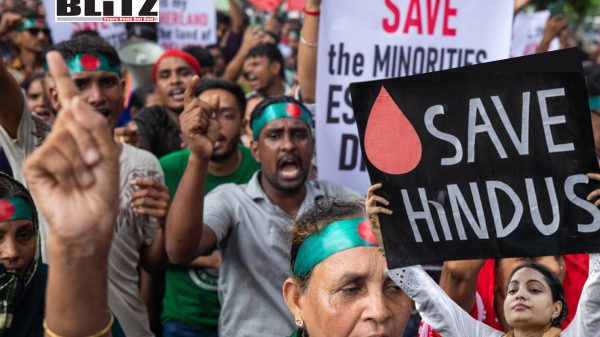
With less than five weeks before Bangladesh’s 13th national election, the country’s domestic politics has reached its nadir since 2024 July Uprising. Since the emergence of ‘new Bangladesh’, the law-and-order situation has taken a toll with no signs of improvements at any time. Bangladesh’s interim government, instead of amplifying security measures and acknowledging its administrative loopholes, maintained a persistent attitude of nonchalance. Geopolitically, under the interim government, the country’s neighborhood dynamics underwent an unsettling change with Dhaka tilting towards Pakistan while rupturing its relations with India, once a closest neighbor. New manifestations of violence—political, ethnic, communal, gender—are raking up simultaneously with the Islamists on a rise in the country. These factions, typically Bangladesh’s predominant pro-Pakistan voices, are now weaponizing violence against minorities as a bait to sustain the India-Bangladesh diplomatic cool.
The July Uprising and the political aftermath in Bangladesh noted anti-Awami League forces making its anti-India sentiments loud and clear—alleging India behind Bangladesh’s controversial elections in the past that enabled Sheikh Hasina’s prolonged stay in power. The July ‘warriors’, a section that later established the National Citizens Party and in electoral alliance with Jamaat-e-Islami, blames New Delhi for making Awami League its own ‘slave’ and establishing hegemony over Bangladesh, a political narrative carried on by the interim government as well. In fact, its geopolitical hedging is believed to be interim government’s deliberate anti-League posturing that blends well with the present political atmosphere and gives interim government the legitimacy it seeks. In other words, by narrowing India-Bangladesh ties through Awami League prism, the present anti-India sentiments not only became somewhat mainstream but also became a great gimmick for political parties now competing to secure electoral mandate in the February election. The interim government, too, has made good use of prevailing anti-India sentiment via statements of shifting blame for every major domestic unrest within the country, bypassing accountability and accusing New Delhi of harbouring activities in its soil that seeks to destabilize Bangladesh, a claim that India has categorically rejected.
An understanding of these changing dynamics will not be complete without taking the radicals on rise into consideration. Taking advantage of political vacuum due to the ostracization of Awami League, the Islamists (living under political repression during League’s rule) went on a rampage to attack the country’s core secular fabric—the minorities. Soon after Sheikh Hasina fled the country on 5 August 2024, these Islamists unleashed violence on minorities, their religious sites, properties and businesses. Despite over 2,000 reported incidents in August 2024 alone, the interim government called these attacks ‘political’, refusing to admit the communal undertones. Minorities became unanimously labelled as “Awami League loyalists”, since Awami League has been Bangladesh’s most significant and powerful secular political party, and hence any attack on minorities received silent justification for being mere political vendetta. The influence and presence of Islamists within the interim government is no secret. The fact that of the 11 reform commissions established by the interim government (expanded from the initial six), none of the reforms focused exclusively on minority issues speaks volume of its lackluster attitude on the question of minorities
Civil organizations like the Hindu-Buddhist-Christian Unity Council (HBCCUC)’s reports on increasing persecution of minorities (which includes land grabs, sexual violence, arson attacks and murders) have been repeatedly claimed by the interim government as ‘false’ and ‘misleading’, even rebutting US’s Religious Freedom Report that detailed the kind of violence minority communities in Bangladesh have been subjected to since Hasina’s departure. Nevertheless, USCIRF Bangladesh Factsheet stated that religious freedom concerns persist, invalidating the interim government’s claim as these ‘exaggerated reports’ to be manufactured in India. 2025 witnessed minorities in Bangladesh turning more vulnerable than ever. Islamists groups like Towhidi Janata have wreaked havoc on every cultural event that celebrated secularism and pluralism, backed by Hefazat-e-Islam that has been championing for the establishment of a caliphate system in Bangladesh. Hefazat has even intensified its efforts demanding for the ban of ISCKON, calling it an ‘Hindutva extremist organization’ and an ‘agent of India’. It should be noted that the spike in mob violence against minorities in over 30 districts noted a common pattern—on the allegation of ‘blasphemy’ often spread through social media rumor. About 71 related cases have been reported by in June-December 2025.
Bangladesh’s political churning took a new turn with the assassination of Inqilab Moncho spokesperson Sharif Osman Hadi last month. The aftermath of Osman Hadi’s death witnessed another wave of mobocracy across the country. Inqilab Moncho-led mob which predominantly included the Islamists attacked and torched Dhaka offices of the country’s most prominent media outlets—Prothom Alo and the Daily Star—branding them as ‘pro-India’ and ‘secular media’ They also attacked and vandalised the country’s most significant cultural centres—Chhayanaut and Bangladesh Udichi Shilpigoshthi—in Dhanmondi, Dhaka with mob chanting Islamic slogans and labelling the cultural centre as a “anti-Islamic’ and a “promoter of Indian culture”. Yet again, in act of disowning Bangladesh’s liberation war, Sheikh Mujibur Rahman’s ancestral home Dhanmondi 32 was vandalised by a group of the mob. A mob group also gathered outside Indian High Commission in Dhaka, and Assistant High Commissions in Chattogram, Sylhet, Rajshahi and Khulna.
Around the same time, in Mymensingh, Bangladesh witnessed the horrifying image of the naked corpse of Dipu Das hanged to a tree and set ablaze as onlookers cheered and celebrated. Das, a Hindu garment worker, was accused of ‘blasphemy’ without direct evidence upon which Islamists mob lynched him to death and showed the world the fate of Bangladeshi minorities at present in the country. More such persecutions continued after Dipu Das, notably, arson attacks by Islamists on several Hindu homes, trapping them inside, in Raozan area in Chattogram and Pirojpur districts. In its latest press release, Bangladesh Hindu Buddhist Christian Unity Council noted at least 51 incidents of violence against minorities in December. The council noted that besides blasphemy, minorities were also attacked on allegation of being RAW (India’s intelligence agency) and intensifying communal violence in the country has been created to be used as intimidation tactic to prevent minorities from exercising their democratic right to suffrage. The eerie silence from the interim government following this press release tells that it is holding onto its usual delusion of this being another ‘exaggerated report’, one that it maintained after India’s press briefing after Dipu Das’s lynching where the MEA spokesperson highlighted that over 2,900 documented incidents of violence against minorities cannot be treated as exaggeration.
It is evident that pro-Pakistani Islamists are using minorities as a bait to deteriorate diplomatic relations between New Delhi and Dhaka. Since August 2024, India has been raising concerns (and also condemnations) of communal violence in Bangladesh, expecting to see a peaceful democratic transition in Bangladesh which is inclusive. The interim government’s refusal to see the deplorable situation of communal violence, not only provided more leverage to these Islamists to continue their shameful acts but also their persistent intimidation attempts to trigger provocative response or action from India, a Hindu majority neighboring country. For mere statements of concern from New Delhi have previously been treated as ‘uncalled interference’, while minorities get profiled as ‘pro-India’ or ‘India’s agent’ that sustained ‘Indian hegemony in Bangladesh’ simply because of their minority identity. Without a doubt, even limited action by New Delhi, if fallen into the bait, would be projected as ‘aggression’ or ‘hegemonic attempt’ to validate their new political narrative, keeping national election in mind. Certainly, the repeated intimidations through attacks on minorities not only keep them vulnerable but also deepen an already strained India-Bangladesh bilateral ties. In this state, the Islamists and its ideological source Pakistan become the ultimate beneficiaries. Islamists parties have already made it clear that they would replace all ‘man-made laws’ with Sharia, a direct indication of minorities vulnerable state to worsen if they win the electoral mandate. On the other hand, the cooling of India-Bangladesh ties has already been benefitting Pakistan the most that is eyeing Bangladesh to operate its military operations from, for Pakistani establishment survives and thrives on regional instability and mutual mistrust.
It is, therefore, pertinent to recognize this pattern, understand the intent behind and address the issues appropriately, for the sake of regional stability, growth and a stronger neighborhood.
Please follow Blitz on Google News Channel
Idrees Aftab is a freelance researcher focusing on foreign policy and security issues in the South Asian region.