
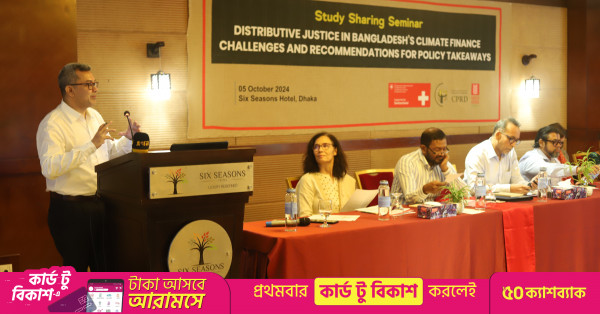
The study findings were disclosed today (5 October) at an event. Photo: TBS
“>

The study findings were disclosed today (5 October) at an event. Photo: TBS
The National Climate Budget, from FY 2008-2009 to FY 2022-2023, had not been justly distributed, said a recent study.
The findings were disclosed today (5 October) at an event “Distributive Justice in Bangladesh’s Climate Finance: Challenges and Recommendations for Policy Takeaways”, organised by the Center for Participatory Research and Development (CPRD) and Swiss Church Aid Hilfswerk der Evangelischen Kirchen Schweiz (HEKS/EPER) at the Six Seasons Hotel, Dhaka.
The study was conducted to understand whether the Bangladesh Climate Change Trust Fund (BCCTF) and National Climate Budget financed projects were approved considering climate change rationale and geographical equity.

It analysed climate finance flow in drought-prone and Barind areas and made a comparison thereof with that in other stress areas. It also analysed the scenario of climate vulnerabilities of the regions and communities, especially the plainland indigenous peoples.
The CPRD conducted the study in Dinajpur, Thakurgaon, Chapainawabganj, Naogaon, and Kurigram districts with support from HEKS/EPER.
The study analysed 790 BCCTF projects from FY 2008-2009 to FY 2022-2023 and 262 National Climate Budget-funded projects implemented through 25 ministries and their line agencies in the FY 2022-2023.
It discovered a lack of distributive justice in the BCCTF and ‘National Climate Budget’ with a dismal scenario of significantly lower financing in the drought-prone and Barind areas compared to other climate-stressed areas.
The Rajshahi and Rangpur divisions together implemented 143 BCCTF projects, which is half compared to 281 projects in the two coastal divisions. Of the ongoing national climate budget projects, 63 were found under implementation in the drought-prone and Barind areas.
The study also discovered a bias of climate financing towards infrastructural development as well as sudden disaster-driven vulnerabilities, with less importance to the sufferers of slow onset events, particularly, drought.
During FY 2009-2010 to FY 2022-2023, more than 50% of BCCTF projects worth Tk2,095.41 crore represented 50.89% of project funds spent on infrastructure development, said the study.
On the other hand, BCCTF’s thematic area ‘integrated disaster management’ received only seven projects worth Tk32.24 crore, representing 0.89% of the funds.
During that time, the Ministry of Local Government, Rural Development and Co-operatives and its allied agencies – city corporations, municipalities, upazilas, and zilla parishads – accessed 479 of the BCCTF projects.
However, the most relevant authorities dealing with the climate-sensitive sectors – the Ministry of Agriculture and the Ministry of Disaster Management and Relief – implemented 23 and 9 projects respectively, representing 3% and 1% of the projects.
Among the BCCSAP thematic areas, food security, social protection, and health received 42.28% of the ‘National Climate Budget’ resources in FY 2023-2024, and the thematic area ‘Infrastructure’ was next to it.
Md Shamsudohha, chief executive officer of the CPRD, explained the study findings and proposed several recommendations.
He demanded a systemic reform of the ‘Climate Change Trust Act -2010’ and setting outcome-focused allocation criteria of BCCTF and the National Climate Budget.
He further demanded increasing climate budget allocation and ensuring need-based and equitable allocation; development of a separate/standalone adaptation plan for the plainland ethnic communities and inclusion of this in the NAP; a locally-led climate vulnerability analysis’; fostering gender-responsive climate-resilient livelihoods; ensuring climate-sensitive land use planning; capacity building of the local government authorities; and exploring mitigation opportunities aligned with the NDCs.
Dr Fazle Rabbi Sadeque Ahmed, deputy managing director, Palli Karma-Sahayak Foundation (PKSF) said, “We need to focus on existing resources and practical solutions based on local needs in decision-making.”
He also said adaptation plans should be designed for vulnerable groups with similar socio-economic backgrounds, ensuring equitable support in the climate-stressed areas and climate finance must be integrated across sectors to maximise impact.
He appreciated the CPRD’s study for it revealed some shadowed issues that really need greater focus.
Corinne Henchoz Pignani, deputy head of mission, Embassy of Switzerland in Bangladesh was present as the guest of honour.
She highlighted that infrastructure is important, but the most important is the dimension of humanity.
She emphasised behavioural change, and localised approaches as there is no “one-size-fits-all” solution. “True progress in climate action and justice will be achieved when communities own and develop the strategies by incorporating locally led adaptation in the central role.”