

November 19, 2025 12:24 PM IST
First published on: Nov 19, 2025 at 06:57 AM IST
The death sentence pronounced on Sheikh Hasina has pushed Bangladesh into a moment of profound reckoning — one that is inseparable from the long, troubled arc of its political history. The verdict is not merely a legal culmination; it is a seismic political event in a nation that has struggled for half a century to find the difficult equilibrium between democratic aspiration and political antagonism. For India too, this moment carries the weight of uncomfortable dilemmas that demand sobriety, patience, and a rare measure of restraint.
Hasina’s story is inseparable from the idea of Bangladesh itself. She has never been only a political leader; she is the daughter of Sheikh Mujibur Rahman — the towering figure who willed East Pakistan into a sovereign nation. Her life has unfolded at the intersection of immense personal tragedy and unusual political endurance. The conviction for crimes against humanity arising from the brutal suppression of the 2024 student protests is therefore an event of exceptional gravity. The ferocity of those months — hundreds killed, families left without answers — inflicted a wound on the country’s moral fabric. Many were astonished that Hasina, with her long tenure and political acumen, allowed such excesses. That the legal process has now assigned responsibility may offer solace to some. Yet, the speed and opacity of the trial have raised their own difficult questions. Justice in fragile democracies often walks a tightrope — swift action can appear selective; hesitation is read as weakness. Bangladesh stands precisely on that knife-edge.

This crisis also forces a reckoning with the more disquieting features of the Hasina years — her unyielding pursuit of political rivals and her readiness to deploy the full weight of the state in doing so. The most striking example was her prolonged campaign against Muhammad Yunus, now heading the interim government. Yunus is not a conventional political adversary. His pioneering work in microfinance transformed global development thinking; the Grameen Bank restored agency to millions of rural women; the Nobel Peace Prize was a recognition of that transformative impact. To large sections of the world, Yunus symbolised moral stature and innovation, standing apart from the entrenched political elite of Dhaka. Yet, he found himself cornered by a series of investigations and prosecutions that many internationally viewed as politically motivated. For his supporters, this was less about legality and more about intolerance — an unwillingness to countenance alternative centres of moral authority.
For all its political volatility, Bangladesh has witnessed remarkable social and economic progress. Women have entered the workforce in unprecedented numbers. Manufacturing has expanded. Health indicators have improved dramatically. A dynamic, aspirational society has often outpaced the political class meant to govern it. It is precisely this tension — between a vibrant society and brittle political institutions — that lends the present crisis its unsettling undertone. The verdict against Hasina may have been intended to signal accountability; unless the wider political culture changes, accountability will collapse into retaliation.
The disorientation of the Awami League at this moment is therefore consequential. Whatever the criticism of its governance, it has for decades been a central pillar of the country’s political architecture. Its abrupt displacement leaves a vacuum, and vacuums in South Asia seldom remain empty. They invite actors of all kinds — some democratic, others opportunistic, still others propelled by ideological currents long kept at bay. Among the forces waiting on the margins are Islamist groups once suppressed or marginalised. Their resurgence would not only destabilise Bangladesh but imperil the security architecture of the entire region. India, sharing a long and porous border, would feel the tremors first. History records that political turmoil in Bangladesh has repeatedly spilled across the frontier — through refugee flows, smuggling corridors, or militant movement. The state capacity of today’s Bangladesh is stronger, but uncertainty remains. This is a moment for India to practise vigilance without alarmism.
Few neighbours have mattered more to India’s security calculus than Bangladesh under Hasina’s tenure. Counter-terrorism cooperation reached unprecedented heights; Northeastern insurgent groups were denied sanctuary; borders grew calmer; India’s “Neighbourhood First” policy found its most reliable partner in Dhaka. The removal of that anchor places New Delhi in uncharted territory. India has granted Hasina asylum — an act rooted in humanitarian obligation, historical affinity, and geopolitical caution. With the new government in Dhaka seeking her extradition, India must now walk a narrow diplomatic line: Firm enough to uphold its decision, careful enough to avoid appearing enmeshed in another country’s internal rupture. Extradition is unthinkable. But even a principled refusal must be wrapped in tact, restraint, and unflagging diplomacy.
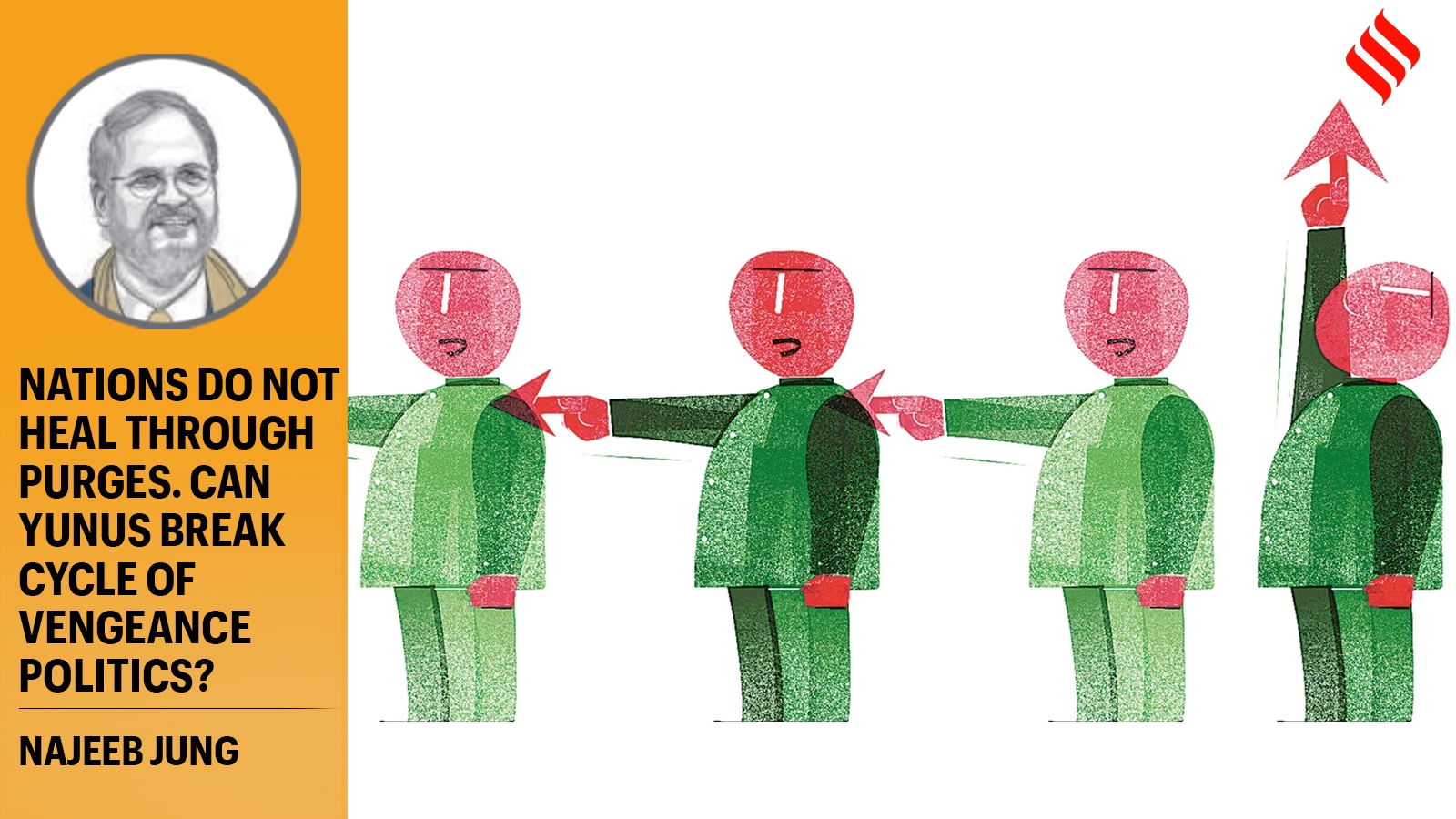
Yet, beneath these immediate anxieties lies a deeper question: Can Bangladesh break with its entrenched political habits? For decades, its politics has been shaped by cycles of delegitimisation — each government discrediting the last, each opposition waiting to avenge its defeats. Such patterns corrode institutions. They deny a nation the continuity, memory, and civic patience that healthy democracies require. Politics becomes a battleground rather than a shared civic space.
Muhammad Yunus now inhabits a moment that may either entrench this culture or begin to unmake it. The bureaucracy and security agencies have long been shaped by the preferences of whichever party held power. Unwinding those loyalties demands not only administrative competence but a moral largeness rarely found in transitional governments. Moments of political rupture often produce haste masquerading as wisdom. Purges are tempting. But nations do not heal through purges. They heal through predictable procedures, credible institutions, and an inclusive understanding of national belonging. If Yunus can guide Bangladesh even a few steps toward such a future, he will achieve what almost every government has failed to achieve: A politics not driven by fear of the other.
If its leaders can now rise above the familiar rituals of rivalry and vengeance, Bangladesh may yet inch closer to Kazi Nazrul Islam’s dream of a Sonar Bangla — a golden land anchored not in grievance but in possibility.
The writer is a former civil servant, former vice-chancellor, Jamia Millia Islamia, former lieutenant governor of Delhi and chairman, Advanced Studies Institute of Asia