
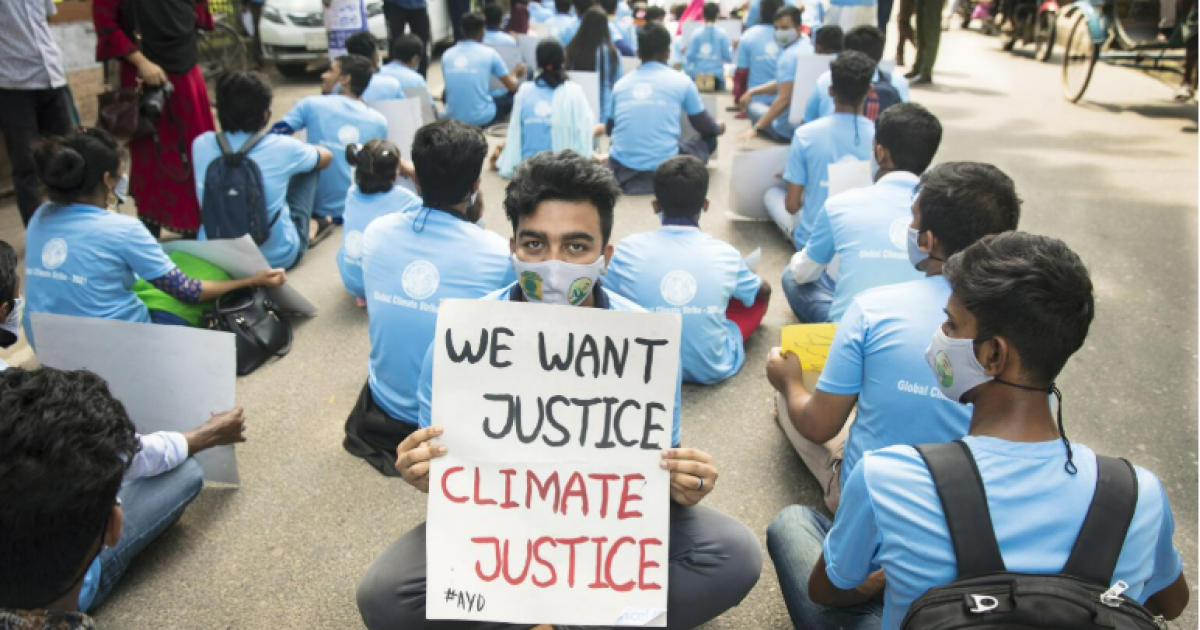
Unicef commends the interim government of Bangladesh for its visionary leadership in embedding children and young people at the heart of the country’s third Nationally Determined Contribution (NDC 3.0) under the Paris Agreement.
Led by the Ministry of Environment, Forest and Climate Change (MoEFCC) and in collaboration with key stakeholders, the new NDC represents an international commitment, with a national climate plan that not only focuses on emissions reduction, adaptation and resilience building but also profoundly commits to safeguarding children’s rights and powerfully empowering children and youth as catalysts for change.
Syeda Rizwana Hasan, adviser to the Ministry of Environment, Forest and Climate Change, said: “NDC 3.0 is not only a plan for emission reduction, but also a pledge to build an inclusive and just future.”
She stressed prioritizing the participation of women, children, the elderly, persons with disabilities, ethnic minorities, and climate migrants, while also calling for climate actions to be rights-based so that no one is left behind.
The NDC 3.0 substantially integrates the perspectives of the young people, simultaneously elevating social sectors to a central position within climate action.
It recognizes the disproportionate and devastating impacts of climate change on children and young people; impacts that severely disrupt the essential services they most rely on.
The strategic focus spans critical areas including health, food security and nutrition, water and sanitation, education, child protection, disaster risk reduction, and loss & damage.
Critically, it introduces child-sensitive sectoral targets designed to ensure the continuity of essentials services—keeping schools open, health services operational, and safe water accessible—even during severe climate events such as floods, cyclones, landslides, salinity intrusion, and heatwaves.
Rizwana said: “The recognition of the impact of the climate crisis on women, children and the most vulnerable in the NDC 3.0 represents a turning point. It captures a shared understanding of why the actions and investments we make today to protect the planet, to protect the people, must include engagement and accountability of those most impacted, and address the essential roles of the social sectors. In warmly congratulating the Interim Government, I recognise that the real work starts now, transforming the vision into tangible action and ensuring that children and young people remain active, indispensable partners as Bangladesh constructs a safer, more climate-resilient future where every child can flourish.”
To further raise awareness and behavioral change, Unicef is actively supporting MoEFCC in developing three engaging educational videos designed to cultivate healthy environmental habits from early childhood.
These resources will be strategically integrated into curricula and reinforced through comprehensive teacher training, dynamic student engagement, and localized climate action initiatives.
The NDC firmly anchors climate action in fundamental child rights principles, explicitly referencing the Convention on the Rights of the Child and the Paris Agreement’s Global Stocktake.
Furthermore, for the first time globally, the NDC meaningfully includes youth in the Measurement, Reporting, and Verification (MRV) monitoring and reporting of the NDC mechanism and commits to strengthening climate-resilient child protection systems and advancing climate justice through grievance and redress mechanisms.
This ensures vital protection for children when climate impacts escalate vulnerabilities like child marriage or child labour.
To effectively execute NDC 3.0 and realize its ambitious 2035 targets, Bangladesh will require strong national leadership and sustained international support.
Unicef stands ready to collaborate closely with all in Government, MoEFCC, and partners to mobilize climate finance, scale up child-sensitive and resilience building solutions, and ensure children and young people remain engaged in both implementation and monitoring.
Far more than a climate plan, NDC 3.0 sets a new benchmark: a transformative blueprint to protect children and young people today, while securing a safer, more resilient future for all.