
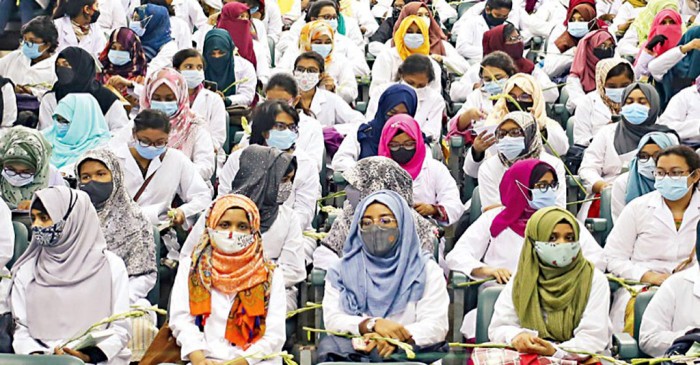

Medical education in public medical colleges, especially those established in recent years, has been badly affected by shortages of teachers, hospital facilities, and other infrastructure crises over the years.
Instead of addressing the problems, the authorities concerned have been increasing the number of seats, deepening the crises gradually.

According to the directorate general of medical education data, 37 public medical colleges enrolled 5,380 students in the 2023–24 academic year. This year, 1,030 seats have been increased in these public medical colleges.
The medical colleges have 6,125 posts for teachers, including professors, associate professors, and lecturers, but 2,482 of these posts remain vacant.
Of the posts, the highest 62.78 per cent of 833 posts for professors are now vacant in the colleges. The colleges have only 310 professors, leaving 523 posts vacant.
One of them, Bangabandhu Medical College, Sunamganj, has one professor out of 11 posts, who is the college principal. The college has only 20 teachers out of 82 posts.
Keeping 62 posts vacant, the medical college has enrolled 75 students in its fourth batch, 25 more than in the past academic calendar. The students will start their classroom activities soon, said the medical college principal, Professor Manojit Majumder.
Students of the medical college were getting clinical experience at Shantiganj Upazila Health Complex, which is roughly 17 kilometre away from their temporary campus.
Manojit Majumder said that work on establishing a 500-bed hospital for the medical college on its permanent campus was in progress.
Each medical college must have a specialised hospital adjacent to the campus, a laboratory, a library, and residential facilities, among others, as per the rules.
Half of the public medical colleges, however, have continued medical education without owning a specialised medical hospital to educate their students.
Public health expert and former president of the Bangladesh Medical Association, Rashid-e-Mahbub, said that medical education is specialised knowledge that deals with the lives of people in critical times.
Keeping huge lapses in this education, particularly clinical knowledge that students must acquire in hospitals, cannot be accepted, he said.
‹If the public medical colleges had such huge lapses, imagine what could be the reality in the 67 private medical colleges,› he wondered.
The country›s private medical colleges enrolled 6,293 students in the past academic year.
Rashid-e-Mahbub explained that medical education was not a matter of passing tests by writing something on a sheet.
‘Students have to learn about how to deal with patients in certain situations. So, practical knowledge is the main,’ he said.
‘We don’t need doctors without knowledge and skills,’ he said, adding that treatment by an unskilled professional could be more dangerous than no treatment.
Nineteen public medical colleges that started academic activities after 2010 were mostly facing the crises.
However, medical colleges established before 2010 also have teacher shortages. Dhaka Medical College has 473 posts, but only 340 are occupied, keeping the others vacant.
Several medical students also expressed their frustration over their education quality and said that they feel no confidence and are nervous even after completing their 5-year course.
Magura Medical College started its journey in 2019, admitting 50 students, but the medical college is continuing its activities in an abandoned old building of Magura›s 250-bed General Hospital.
The college has 25 physicians and other staff against 97 posts. They include just one professor among 11 posts. The authorities even failed to start the construction of infrastructure for the medical college.
In 2009, Abdul Malek Ukil Medical College started academic activities in Noakhali. The college students still travel 10 km for clinical classes to Noakhali›s 250-bed General Hospital because they lack their own hospital.
Several principals of a number of medical colleges said that they had repeatedly informed the authorities about their problems, including a lack of teachers, an equipment crisis, a hospital crisis, and a classroom shortage, but to no avail.
The director general of the directorate general of medical education, Professor Md Titu Miah, admitted the crisis and said that the students were given support from alternative sources, like a clinical practice facility at a 250-bed district hospital where roughly 500 patients take treatment most of the time.
‘I think within the next two to three years, infrastructure problems will be solved,’ he said.
Titu Miah said that a lack of coordination between the health education and health service divisions created a slow promotion and recruitment process.
He said that the health service division could not respond to crises accordingly and timely.
‘The agencies and other agencies involved in the process need to work collaboratively,’ he said.