
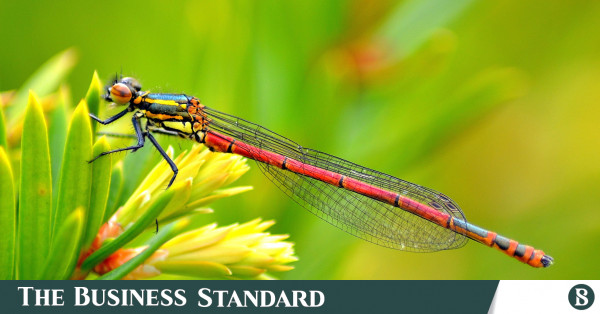
Shimmering like living jewels over rivers, ponds and marshes, dragonflies and damselflies embody both transformation and survival. Their fleeting dance across sunlit waters reveals the hidden rhythms of Bangladesh’s wetlands
Delicate yet purposeful, damselflies control insect populations, helping reduce mosquitoes and other
pests naturally. Photos: Collected
“>

Delicate yet purposeful, damselflies control insect populations, helping reduce mosquitoes and other
pests naturally. Photos: Collected
I was walking along the riverbank of the Padma, scanning the water and trees for any sign of birds, when something caught my eye. The soft mud along the bank was dotted with empty husks — the exuviae of dragonfly nymphs.
“They emerged last night,” my boatman said, pointing at the delicate shells clinging to the reeds. “Usually, during the full moon, the young ones crawl out of the water and take flight.”
I knelt to examine the tiny shells. Each one was a testament to transformation — from an aquatic, gill-breathing predator to the free-flying, sun-drenched hunter above. These were dragonflies and damselflies, insects we affectionately call ‘foring’ in Bangla.

Their iridescent wings caught the sunlight, reflecting greens, blues, and fiery reds. They are among the most spectacular residents of Bangladesh’s wetlands, marshes, ponds, ditches, and estuaries, and yet they remain underappreciated.
Dragonflies and damselflies belong to an ancient and specialised order of insects, Odonata. They were the first aerial conquerors among insects, evolving during the Carboniferous era, around 250 million years ago.
All four wings of a dragonfly can move independently, allowing it to hover, twist sharply, and even fly backward—a master of aerial
acrobatics.
“>

All four wings of a dragonfly can move independently, allowing it to hover, twist sharply, and even fly backward—a master of aerial
acrobatics.
Their wings — robust and versatile — exemplify a mastery of flight that even modern engineers admire. Unlike many insects, they can hover, dart, twist mid-air, and even fly backwards — an aerial skill set perfected over hundreds of millions of years.
Yet their lives are not just about dazzling flight. Dragonflies and damselflies lead dual lives, tied inseparably to water. They lay their eggs in ponds, ditches, or slow-moving rivers. The first two stages — egg and nymph — are entirely aquatic, gill-breathing and far longer than the adult stage.
Nymphs are stealthy hunters, crawling along submerged plants and mud, ambushing mosquito larvae, midge maggots, tadpoles, and other small aquatic prey. Some even move with surprising agility along the waterbed, proving that wings are not always necessary to dominate their world.
When they finally emerge as adults, the nymph sheds its exoskeleton, leaving behind the husk I had seen along the Padma. Now a lung-breathing, terrestrial flier, the dragonfly abandons walking entirely. Its legs are no longer meant for movement on land; instead, they form a capture basket at a 45° angle, perfect for seizing prey mid-air.
Its compound eyes swell into a dome, offering nearly 360° vision. Its four wings beat independently, allowing unparalleled manoeuvrability. Watching them dart above the water, I often marvel at how such fragile-looking creatures command the air with the precision of a flying ace.
Dragonflies are the only insects that cannot walk.
“>

Dragonflies are the only insects that cannot walk.
Odonates are divided into two major suborders: Zygoptera, the damselflies, and Anisoptera, the dragonflies. Damselflies are slender, delicate, and fragile, with narrow wings and subtler flight. Dragonflies are robust, powerful, and larger — masters of the skies over wetlands and rivers. Both, however, share the same life cycle and the same ecological importance.
Bangladesh, with its subtropical climate and an abundance of wetlands, ponds, marshes, and estuaries, provides an ideal home for these insects. Yet the study of Odonata — odonatology — is still emerging. Of about 5,900 species worldwide, only around 600 have been documented in the Indian subcontinent, and fewer still in Bangladesh. Each pond and ditch hides a myriad of species waiting to be noticed and recorded.
The ecological roles of dragonflies and damselflies are remarkable. As nymphs, they keep aquatic insect populations in check, feasting on mosquito larvae, midges, and gnats. Adults hunt tirelessly, catching smaller flying insects with astonishing accuracy.
Both nymphs and adults form a crucial link in the food web, supporting birds, frogs, and other
wildlife while indicating the health of freshwater habitats.
Both nymphs and adults form a crucial link in the food web, supporting birds, frogs, and other
wildlife while indicating the health of freshwater habitats.