
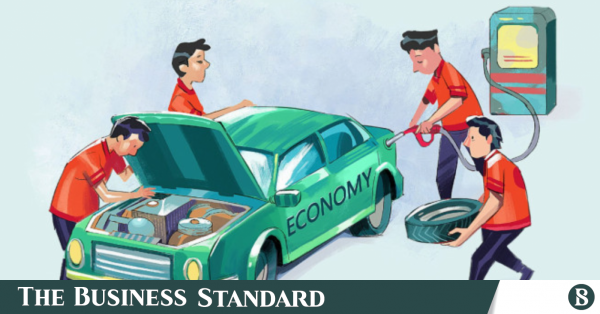
From banking to mega projects, political interests often outweigh economic logic in Bangladesh. Learning from East Asia, the nation must rebalance power to secure sustainable growth
Illustration: TBS
“>

Illustration: TBS
In the journey towards becoming a developed nation, one critical question continues to shape Bangladesh’s destiny: should politics dictate economic priorities, or should economic development guide political decisions?
The answer, though seemingly straightforward in theory, is far more complex in practice — particularly in a country where politics often overshadows policy, and short-term gains undermine long-term national interests.
A comparative analysis with developed countries — particularly those in East Asia and the West — reveals that sustained development rarely happens when politics holds primacy over economic planning. In those nations, political institutions generally serve the economy, ensuring policy continuity, institutional independence, and strategic investments in human capital and innovation.
Bangladesh: A politically driven economic landscape

Since its independence in 1971, Bangladesh has made remarkable progress. From a war-torn economy to over 6% average annual GDP growth for decades, and achieving lower-middle-income status — these are no small feats. Yet the country’s full potential remains hindered by the politicisation of economic policymaking.
Banking sector fragility: Chronic non-performing loans, often written off or left uncollected due to political connections, have eroded trust in the financial system. The central bank’s authority is frequently undermined.
Power sector politics: While electricity generation has expanded impressively, capacity payments to rental plants and over-reliance on quick fixes — driven by vested interests — have raised concerns about fiscal discipline and long-term sustainability.
Mega projects and patronage: Although the completion of the Padma Bridge is a national triumph, delays and inflated costs were influenced by political considerations as much as engineering challenges.
Public service delivery: Political patronage in local governance, civil service promotions, and project selection has reduced accountability and efficiency across sectors.
The developed world: Politics serving economic goals
In developed nations, economic priorities are embedded into the political agenda — not the other way around.
Germany’s social market economy model balances efficiency with social justice. Changes in political leadership do not cause abrupt reversals in economic policy. Japan’s Ministry of International Trade and Industry (MITI) in the post-war era aligned bureaucratic expertise with national development strategy, accelerating industrialisation.
Even in politically polarised countries like the United States, core institutions such as the central bank, judiciary, and market regulators maintain enough independence to shield economic policy from political upheaval.
Bangladesh’s economic model: Present vs recommended
Currently, Bangladesh follows a semi-capitalist, politically influenced mixed economy, where a few sectors — such as ready-made garments (RMG) and remittances — dominate GDP and foreign exchange earnings. The economy is heavily centralised, with limited diversification and weak institutional checks.
What’s missing? A long-term, non-partisan development model that survives election cycles and reflects national — not political — priorities.
Recommended model: Developmental state with inclusive growth
Drawing lessons from East Asian developmental states (e.g., South Korea, Vietnam) and blending them with modern inclusive growth principles, Bangladesh should aim for a model defined by:
Export diversification: Expand beyond RMG into agro-processing, pharmaceuticals, light engineering, and digital services.
Institutional reform: Strengthen the autonomy of Bangladesh Bank, the Anti-Corruption Commission, and other regulatory bodies. Depoliticise civil services and public procurement.
Human capital investment: Prioritise universal education and vocational training aligned with the Fourth Industrial Revolution.
SME and startup ecosystem: Create enabling conditions for small businesses and entrepreneurs through access to finance, digital platforms, and supportive policies.
Decentralised development: Empower local government institutions with budgetary control, decision-making authority, and accountability to drive grassroots growth.
Real-world inspiration: Vietnam and South Korea
Vietnam, despite its socialist roots, successfully transitioned to a market economy by decentralising decision-making, opening up to foreign direct investment, and investing heavily in technical education. Today, it competes globally in electronics, machinery, and agriculture.
South Korea, in the decades following the 1960s, embraced state-led capitalism. With a focused bureaucracy, national development plans, and strong export incentives, it transformed from a war-ravaged agrarian economy into a global innovation powerhouse.
Both nations ensured that politics did not derail economic strategy — rather, political will reinforced a coherent, long-term development agenda.
Why the shift is urgent
Bangladesh aspires to become a developed country by 2041. But the road ahead is narrow and fraught with risks. Climate vulnerability, global economic shocks, a growing youth population, and rising income inequality all demand a more professional, forward-looking approach to governance.
To meet these challenges, Bangladesh must move from political economy to economic politics — where governance, investment, and reform are driven not by electoral calculations but by evidence-based, inclusive, and visionary policy.
Time to rebalance
The path to sustainable development for Bangladesh lies in rebalancing the relationship between politics and economics. Politics must enable, not obstruct, national progress. Institutions must be empowered to uphold professionalism, transparency, and continuity. Economic decisions must be rooted in long-term planning rather than short-term partisanship.
Bangladesh has the talent, resilience, and demographic dividend to become a regional leader. But unlocking that potential requires a fundamental political consensus: that the economy — not politics — should lead the way.
Fazlur Rahman is a Financial Analyst.
Disclaimer: The views and opinions expressed in this article are those of the author and do not necessarily reflect the opinions and views of The Business Standard.