
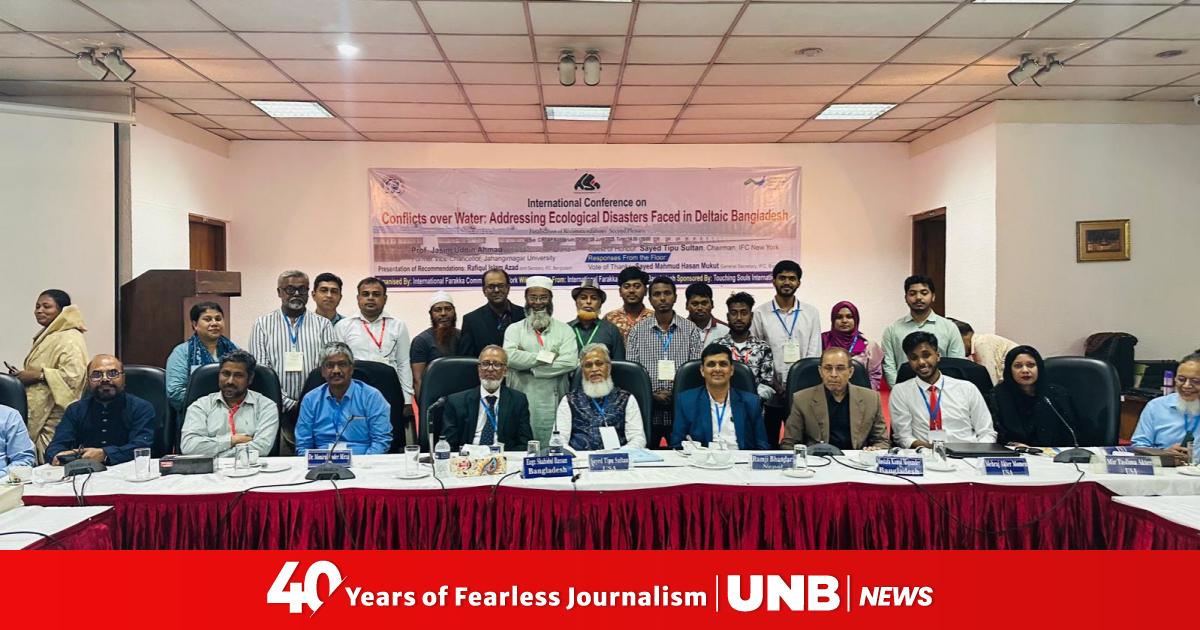
As upstream water diversion by India worsens ecological damage in Bangladesh, speakers at an international conference on Saturday urged the government to push for fair trans-boundary river management and assert its voice in regional and global forums.
The conference, held at the Cirdap auditorium under the title ‘Disputes over Water: Addressing Ecological Disasters Faced in Bangladesh’, brought together experts, activists and policymakers from Bangladesh, India, Nepal, Canada and the United States.
They stressed that ecological disasters caused by unilateral water diversions of the 54 common rivers flowing from India are wreaking havoc on Bangladesh’s environment, agriculture, fisheries, navigation, industry, forestry, wildlife and biodiversity, forcing millions to abandon their ancestral homes and livelihoods.
Dr Anisuzzaman Chowdhury, Special Assistant to the Ministry of Finance, attended the event as chief guest, while Sayed Tipu Sultan, Chairman of the International Farakka Committee (IFC), New York, presided over the inaugural session. Mostafa Kamal Majumder, President of IFC Bangladesh, moderated it.
Speakers pointed at the severe consequences of unsustainable upstream water control, including recurring floods in the Teesta, Meghna and Ganges basins, as well as dry season desertification in various regions.
One such disaster occurred in August last year, when sudden release of water from India’s Dombur reservoir in Tripura triggered unprecedented flooding in eastern Bangladesh without prior notice to lower riparian authorities.
In the last season, they mentioned, most rivers in Bangladesh face critical water shortages as dams and barrages built upstream divert water without consultation or coordination.
These actions violate both ecological balance and basic principles of international river-sharing law, they said.
Five research papers were presented at the conference by Dr Monirul Qader Mirza, trans-boundary water expert based in Canada; Ramji Bhandari of Jalsrot Vikas Sanstha, Nepal; Advocate Ebo Mili from Arunachal Pradesh, India (virtually); Prof Saiyadur Rahman of Cumilla University; and Dr Mohammad Imran Ansary and Mehraj Akter Momen from the USA.
WB approves $640mn to boost Bangladesh’s gas supply, air quality
Among other notable speakers were Prof Sirajul Islam of North South University, Siddiqur Rahman, General Secretary of Bangladesh Water Partnership (BWP), Nazmun Nahar, BWP Coordinator and Abdus Sattar Dulal from BPKS.
Engr Shahidul Hassan, former Chief Engineer of LGED and former BWP President, chaired the business session, while Prof Jasim Uddin Ahmad, former Vice-Chancellor of Jahangirnagar University and Chief Adviser of IFC Bangladesh, chaired the concluding session.
The conference concluded with a 10-point resolution, urging urgent reforms in regional water governance.
Their Key Demands:
Formation of a Regional River Commission led by Bangladesh and supervised by the United Nations, with participation from India, Nepal, Bhutan, and China, to ensure transparent and equitable river management.
A New Ganges Treaty with guaranteed water flow beyond the expiration of the current 1996 treaty in 2026, under international oversight.
Immediate halt to India’s unilateral inter-basin river-linking projects until the rights of downstream countries are secured.
Establishment of a joint river management framework with real-time water data sharing to prevent man-made disasters.
Inclusion of environmental flow guarantees in all trans-boundary river treaties to maintain ecological viability.
Implementation of water-holding infrastructure, such as the Ganges Barrage and Teesta River Management Project, along with systematic dredging to boost national water retention capacity.
Recognition of access to water as a human right, particularly for downstream communities.
Global advocacy to elevate the water-sharing crisis at the United Nations, COP summits, and other international climate forums as an issue of climate injustice.
Formation of a South Asian Water Forum to unite civil society and promote cross-border cooperation on river and water issues.
Protection of the Sundarbans through assured freshwater flows to preserve its ecosystem, alongside access to international climate resilience and Loss and Damage funds to help Bangladesh adapt to water-related challenges.
The speakers warned that political boundaries cannot divide natural rivers without causing irreversible ecological and humanitarian harm, and called for South Asian solidarity in managing shared resources.