
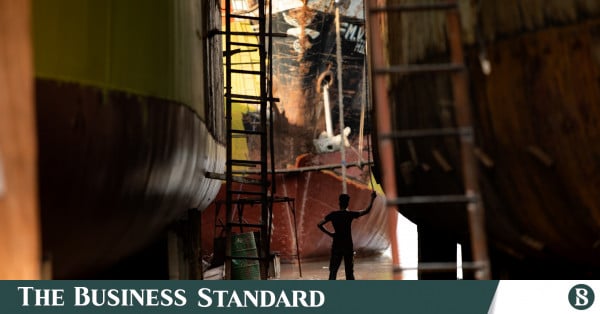
From the mighty vessels of the Pala Empire to modern shipyards along the Karnaphuli, Bangladesh’s shipbuilding story spans centuries. Today, that legacy could drive the nation’s next economic transformation
Shipbuilding in Bangladesh has a long history dating back thousands of years. Photo: TBS
“>

Shipbuilding in Bangladesh has a long history dating back thousands of years. Photo: TBS
The main driving force of Bangladesh’s economy is the readymade garments (RMG) industry. Nearly 80% of the country’s export earnings come from this sector, which employs millions of people.
However, with the rapid growth of automation, the demand for human labour in this industry may decline sharply in the near future. For a labour-dependent economy like Bangladesh, identifying alternative industries has become crucial. In this context, the shipbuilding industry could open a powerful new avenue of opportunity.
Shipbuilding in Bangladesh has a long history dating back thousands of years.
The massive Bengal sea-going ships of the Pala Empire (8th–12th centuries) were an important component of trade and cultural contact with Southeast Asia, China, and Sri Lanka. Chinese traveller I-Tsing and Arab traveller Ibn Battuta both noted the performance of Bengal’s ships and wrote highly of the shipbuilding in Chattogram. Bengali ships of that era were constructed from wood and rope, yet were strong enough to endure long ocean voyages.

During the Mughal era, Bengal’s naval technology and maritime trade remained robust. Many ships were built along the coasts of Chattogram and Sandwip for the Mughal navy. Later, under British colonial rule, Chattogram and Narayanganj became major centres for both naval weapon production and commercial shipbuilding.
The East India Company built ships in these regions for use across the Indian Ocean. Historical records even suggest that some of the ships used in the famous Battle of Trafalgar in 1805 were built in Bengal. Over time, a skilled network of craftsmen and shipbuilders developed along the coast — a legacy that endures to this day.
The shipbuilding industry of Bangladesh slowed down after independence. However, it made a historic breakthrough in 2008, when Ananda Shipyard constructed and exported the MV Stella Maris to Germany — the first Bangladeshi ocean-going ship exported to Europe.
Since then, over 40 vessels have been exported, including the MV Saronic Wave, MV Emsriver, MV Harmony, MV Cape Sable, MV Orca, MV Mashhour, and MV Al Faruq to destinations across Europe, the Middle East, Africa, and Asia. Western Marine Shipyard alone is expected to export eight new vessels by 2025.
Today, several major shipyards are operating in Bangladesh, including Western Marine Shipyard (Chattogram), Khulna Shipyard, Karnaphuli Ship Builders, Delta Shipyard, MV Dockyard, and Pragati Industries.
These facilities are capable of building cargo ships, tankers, tugboats, fishing vessels, and even naval patrol ships. Among them, Western Marine has already earned ISO certification for international-quality ship production.
The global shipbuilding industry is estimated to be worth around $400 billion. Small and medium-sized vessels are in particularly high demand, especially in developing and coastal nations.
Bangladesh enjoys a competitive advantage in this segment due to its low labour and production costs, and the availability of skilled craftsmen. As a result, a growing number of countries in Europe, the Middle East, and Africa have expressed interest in importing Bangladeshi-built ships.
Bangladeshi-made ships have already reached at least 14 countries, including Germany, Denmark, Norway, India, Kenya, the UAE, Saudi Arabia, Malaysia, and Pakistan. Some vessels are also being built for the Bangladesh Navy and Coast Guard.
Nevertheless, there are a number of challenges that must be addressed to maximise the potential of this sector.
First, it lacks sufficient qualified design and marine engineers, as well as innovative technology.
The shipbuilding industry is not only critical for exports but also for enhancing domestic transportation. As a riverine country, Bangladesh relies heavily on its waterways. Locally produced ferries, passenger ships and cargo vessels would save foreign currency and create employment opportunities.
Second, many shipyards still adhere to traditional methods and lack modern machinery or computer-based design systems.
Third, the sector must meet international standards for environmental and labour practices, as global buyers are increasingly prioritising products from environmentally sustainable and socially responsible companies.
To overcome these challenges, the government, private sector, and academic institutions must work together. If the government recognises shipbuilding as a “special economic sector” and provides tax incentives, soft loans, support for technology imports, and export subsidies, investment interest will rise.
At the same time, universities should introduce specialised training and research in marine engineering, ship design, and automation systems.
Several countries have already identified shipbuilding as a strategic industry and are developing it accordingly, including South Korea, China, and Japan. South Korea, currently the largest shipbuilder in the world, began making systematic investments in the 1970s and within a few decades overtook Japan and Europe. With proper planning, Bangladesh could follow a similar path.
The shipbuilding industry is not only critical for exports but also for enhancing domestic transportation. As a riverine country, Bangladesh relies heavily on its waterways. Locally produced ferries, passenger ships, and cargo vessels would save foreign currency and create employment opportunities.
Moreover, this sector can stimulate many related industries, such as steel, electronics, rubber, paint, safety equipment, and software. Studies show that building a medium-sized ship requires components and services from around 100 supporting sectors.
Some private shipyards in Bangladesh are already using modern dry docks, cargo loading systems, and GPS technology to construct ships that meet international standards. However, to strengthen its position in the global supply chain, Bangladesh must focus on greater participation in international expos, branding, and digital marketing.
For young entrepreneurs and engineers, startup incubators, venture funds, and business support centres could be established to promote innovation in shipbuilding. Additionally, introducing innovative financial instruments such as “shipping bonds” could attract investment from Bangladeshi expatriates.
Bangladesh must diversify its exports beyond garments to ensure a more resilient economy. The next great pillar could be shipbuilding. With the garment industry undergoing automation, it is high time to establish shipbuilding as another major national industry.
With a glorious past, strong present capabilities, and immense future potential, Bangladesh’s shipbuilding industry could become a promising export sector — and possibly the country’s second major economic pillar after the readymade garments industry.
Hasibul Islam Rafi is an International Consultant for UNDP Asia and the Pacific.
Disclaimer: The views and opinions expressed in this article are those of the author and do not necessarily reflect the opinions and views of The Business Standard.