


The floating agriculture practice in Bangladesh is one example of nature-based solutions (NsB). FILE PHOTO: REUTERS
“>
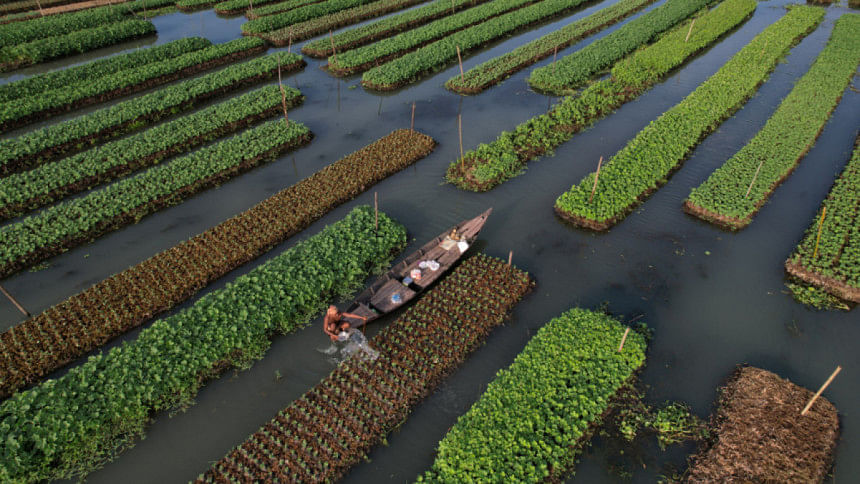
The floating agriculture practice in Bangladesh is one example of nature-based solutions (NsB). FILE PHOTO: REUTERS
The first comprehensive compilation of Bangladesh’s nature-based solutions (NbS) experiences is a review article published in the Frontiers in Environmental Science journal in 2021. Six researchers from the University of Oxford, Independent University, Bangladesh, University of Liberal Arts Bangladesh, and University of Quebec in Montreal showed significant benefits that many NbS can provide in numerous natural and modified ecosystems. This freely accessible article also highlights urban NbS as a part of the research implications and the way forward. In March 2025, the International Union for Conservation of Nature (IUCN), Bangladesh and the Global Center on Adaptation (GCA) published a compendium on urban NbS of Bangladesh. This book describes in detail 20 NbS from 12 districts. It, however, doesn’t refer to the first compilation of NbS for Bangladesh, although it is relevant. This shows that, despite being openly available, important latest scientific knowledge on Bangladesh’s NbS may not reach Bangladeshi experts working on NbS.
IUCN, the world’s largest and oldest environmental network, became a pioneer in 2020 by developing the Global Standard for NbS, which has eight criteria and 28 indicators to assess real NbS. The urban NbS compendium used the IUCN standard to conduct a “subjective assessment” of each Bangladeshi NbS against the eight criteria. By reviewing all 20 assessments, I found that 15 NbS scored one or less in at least one criterion. Since the compendium used its own “1 to 5 scale”, it means that these 15 NbS scored 20 percent or less. But, as per the original IUCN Global Standard, if it scores less than 25 percent in one criterion, it cannot be called an NbS. It means 15 of those that IUCN Bangladesh and the GCA described as NbS are not NbS. Moreover, how these subjective assessments were done and based on which data sources is also not mentioned. Thus, the remaining five also can’t be called NbS with confidence. Further, the compendium stated that the “biodiversity gains from these initiatives are not well documented,” and only indications of biodiversity improvement were there. But the biodiversity criterion, on average, scored quite high (3.65 out of 5) across all 20 NbS. This shows that in creating new NbS knowledge, even the knowledge-based reputed organisations, which are experts on the topic, can struggle.
 For all latest news, follow The Daily Star’s Google News channel.
 But creating knowledge means nothing unless it is used. That brings us to my second point. During 2014-2022, Bangladesh’s Local Government Engineering Department implemented the Coastal Towns Environmental Infrastructure Project in 11 coastal municipalities, with funding from the Asian Development Bank (ADB). But, when a follow-up phase was agreed on (Coastal Towns Climate Resilience Project, 2023-2029), the agencies adopted NbS to build resilience in 22 coastal municipalities. The British Foreign, Commonwealth & Development Office has been implementing a 120 million pound Bangladesh Climate and Environment Programme (BCEP, 2022-2030). Under this initiative, CARE is leading a large NGO consortium to implement the Nature-Based Adaptation towards Prosperous and Adept Lives and Livelihoods in Bangladesh (NABAPALLAB) project, where NbS is a key component. (Interestingly, the urban NbS compendium mentioned above was also supported by the BCEP). Recently, WaterAid organised a competition to design restoration projects to improve the dire condition of the Institute of Public Health (IPH) pond in Mohakhali, Dhaka. As a jury member, I was amazed to see the extent and depth of science-based creativity our young minds put into designing NbS projects for this urban pond. This commendable initiative was only possible when WaterAid and the Swedish government showed flexibility to adopt a biodiversity-focused approach. Further, the Bangladesh Red Crescent Society has recently launched a new project in collaboration with the British Red Cross. The Nature Pulse programme will implement NbS in ecosystem restoration, sustainable livelihoods, health, water, sanitation and hygiene, and disaster risk reduction. This is indeed encouraging that humanitarian agencies are fighting climate change and building community resilience by adopting NbS, which will, in turn, improve local biodiversity and ecosystem services.
My final point: how can these recent developments be scaled up through policy interventions? The answer is quite simple: we need to implement the 21 NbS-related actions Bangladesh’s National Adaptation Plan (NAP, 2023-2050) has already identified. This will need a total of Tk 51,500 crore over three decades, but it is only 2.6 percent of the total value of the NAP implementation. Bangladesh is already a step ahead in such fund allocation. In 2022, the government adopted “Guidelines for Green and Climate Resilience (GCR) in Public Investment Projects”, which strongly suggests incorporating NbS in the projects of agriculture, local government and rural development; environment, climate change and water resources; and housing and community amenity sectors. The government is currently updating the National Biodiversity Strategy and Action Plan, preparing the third edition of Nationally Determined Contributions (NDC), and, with ADB’s facilitation, at last activating the Bangladesh Climate and Development Platform’s (BCDP) four working groups. These policy interventions should contextualise, adopt, and operationalise the “IUCN Global Standard for NbS” for effective mainstreaming of NbS on a wider scale. To do that, the interim government should establish an NbS working group, so that the limitations the new urban NbS compendium shows are overcome.
Dr Haseeb Md Irfanullah is an independent environment and climate change consultant, and visiting research fellow at the University of Liberal Arts Bangladesh (ULAB). He can be reached at [email protected].
Views expressed in this article are the author’s own.
Follow The Daily Star Opinion on Facebook for the latest opinions, commentaries and analyses by experts and professionals. To contribute your article or letter to The Daily Star Opinion, see our guidelines for submission.