
Swedish International Development Cooperation Agency (Sida) expressed its desire to support Bangladesh to qualify for the European Union’s trade preferences
Dr Jakob Granit, Director-General of the Swedish International Development Cooperation Agency (Sida), during his visit to Bangladesh, mentioned this intention.
“Bangladesh is on a solid path of reform and development. We wish to build a broader partnership with Bangladesh going forward, including through trade. As it graduates from the group of least-developed countries, Sida may assist Bangladesh to qualify for the EU’s trade preferences as well as optimize synergies between the country’s exports of priority products and imports of green technologies,” said Dr Granit after meeting with Md. Shahriar Kader Siddiky, Secretary of the ERD.
Dr Granit expressed interest in investment areas and activities that increase climate resilience, create livelihoods and employment, support economic growth, mobilise capital, and strengthen the connections with the European and Swedish markets, said a spokesperson of the Swedish Embassy.
Dr Granit concluded his visit to Bangladesh on February Monday. He was accompanied by members of Sida senior management, as well as an official of the Swedish government.
The delegation also learned more about the initiative “Sustainable Fashion Platform by Sweden,” which is bringing together major Swedish brands like H&M, IKEA and Lindex, and other commercial and financial actors to promote fair business policies and practices and climate-smart, green technologies and solutions in the ready-made garment and textile industries.
During the visit that lasted from February 21-24, the delegation had constructive meetings with representatives of the Government of Bangladesh, including Chief Advisor Muhammad Yunus and Advisor Syeda Rizwana Hasan of the Ministry of Environment, Forest and Climate Change.
These meetings served as opportunities for the delegation to express continued support for the interim government’s reforms and on the Rohingya situation in the face of reduced overall humanitarian contributions.
The Director-General reiterated Sida’s continued support for critical development areas such as democracy, human rights, rule of law, gender equality, climate adaptation, environmental protection and management; health and SRHR, and inclusive economic development.
The Director-General and his delegation also had the opportunity to meet with civil society, youth, national and international development partners, private companies and many other stakeholders to get their views on the reform and other development priorities, and opportunities and challenges of the future in Bangladesh.
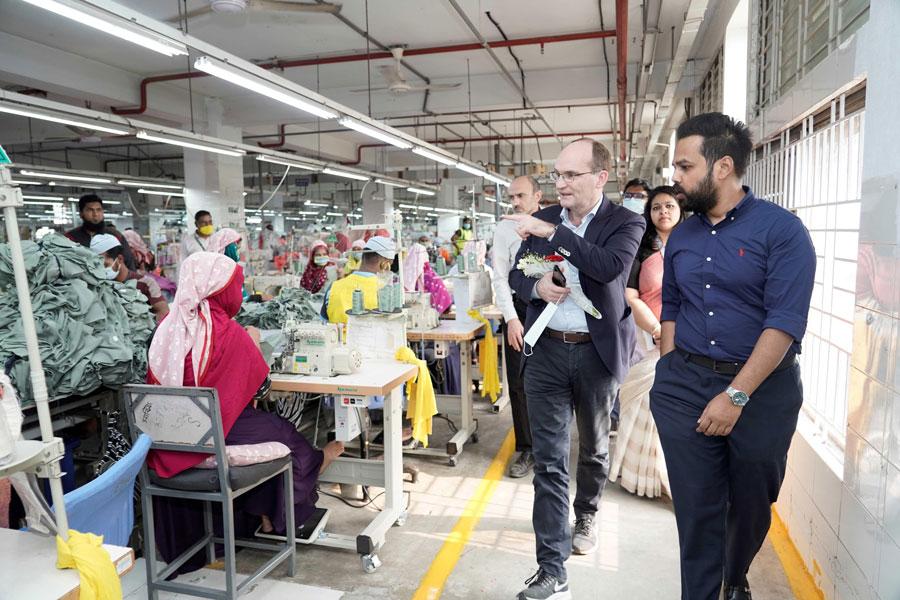
The delegation visited IRIS Fabrics Ltd, a factory partner to the Sweden-supported PROGRESS project, implemented by Swisscontact.
The RMG and textiles industry is the largest employer of women in the formal sector, which is why its sustainability and competitiveness are major concerns for Sweden.
In this regard, the PROGRESS project is helping RMG factories to reduce carbon emission, recycle wastewater, and provide green skills training for workers and comply with the standards for the Global Reporting Initiative (GRI).
In addition, the delegation met with counterparts from the European Delegation to Bangladesh, the Asian Development Bank and the External Relations Division (ERD) of the Ministry of Finance to discuss the economic outlook, trade and investment priorities, and the means to use public and development funds to mobilise resources, technology, and financing from the private sector.
The Director-General was the Chief Guest at the launch of the Initiative to Stimulate Private Investment for Resource Efficiency (InSPIRE) Project, the aim of which is to support a more sustainable, resilient and competitive RMG sector in Bangladesh. InSPIRE will incentivise RMG factories to adopt energy efficiency solutions through technical assistance, training, and grants.
“Sweden is a longstanding cooperation partner to Bangladesh since its independence. Ongoing global changes are worrying and have a big impact on overall development cooperation, including from Sweden. Building resilience is fundamental. We do this by strengthening climate adaptation—through knowledge, skills and strong infrastructure—and also by creating an enabling environment for SMEs and businesses, and through the sustainable use of resources like water, energy and land,” said Director-General Granit.
The delegation visited Gazipur to learn about efforts to improve water resources protection and management issues.
They visited Belai Beel, an environmentally critical area, where partner organisations like the Bangladesh Environmental Lawyers Association (BELA) are helping to strengthen the enforcement of environmental laws to protect wetlands from illegal encroachment.
In Bangla Bazar, the delegation was given an overview of a project on groundwater monitoring and management funded by Sweden, which is being implemented by UNICEF, Dhaka University, and counterparts for the Local Government Division.