
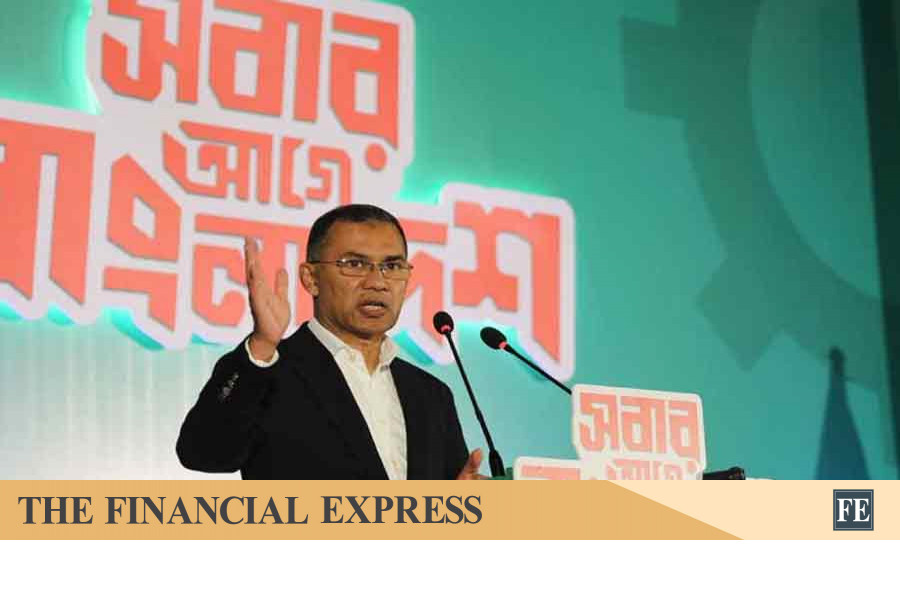
BNP Chairman Tarique Rahman has pledged to give the ‘utmost priority’ to curbing corruption and establishing the rule of law and accountability if his party wins the general election.
He warned that without taking stern measures in these three sectors, no national plans can be successfully implemented.
Tarique made this commitment on Friday during the unveiling of the BNP election manifesto, where he also defended his party’s record against graft allegations dating back to the 2001–2006 term.
The manifesto, built on the promise of creating a “humane, inclusive, and accountable state”, focuses on nine priority areas.
The party chief described the document not merely as a set of election pledges, but as a declaration of a “new social and state contract”.
In the “Governance” section under the chapter on state reforms, the BNP addressed the issue of Bangladesh repeatedly topping Transparency International’s corruption index during the previous BNP-Jamaat coalition government.
While the Jamaat-e-Islami has recently used that period to attack the BNP during the current campaign, Tarique blamed the preceding Awami League administration (1996–2001) for the “corruption champion” label.
In the manifesto, Tarique said the BNP took over a country already leading in corruption from the Awami League in October 2001 and immediately launched an all-out effort to control it.
To strictly manage graft, the Khaleda Zia government transformed the then “Anti-Corruption Bureau” into a fully independent “Anti-Corruption Commission”, free from government interference, he added.
He noted that due to multiple government steps, Bangladesh’s position on the corruption index began to improve from the very first year.
“As a result, the score in the TIB report rose from 0.4 in 2002 to 1.2. It reached 1.3 in 2003, 1.4 in 2004, 1.5 in 2005, and 2.0 in 2006. This means corruption was consistently declining in Bangladesh,” the manifesto reads.
The BNP chairman also claimed that the “unbridled corruption of the fallen fascist government” caused the score to drop again from 2013.
He promised that if the BNP is given the chance to run the state by the people’s mandate, fighting corruption and maintaining law and order will be the first priorities.
He vowed that the BNP would make no compromises on corruption, pledging to curb the graft that has spread like a “cancerous wound” through all levels of society by ensuring transparency, accountability, and legal and systemic reforms.
The party plans to reform the Anti-Corruption Commission and its laws, while noting that the interim government’s recent measures for the commission remain “insufficient”.
Concluding a speech lasting nearly two hours, Tarique returned to the themes of graft and governance.
He said if his party wins the election on the 12th and forms the government, their highest priority will be placed on three pillars: anti-corruption, the rule of law, and accountability.
The event began at 3:30pm at the ballroom of Pan Pacific Sonargaon Dhaka with a recitation from the Quran and the national anthem.
Presided over by Secretary General Mirza Fakhrul Islam Alamgir, the programme was conducted by Ruhul Kabir Rizvi, the member secretary of the central election steering committee.