
Groundwater is a precious resource worldwide, especially in communities where surface water is scarce or contaminated. Clay layers are widely thought to protect these valuable groundwater aquifers from above-ground pollutants and contaminants.
But new research recently published in Nature Communications has shown that in Bangladesh, clay layers that were thought to protect underlying aquifers from downward migration of naturally-occurring, high-arsenic water from shallow aquifers are actually making arsenic groundwater contamination worse.
“This study documents the long-term rise in arsenic concentrations in an aquifer lying below a clay layer,” said study co-author Peter Knappett, associate professor in the Department of Geology and Geophysics at Texas A&M University. “Above that clay layer is a shallow aquifer with high arsenic concentrations. This deeper of the two aquifers is a crucial source of safe drinking water for much of the rural population of Bangladesh.”
In explaining the rising arsenic concentrations, the research provides the most conclusive evidence to date that organic carbon from clay layers drives the release of arsenic from sediments in low-arsenic aquifers, Knappett said.
“This study adds to growing evidence that how much and where humans pump aquifers can influence the quality of the water that remains,” he said.
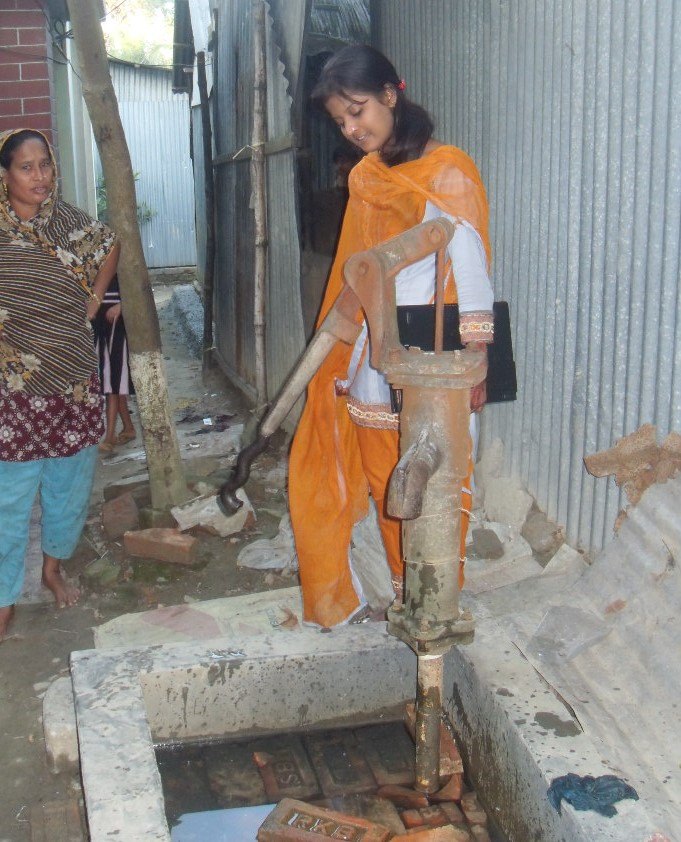
Villagers at a community well in Bangladesh.
Courtesy of Peter Knappett
Dangerous Wells
Well water contaminated by arsenic in Bangladesh is a widespread public health crisis. There, an estimated 39 million people drink water naturally contaminated by this deadly element, which can silently attack a person’s organs over years or decades, leading to cancers, cardiovascular disease, diabetes, developmental and cognitive problems in children and death. An estimated 43,000 people die annually from arsenic-related illness in Bangladesh.
To alleviate this problem, many communities in Bangladesh no longer rely on shallow wells and instead drill deeper, more expensive, private or community wells, which are thought to produce safer water. And typically, confining clay layers protect groundwater aquifers against downward intrusion of such contaminants, lowering the risk of dangerous exposure levels.
But at their research site near the village of Baylakandi, east of Bangladesh’s capital Dhaka, Knappett and this research team found concerning results. Their analysis showed that an aquifer’s proximity to a confining clay layer that expels organic carbon as an indirect response to groundwater pumping drove the rising arsenic concentrations in the previously safe aquifer.
The team used a number of methods to determine the processes driving the observed increasing arsenic concentrations over time.
“Dozens of monitoring wells were installed and equipped with pressure transducers to monitor hydraulic heads over several years,” Knappett said. “And sediments and pore-waters recovered from the drilling of these wells underwent extensive chemical measurements to determine the source of the organic carbon driving the release of arsenic underlying the clay layer.”
Households Depending On Depressurized, Contaminated Aquifers
For local households on the outskirts of Dhaka that have been privately re-installing wells to access relatively shallow aquifers beneath the impermeable clay layer, the team’s findings were especially worrisome, Knappett said.
Over-pumping to meet Dhaka’s municipal water needs has resulted in water levels under Dhaka itself being almost 300 feet below what they would naturally be — resulting in a “cone of depression” in the aquifer below the city and exacerbating communities’ water insecurity.
With groundwater pumping from sedimentary aquifers expected to continue throughout the world, he said, more attention should be paid to the potential contamination of groundwater with arsenic by compacting clay layers.
The lead author of the research is Ivan Mihajlov, Department of Earth and Environmental Sciences at Columbia University. Co-authors are M. Rajib H. Mozumder, Benjamin Bostick, Martin Stute, Brian Mailloux, Peter Schlosser and Alexander van Geen of the Lamont-Doherty Earth Observatory at Columbia University; Knappett of the Department of Geology and Geophysics at Texas A&M University; and Imtiaz Choudhury and Kazi Matin Ahmed of the Department of Geology at Dhaka University.
The research was funded by in-part by the National Institute of Environmental Health Sciences and the National Science Foundation.